
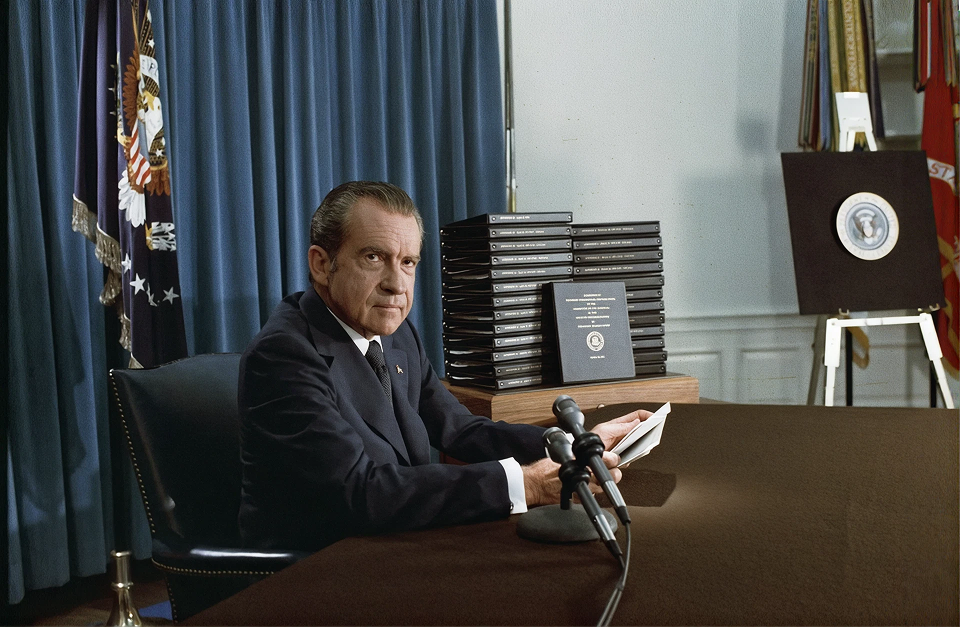
Richard Nixon’s Permanent Counter-Revolution

Do Nixon’s new disciples understand his true legacy?
Over fifty years after he resigned from office, President Richard Nixon is going viral. “Nixon-maxxing” (a verbal riff on the absurd, and mildly transhumanist, practice of “looks-maxxing”) has taken young conservatism by storm. In remarks delivered at the Nixon Presidential Library in June 2026, Vice President J.D. Vance observed that Nixon’s “historical legacy is enjoying a bit of a renaissance,” and quipped, “I’ve always liked Richard Nixon.”
This Nixon bull market did not emerge from nowhere. The Richard Nixon Foundation has creatively repackaged Nixon for the social media age, layering hip-hop music over archival footage of the 37th President to present him as a populist champion of traditional American values. Speaking with the Wall Street Journal, the popular X personality and podcaster “Comfortably Smug” describes this rebranded Nixon’s appeal to young conservatives as representing a “heterodox middle finger to the establishment.”
Conservative commentator Christopher Rufo likewise has remarked on the aesthetic appeal of Nixon to young conservatives, observing that the conservative right’s “rediscovery of Richard Nixon is not about particular policies—some good, some bad—but about the aesthetic, the attitude, and the narrative of the self-made man who won 49 states on behalf of the Silent Majority,” and, in Rufo’s telling, “was taken down in a Deep State coup.”
The Bulwark’s Michael Koncewicz has echoed this sentiment, writing that “Nixon’s edge, his embattled dyspepsia, his willingness to think in terms of enemies, and his hatred of elites make him the preferred model for a generation of Republicans who see themselves as eternal underdogs in an endless ideological fight.”
Nixon Agonistes
But the Nixon resurgence isn’t merely aesthetic. Its foundations, in part, lay in efforts by conservative activists and intellectuals to connect the current political moment to historical antecedents—and to build a response modeled on a heroic forerunner.
In 2023, Rufo released a 10-minute video titled “Nixon Forever,” in which he pits Nixon against the revolutionary Marxist spirit of 1968. Rufo contends that the radical ideological movements of 1968 have now been cashed out in present-day cultural and institutional capture by the Left. Nixon, he argues, can serve as our “guide” to launching a “counterrevolution” that will “break the loop of 1968.” He concludes by urging modern conservatives that if they “want to protect the American way of life,” they must, like Nixon, “be willing to lay siege to the institutions and reorient them according to their own values.”
This reassessment of Nixon’s legacy has been accompanied by a reexamination of Nixon’s political downfall. Part of the attraction, it turns out, stems from the belief that Nixon, much like President Trump, was a victim of lawfare waged by powerful, entrenched institutional interests. Drawing on troves of archival documents, Nathan Pinkoski has argued that “Nixon was removed from office not because he endangered the constitutional order, but because his bureaucratic and political enemies plotted successfully against him.” This alleged plotting, Pinkoski has argued, endears Nixon to “the younger American Right” because the institutions that contributed to Nixon’s demise “are the same ones that have become discredited during the last decade: military and intelligence agencies, the legal profession, and the legacy media.”
The Importance of Sound Anthropology
Like any hagiographical impulse, Nixon-maxxing risks overlooking Nixon’s many faults in favor of his virtues. Hagiography—hero worship—is itself fundamentally anti-conservative. Conservatism takes people as they are. Indeed, central to the conservative project is a proper understanding of human anthropology.
But this momentary Nixon mania also carries valuable lessons for conservatism, particularly in its current highly contested state. At his best, Nixon could articulate an elevated and unifying vision of American patriotism. Reflecting on the violent revolutionary spirit of 1968, Nixon pointed to what he termed the “peaceful” and “permanent” revolution flowing from the American Revolution of 1776. This framing of the American Revolution echoes that of the great Russell Kirk, who described it as a “preventive movement, intended to preserve an old constitutional structure.”
Historian and philosopher Os Guinness has described the modern American divide—the same one Nixon confronted over fifty years ago—as a contest between two rival heirs to the republican tradition of freedom: those who trace it to the American Revolution, and those who trace it to the French. At the heart of that split lie competing anthropologies: America’s revolution began with the Judeo-Christian view of fallen man made in God’s image; France’s began with man as pure potential, chained by nothing but his institutions. One locates man’s fundamental problem within him; the other locates it as something imposed on him from outside.
Those competing views of human nature played out in very practical ways. In France, the revolution sanctified liberty through suffocating rationalism, which rejected every aspect of the French cultural, religious, and political inheritance. Predictably, it ended poorly by endorsing government-sanctioned murder and tyranny. This excluded Christianity, which was attacked as the enemy of freedom. Indeed, the revolt against external constraints on human freedom imposed by religion was so wholesale that Notre Dame Cathedral was repurposed as the secular Temple of Reason. The hostility to religion was so comprehensive that only five years after the outbreak of the revolution, only 150 of France’s 40,000 parishes were openly celebrating Mass.
The American Revolution, in contrast, opened with a ringing endorsement of human equality and natural rights grounded in a created order and subject to a Creator. It concluded with a constitution anchored in a deep understanding of human frailty—an understanding redolent of the biblical account of the fall.
The Federalist Papers echo and reinforce this theme. In Federalist 15, Hamilton refuted the spirit of 1789, observing that government is necessary because “the passions of men will not conform to the dictates of reason and justice, without constraint.” Madison put the point even more memorably in Federalist 51: “If men were angels, no government would be necessary.”
Of course, the authors of the Federalist Papers also recognized that, as much as government constrains man, government itself must be constrained. Madison recognized, in Federalist 47, that the “accumulation of all powers, legislative, executive, and judiciary, in the same hands” is “the very definition of tyranny.” Thus, by its very design, the American Constitution, with its careful separation of powers, instantiates a Judeo-Christian understanding of anthropology.
A Return to the Counter-Revolution
Young conservatives are right to view Nixon as significant, but not necessarily for the same reasons they are plastering his image on t-shirts and hats. Nixon became president at a time when revolutionaries announced a plan to disrupt America’s experiment in freedom by capturing commanding-height institutions and turning them to their own purposes. Indeed, it was around 1968 when Rudi Dutschke, a disciple of Marcuse, called for a “long march through the institutions.” That revolutionary march, which is now far advanced as Rufo recognizes, idolizes human autonomy at the expense of transcendent truth, and can only end in tyranny, whether hard or soft.
The response to this revolution does not lie in further revolution. In the argument that young conservatives must “lay siege to the institutions and reorient them according to their own values,” one can hear echoes not of Madison and Hamilton, but of the young French revolutionaries eyeing the Bastille. Young conservatives should resist the call to model their response to the times purely on a pugilistic aesthetic.
Rather, the courageous and heroic path lies in Nixon’s call for a return to the “permanent” revolution of 1776, which was, in fact, a counter-revolution grounded on a clear biblical anthropology. Embracing that call to counter-revolution is not an abdication to a flaccid nostalgia for some hypothetical bygone political era. Rather, it demands embracing timeless principles enshrined in the Declaration and the Constitution, grounded in Christian anthropology, and applying those principles to the modern problems of 2026. Yet, too many on the new right—much like the emerging left—bypass the Declaration and the Constitution, with their emphasis on effective government by limited government, in favor of statist solutions aimed at achieving political dominance.
The defense of natural human rights within a framework of limited government, bounded by the rule of law, is the ongoing revolution because it runs counter to the received wisdom of tyrants throughout the ages. That defense stands the test of time because it is rooted in truths that transcend time. Those ideas motivated the signers of the Declaration to pledge their lives, fortunes, and sacred honor.
So, as you don your Nixon hat, instead of giving a “heterodox middle finger to the establishment,” let your message be: “long live the counter-revolution.”
Ryan Bangert serves as senior vice president for strategic initiatives and special counsel to the president at Alliance Defending Freedom.

Richard Nixon’s Permanent Counter-Revolution
Instead of giving a “heterodox middle finger to the establishment,” let your message be: “long live the counter-revolution.”


The Uses and Abuses of the Pardon Power
The recent flood of pardon controversies shows no signs of abating.
.jpeg)


Get the Civitas Outlook daily digest, plus new research and events.
Get the Civitas Outlook daily digest, plus new research and events.