.jpeg)
The Declaration Is a Metaphysical and Political Triumph

Bradley J. Birzer’s The Declaration of Independence: A Radical Experiment in Liberty weaves a compelling tapestry of contemporary voices from all sides of the American Revolution.
As we approach the 250th anniversary of the Declaration of Independence, educated Americans might logically conclude that there is little more to say about it. It has been analyzed, if not dissected, and its claims subjected to every criticism imaginable. Yet it is the nature of genuinely lasting great texts that we observe new things in them that fit our moment.
Bradley J. Birzer’s The Declaration of Independence: A Radical Experiment in Liberty contributes to the ongoing conversation about the Declaration by providing an excellent synthesis of varied strands of modern scholarship. However, it truly shines in the way it weaves a compelling tapestry of contemporary voices from all sides of the American Revolution. Birzer uses extensive primary source quotations to provide a wealth of evidence about the crisis and the ideas that shaped the Declaration. This makes it a fantastic resource for those who wish to explore how the Revolution unfolded.
To claim that the American Revolution began as a clash of ideas is not novel, but Birzer’s Declaration makes this claim in an unusually clear way; it helps readers understand that the issues the imperial crisis with Great Britain raised were not merely about the burdens of taxation or the colonies’ financial interests. “The Revolution was,” he argues, “first and foremost, a war of ideas even before it became a war of bullets.”
Birzer relates the period’s major issues leading up to the Revolution to the deeper traditions of political philosophy and religion that helped animate these events. Throughout, Birzer avoids the ever-fashionable academic tendency to collapse principles into their contexts or to attribute motives to them based on supposed interests. He instead insists that the Declaration stands or falls on its claims to tell the truth about who we are as a people.
As such, perhaps it is unsurprising that Birzer opens and closes the book with Calvin Coolidge, who viewed the Declaration as a lodestar for American political life at all times: “If all men are created equal, that is final. If they are endowed with inalienable rights, that is final. If governments derive their just powers from the consent of the governed, that is final. No advance, no progress can be made beyond these propositions.” He sets Coolidge and his own views against Woodrow Wilson, whose Darwinian views led him to conclude that fixed philosophical principles are impossible, and instead accept the idea that “a nation is a living thing and not a machine.” On this point, Birzer observes that to “interpret the Founding in such a fashion, though, is to dismiss the significance of the Founding and place history as an ever-moving target. It becomes malleable, subservient to the whims of the present.” The Founders articulated something more permanent and real: “what it proclaimed was timeless, a moment of eternal things entering our existence.”
The book proceeds in chronological order from before 1774, when the crisis grew more acute, through the two Continental Congresses, the debate over the Declaration itself, and finally to some considerations of how we might interpret the document’s sources and legacy. Throughout, Birzer attempts a balanced understanding of the Founding, and aims to understand the varied elements which “played off and inspired one another, forging a continuity in American history.”
Birzer emphasizes the shared intellectual resources the founding generation could deploy to the challenges they faced. Colonial leaders were educated in Greek and Latin, and in a range of classical texts that formed their imagination. The “Americans were generally very aware of the history of Greek and Roman colonization, and many of their own ideas on independence came from the actual history of the ancient world,” Birzer argues. More importantly, their education tended to connect “the classical tradition through the Christian tradition, Catholic and Protestant, to a mythologized view of the liberties and common law of the Anglo-Saxons.” This meant that classical republicanism, philosophical natural rights rhetoric, Christian natural law reasoning, and the practice of self-government in a common law system each offered different kinds of inspiration to different groups of the Founders. These sources fed into the Declaration and were at least a part of what kept the Americans fighting for eight long years.
Concretely, though, leaders in the colonies also held a well-developed belief in their own powers of self-government and, at the same time, disputed Parliament’s default assumptions about its sovereignty over the empire. Here it is worth remembering a 91-year-old Captain Levi Preston’s comment in 1843 to an inquiring intellectual that “what we meant in going for those Redcoats was this: we always had governed ourselves and we always meant to. They didn’t mean we should.” This was a powerful motive to oppose the British.
By the time of the Stamp Act in 1765, the men who would go on to sign the Declaration largely disbelieved that the mother country had any right to tax the colonies. John Adams viewed the Stamp Act as unconstitutional:
We have called this a burthensome tax, because the duties are so numerous and so high, and the embarrassments to business in this infant, sparsely-settled country so great, that it would be totally impossible for the people to subsist under it, if we had no controversy about the right and authority of imposing it…. We take it clearly, therefore, to be inconsistent with the spirit of the common law, and of the essential fundamental principles of the British constitution, that we should be subject to any tax imposed by the British Parliament.
Adams was one of the first to reject the idea of compromise, but many on both sides of the Atlantic, including Adam Smith and Edmund Burke, hoped for ongoing union around the idea of a “decentralized commonwealth,” a situation where “sovereignty competed with sovereignty, a world of imperium in imperio.” A significant minority in Parliament hoped for this as well, arguing that Britain should avoid taxing the Americans entirely. But this was not to be. After repealing the Stamp Act only a year later, they nonetheless passed the Declaratory Act, which asserted Parliament’s absolute right to make laws for the colonies.
Birzer nicely traces the history from this point through the Regulating Act and Tea Act in 1773, and the Intolerable Acts and Quebec Act in 1774, which galvanized many in the colonies around the idea of independence. Some of the work’s best sections show the complexity of colonial politics’ intellectual and practical issues, and here he selects several representative figures from different perspectives whose commentary on the Continental Congress helps us understand the moment.
American Loyalists thought the colonial reaction to the acts in 1774 ridiculous, and their pretension to legislative power was arrogant in the extreme. Samuel Seabury denied that the Continental Congress had the right to claim they represented anyone: “tell me, what right or power has any assembly on the continent to appoint delegates…. It has exercised a power which it never received from the people, but which it has usurped over them.” William Allen, another Loyalist pamphleteer, proposed that rather than allowing Britain’s power to suffer, “it is better that the supreme Authority be established; and that only can be completely done, but by a proper Annihilation of inadequate Charters now forfeited by a Spirit of Rebellion.” Across the Atlantic, Samuel Johnson insisted on a strong vision of British sovereignty over the colonies and argued that all “government is ultimately and essentially absolute,” and in “every empire all the subordinate communities are liable to taxation, because they all share the benefits of government, and, therefore, ought all to furnish their proportion of the expense.” Views such as these made compromise with the colonies impossible.
These authors, who prized colonial sovereignty, could not be more distant in their views from Edmund Burke, who opposed sterner policies against the colonies from the beginning. By the start of combat in 1775, “Burke thought of the conflict as a civil war with little hope for the restoration of a peaceful empire.” Birzer also notes a surprising detail about the Irishman’s protests: “Burke held feasts and parties when the king declared fast days to support the war in America, and he even briefly seceded from Parliament in protest,” even going so far as equating King George III with Satan. Burke wrote: “In this situation, Sir, shocking to say, we are called upon by another proclamation, to go to the altar of the Almighty, with war and vengeance in our hearts, instead of the peace of our blessed Saviour.” These arguments would fall upon deaf ears.
To his credit, Birzer presents a range of revolutionary American views, most prominently John Dickinson, Thomas Paine, Thomas Jefferson, Benjamin Rush, and John Adams. Dickinson remained unpersuaded that the colonies should take up arms in 1775 but nonetheless hoped to persuade the British people to step back from the abyss before they created a menace to their own liberties as well: “Soldiers who have sheathed their swords in the bowels of their American brethren, will not draw them with more reluctance against you.” For his part, Paine’s fiery rhetoric mostly united colonials and solidified resistance against the British, while his crude understanding of Christianity and the Hebrew Bible in particular triggered worries, as did the grandiosity of his ambitions. Paine asserted, “we have it in our power to begin the world over again.” That phrase suggests why he later fell so fully for the French Revolution’s promises. As independence began to grow as an ideal, Adams recognized that having argued from the beginning against British excesses, the colonies would need a positive vision of politics, one that recognized “there is no good government but what is Republican.”
Here, Birzer’s account of the Declaration’s substance is striking: “The rights discussed in the Declaration were not created by the Declaration, but affirmed by it. They already existed in the human person, granted by nature and God’s providence.” In one of the book’s most striking paragraphs, Birzer writes:
After giving a philosophy of history, the Declaration, in the second paragraph, begins with a metaphysical understanding of the human person and ends with a political philosophy…. It would not be an exaggeration, however, to say that what Christianity accomplished theologically, the Declaration accomplished—or would eventually accomplish—politically.
This “promissory note” vision of the Declaration, one reminiscent of both Abraham Lincoln and Martin Luther King, Jr., harmonizes with Coolidge’s notion that if the Declaration promises moral truths, those indeed are final. Birzer also does not neglect the extent to which the charges articulated in the Declaration remain firmly rooted in British history and constitutionalism.
The book’s patient and thorough reading of the Declaration’s text and context helps clear up a range of misconceptions and enriches the reader’s understanding. One example can be found in a brief discussion of Jefferson’s substitution of happiness, where John Locke had emphasized property:
Embracing happiness did not mean that the Founders rejected the right of property. Quite the opposite. They merely thought that pursuits of happiness covered it and transcended it. For the Founders, the right to property was an essential right, critical to any dignified humanity or human culture.
This is just one civics lesson that Americans today might benefit from reading and pondering.
At a few points in the text, Birzer describes the Continental Congress as an “extra-legal” assemblage, but I wonder if that grants too little to the idea that a regime that repeatedly acts in an unconstitutional manner by its own standards deserves no legal sanction, which was a point the revolutionaries themselves insisted upon with fervor. Birzer writes that “it must be noted, the Second Continental Congress was still extra-legal in 1775, but it was rapidly becoming legal as more and more Americans longed for independence.” Arguably, by the Battle of Lexington, the question of the colonials’ legality in exercising their right to assemble was unquestionable, but this is a minor quibble.
Birzer’s Declaration may be most valuable for its reminders that republican government demands particular virtues. The Founders, he reminds us, were keen readers of Cicero and the Roman Republic more generally, and aware of such a regime’s fragility. Summarizing Cicero, Birzer observes that when “the people enjoy true liberty, they often fail to identify its source, admiring its effects rather than its causes. In particular, they misunderstand the necessity of virtue to the health of the republic, misbelieving it to be the possession of the haughty and elite.” Adams took this point further still. In an April 1776 letter to Mercy Otis Warren, he wrote of the republic that “its Principles are as easily destroyed, as human Nature is corrupted. Such a Government is only to be supported by a pure Religion, or Austere Morals. Public Virtue cannot exist in a Nation without private, and public Virtue is the only Foundation of Republics.”
As the United States celebrates its 250th year, we might remember these calls to virtue and the role they played in the hearts of men who pledged their lives, fortunes, and sacred honor to the cause of liberty. If the Revolution itself is any guide, we will not find renewal of these powers in the government, but rather in ourselves.
Brian A. Smith is Senior Program Officer at Liberty Fund and a Contributing Editor at Law & Liberty.

The Declaration Is a Metaphysical and Political Triumph
It is the nature of genuinely lasting great texts that we observe new things in them that fit our moment.
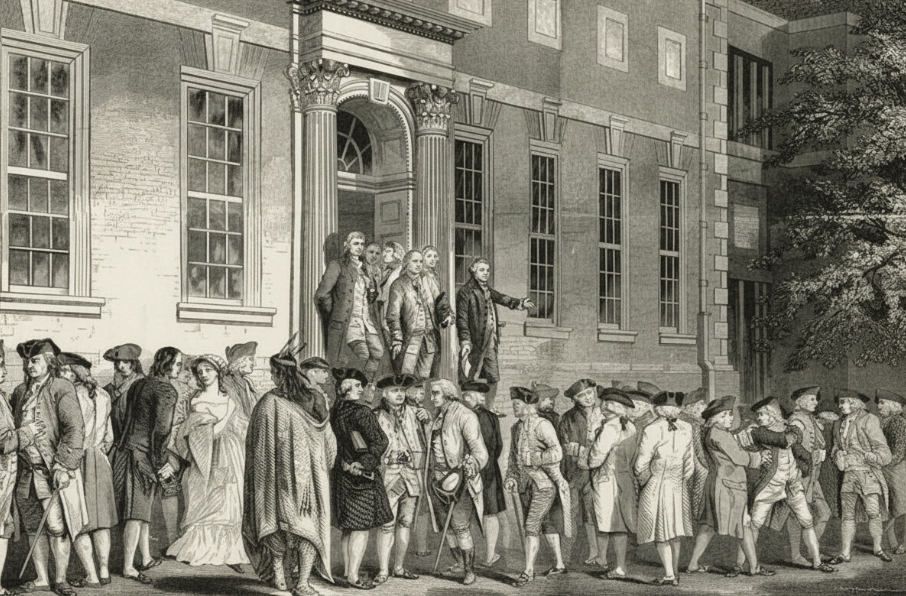
The Backstory of 1776
The Declaration of Independence was not written to attain liberty. It was written because the founders concluded that England was eroding the liberty they already had.
Gordon Wood's American Revolution
Widely acknowledged as the pre-eminent historian of the American Founding in our time, Wood was virtually without peer within academic American history today.





Get the Civitas Outlook daily digest, plus new research and events.
Get the Civitas Outlook daily digest, plus new research and events.