
.png)
The Constitution Gets in the Way

Americans need to recognize progressive Constitutional reform efforts as threats to the American system of balanced government.
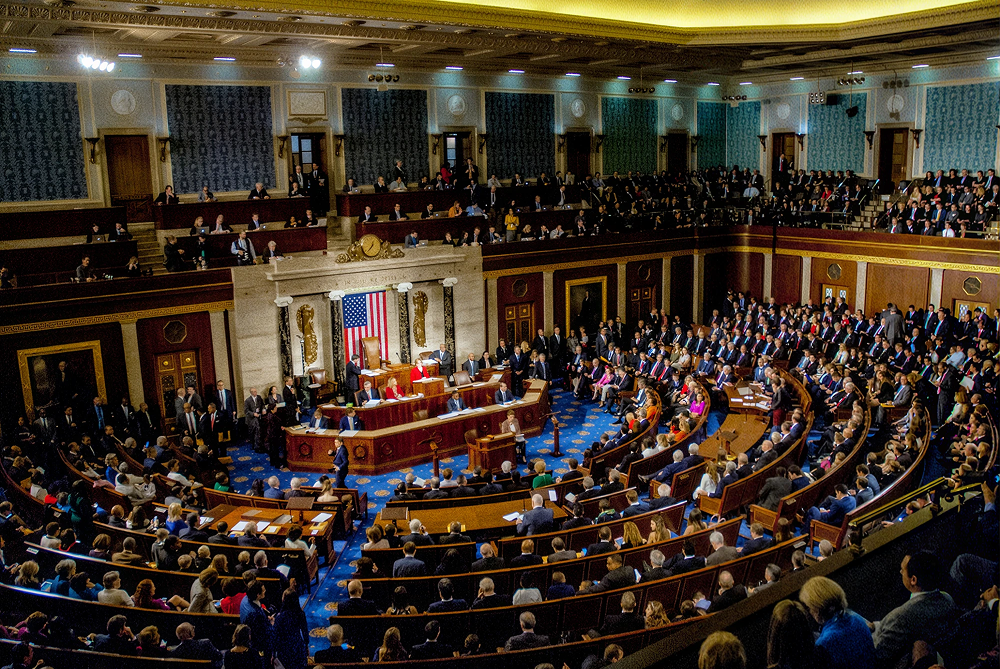
Proposals are circulating for significant changes to the Constitution’s structure. The Democratic Socialists of America, which recently won a string of successes in Democratic primaries for state and federal office, demand an end to the Senate, a President and Supreme Court chosen by Congress, and public control of major industries. Even many leading members of the mainstream Democratic Party promise to pack the Supreme Court, end the Electoral College, and expand the Senate by adding small entities, such as Puerto Rico and the District of Columbia.
The primary purpose of these reforms is to expand direct majority rule in the federal government and to reduce the role of the states. Socialists seek to remove these constitutional limits because they need an unlimited government to have their way. American federalism, with its division of power between a national government and fifty sovereign states, makes the central planning necessary to supplant capitalism difficult. The Constitution’s decentralization of power has not only promoted balanced government but also protected individual liberty from the disastrous schemes conjured by socialists.
The large governments needed to run socialism successfully have led to its many twentieth-century failures. As Friedrich Hayek famously argued in The Road to Serfdom (1944), government bureaucracies lacked the intelligence, computational power, or information needed to determine exactly how much to produce to satisfy a population’s desires. But that did not prevent nations from trying, from the tyrannical version of planning pursued by Russia and China to the mild version pursued by the United Kingdom, France, and Italy after World War II.
The socialist experiment, as Niall Ferguson observes, did not produce utopia but instead “generally delivered hell on earth.” He estimates that communism cost the lives of between 85 and 100 million in the twentieth century alone. The central economic planning of communist regimes produced agricultural and industrial disaster. Their rigid, ossified economies imposed perverse incentives that destroyed the economies of China, Russia, and Eastern Europe. Socialism today need not run hand in hand with brutal dictatorships, as the Scandinavian nations show (though several Scandinavian nations, such as Sweden, in recent decades have moved away from the socialist model). But the prevalence of authoritarian governments among the large socialist nations reflected the extremes of state power upon which socialism depends.
While the Old World struggled through two world wars, a Great Depression, and socialist disasters, the United States stood apart. Admittedly, the federal government greatly expanded its size and reach during the New Deal of the 1930s and the Great Society of the late 1960s. The United States, however, never had a competitive socialist party (Eugene Debs set the high watermark with 6 percent of the vote for president in 1912) or widespread nationalization of industry. The size of the federal government in the number of employees or as a percentage of the economy still pales in comparison to that of European governments. The United States still enjoys a significant decentralization among federal, state, and local governments, with strong institutions of private civil society (such as schools, churches, charities, and civic groups) further curbing public power.
The failure of socialism in America has sparked a long scholarly debate over “Why Is There No Socialism in the United States?” as German sociologist Werner Sombart asked as early as 1906. Marx and Engels expected communist revolutions to break out in the advanced West, not in the backward nations of Imperial Russia and Qing China. Great concentrations of capital and declining wages for a vast working proletariat, spurred by industrialization, should have sparked class revolution. But these conditions, which at times prevailed in the United States during the late 19th and early 20th Century, did not provide as fertile ground for socialism in America as they did in Europe.
Explanations for American exceptionalism have often turned sociological. Alexis de Tocqueville suggested that the United States would not fall prey to the same political upheavals as Europe because America did not suffer from the feudalism, aristocracy, and oppressive state of the Old World. Louis Hartz argued that Americans have an individualistic society and culture, rooted in the Lockean origins of the Founding, that resists centralized state power. As Seymour Martin Lipset summarized the scholarship in 2000, America’s very diversity makes the class solidarity required for socialism impossible. Americans identify less by economic class than by ethnic, cultural, geographic, religious, and social differences. Americans were “born conservatives” who enjoyed economic prosperity and social mobility in a land without an aristocratic, centralized state.
But these explanations must also include a unique element of the American experiment, its constitutional structure. The Constitution originally established a radically decentralized system of government. Dividing power between a single federal government and fifty states makes it difficult to achieve the unified economic planning required by socialism. The states are not just convenient administrative subdivisions for Washington, D.C. Instead, they retain significant aspects of sovereignty in both their operations and their regulatory reach. They provide a forum for political opposition to the centralization of public power. The separation of powers at the national level encourages the President, Congress, and the Judiciary to challenge each other’s claims of power. As James Madison wrote in Federalist 51, “In the compound republic of America, the power surrendered by the people, is first divided between two distinct and separate departments,” here the federal and state governments,
“and then the portion allotted to each, subdivided among distinct and separate departments,” in other words, the legislative, executive, and judicial branches. “Hence a double security arises to the rights of the people. The different governments will controul each other; at the same time that each will be controuled by itself.”
Progressive proposals to dilute or eliminate the Senate, bypass the Electoral College, and subject the Supreme Court to political control share the goal of defeating these checks on national power. They seek to concentrate government authority in a single national legislature. These checks temper excess enthusiasms and passions within democracy. In doing so, they allow reason to emerge and slow the adoption of utopian schemes. This has saved the United States from the tragic mistakes wrought by socialism and communism. Our Founders wisely established a risk-averse political system that sought to contain the passions of democratic rule with structures designed to encourage the rule of reason. Americans should not welcome these proposals as needed reforms to the Constitution, but instead recognize them as threats to the American system of balanced government.
John Yoo is a senior research fellow at the Civitas Institute, and a distinguished visiting professor at the School of Civic Leadership at the University of Texas at Austin.

.png)


.jpg)
.png)


Get the Civitas Outlook daily digest, plus new research and events.
Get the Civitas Outlook daily digest, plus new research and events.