Three Generations of Living Constitutionalists Is Enough
We would do well to heed Justice Thomas’s call to rededicate ourselves to the permanent principles of the Declaration as a country and as individuals.
Justice Thomas’s “Remarks on the 250th Anniversary of the Declaration of Independence” can be understood as a tribute to what Russell Kirk called (in a different context) “the permanent things”—the permanent, unwavering virtues of individual liberty and the virtues of character and courage that uphold it. Holding the right intellectual principles without the courage to defend them results in a pragmatic surrender to passing trends; courage without the right principles to animate it produces recklessness and nihilism.
No living American, and I’d wager only a few historic Americans, could have delivered the remarks Justice Thomas delivered at the University of Texas. He exemplifies that rare combination of intellect and brilliance we all aspire to. But above all, the man radiates a fundamental sense of decency, humility, and respect for the dignity of every human being—he lives the virtues of which he speaks.
In the modern world, dedication to the permanent virtue of courage—the idea that there are things worth dying for (faith, family, country, friendship)—is not so much mocked, dismissed, or ignored as treated with ironic amusement as an archaic quirk, like wearing spats or carrying a flip phone. “Efficiency” and maximizing the amount one can pack into every day are the objectives (which somehow are also compatible with wasting hours with mindless phone scrolling—a habit to which I’m guessing Justice Thomas does not succumb).
Likewise, the Declaration’s statement of the “permanent things” in the realm of ideas is often dismissed as a quaint anachronism—that individuals are endowed by God with unalienable rights to life, liberty, and the pursuit of happiness, and that the purpose of government is to preserve those rights. While it has become common in elite circles to vilify the Constitution as entrenching slavery, sexism, and economic inequality, the Declaration is frequently ignored or simply treated as a series of abstractions to be filled in with whatever definitions of “life, liberty, and the pursuit of happiness” suit the moment.
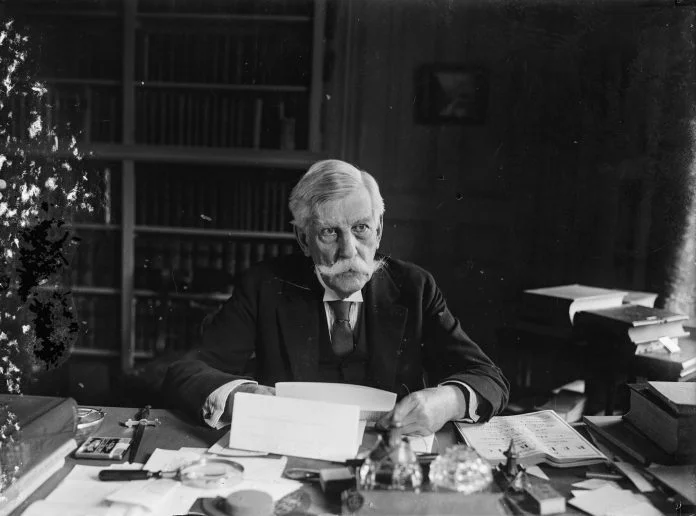
Justice Thomas rightly points to the Progressive Era as the turning point. After all, as Lincoln explained, the Civil War was fought over the principles of the Declaration—that all men are created equal and that the purpose of government is to preserve the individual liberty of all. Yet even though those principles won the literal battles, in the decades that followed, they lost the intellectual war of ideas among American elites. As Justice Thomas notes, it is precisely in the era following the Civil War that the nation saw the rise of progressivism and the scientific management of society. Perhaps it is therefore not surprising that Oliver Wendell Holmes, Jr., became the intellectual leader of Progressivism in the law. Holmes volunteered for the 20th Massachusetts Volunteer Infantry (known as the “Harvard Regiment”) as an ardent abolitionist, was wounded three times during the Civil War, and emerged from the experience as a nihilist, skeptical of “causes” and abstract principles (having seen mass deaths fighting over contrary absolutes), and convinced that the motivating force on the world is power and struggle, not divine providence or inherent natural rights.
As Justice Thomas observes, Holmesian judicial progressivism reached its full fruition in the notorious case of Buck v. Bell (1927) in which the Supreme Court upheld by an 8-1 vote Virginia’s state law that mandated forced sterilization of individuals assessed as “feeble minded” by a vote. Holmes’s eugenic justification of the constitutionality of Virginia’s law is worth quoting in full:
“We have seen more than once that the public welfare may call upon the best citizens for their lives. It would be strange if it could not call upon those who already sap the strength of the State for these lesser sacrifices, often not felt to be such by those concerned, in order to prevent our being swamped with incompetence. It is better for all the world if, instead of waiting to execute degenerate offspring for crime or to let them starve for their imbecility, society can prevent those who are manifestly unfit from continuing their kind. The principle that sustains compulsory vaccination is broad enough to cover cutting the Fallopian tubes. Jacobson v. Massachusetts, 197 U. S. 11. Three generations of imbeciles are enough.”
But Progressives of the era did not just support the eugenic policies of Buck or the constitutionally-protected racial discrimination of Plessy v. Ferguson (1896). It had similar views of women’s rights. Consider the case of Muller v. Oregon (1908), which upheld an Oregon law that limited the maximum work hours of adult women, but not men. The Court held that the principles of liberty of contract endorsed by Lochner v. New York (1905) did not apply to women and thus the law was an appropriate exercise of the state’s police power. As the Court explained, the principle of Lochner did not apply to women’s labor because it “assumes that the difference between the sexes does not justify a different rule respecting a restriction of the hours of labor.”
The Court relied on the “opinions” of experts as reflected in “over ninety reports of committees, bureaus of statistics, commissioners of hygiene, inspectors of factories, both in this country and in Europe to the effect that long hours of labor are dangerous for women.” Moreover, the Court noted that it was entitled to take “judicial cognizance” of the “widespread and long-continued belief” that “women’s physical structure, and the functions she performs in consequence thereof, justify special legislation restricting or qualifying the conditions under which she should be permitted to toil.” The Court’s rationale elaborated on why these features of women justified restricting women’s rights to work, encapsulating the logic of the Progressive Era to which Justice Thomas refers.
American Indians also felt the boot of Progressivism’s scientific societal planning. In United States v. Sandoval (1913), the Supreme Court declared them incapable of self-governance and relegated them to wards of the state, characterizing them as “essentially a simple, uninformed, and inferior people” who “adher[ed] to primitive modes of life, largely influenced by superstition and fetichism, and chiefly governed according to the crude customs inherited from their ancestors.”
Needless to say, it is not difficult to draw a through-line between these Progressive Era cases that celebrated scientific expertise and social utility to the Supreme Court’s New Deal decision in Korematsu v. United States (1944), in which the Supreme Court upheld the mass detention of Japanese-Americans by deferring to the expert judgment of military leaders that a blanket discriminatory suspension of individual rights was appropriate during the War.
As all of these cases show, Buck and Plessy were not anomalous decisions of Progressive jurisprudence. Rather, they are workaday examples of the struggle between the timeless principle of the Declaration that liberty and dignity are inherent in the individual, regardless of race, sex, or mental capability, and the Progressive belief that individual liberty must be subordinated to scientific planning or the “vigor of the race.”
I wasn’t around to serve in the trenches of World War I—thank goodness—but I am a voracious reader of the “Lost Generation” of writers who rejected faith in the traditional virtues of character just as Woodrow Wilson rejected faith in the traditional principles of America. But even in the wake of the pointless struggle of World War I came Calvin Coolidge’s response, invoking the principles of the Declaration: “that it is final. No advance, no progress can be made beyond those principles.” On this, the 250th Anniversary of the Declaration, we would do well to heed Justice Thomas’s call to rededicate ourselves to the permanent principles of the Declaration as a country and as individuals.
Todd Zywicki is George Mason University Foundation Professor of Law, Antonin Scalia Law School.
Symposium on Associate Justice Clarence Thomas’s Remarks on the Declaration of Independence
.webp)
Reclaiming Our American Inheritance
Thomas’s message is the same insight Abraham Lincoln invoked against Chief Justice Taney’s sophistry in the Dred Scott decision.

Three Generations of Living Constitutionalists Is Enough
Justice Thomas radiates a fundamental sense of decency, humility, and respect for the dignity of every human being—he lives the virtues of which he speaks.

.webp)
The Declaration’s Truths Heal a Multitude of Errors
Attacks on the Declaration from both the left and the right deny the universal character of its self-evident truths and their foundation in natural law.

.jpg)
.jpeg)


Get the Civitas Outlook daily digest, plus new research and events.
Get the Civitas Outlook daily digest, plus new research and events.