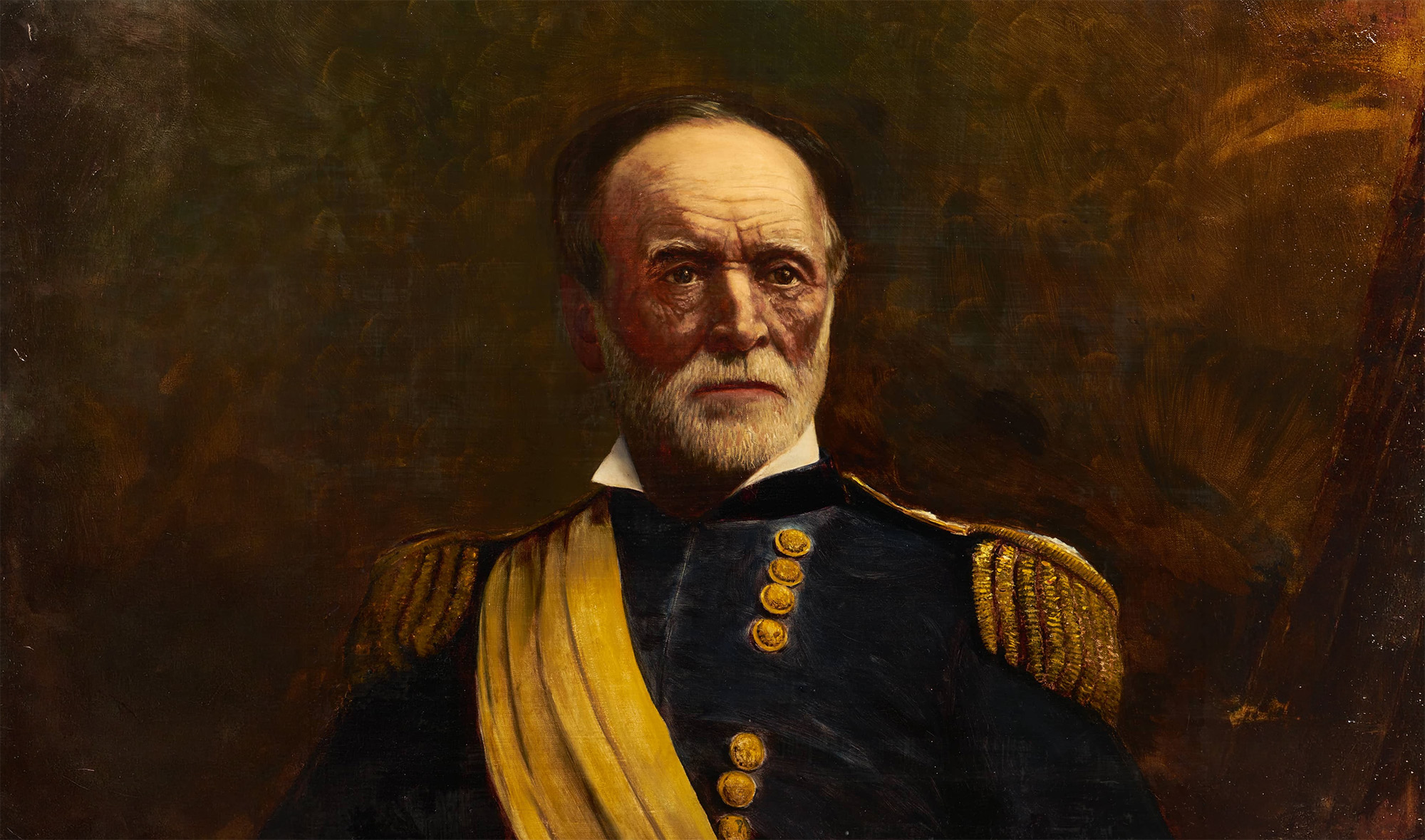
America’s Clausewitz: William Tecumseh Sherman’s Meditations on the Nature of War

Sherman argued that the only real issue was whether U.S. leadership would force southern submission by means of war.
In August 1863, Major General Henry Wager Halleck, Commanding General of the U.S. Army, wrote to William Tecumseh Sherman, then commanding the Fifteenth Army Corps, seeking Sherman’s views on military policy during the War of the Rebellion. Recent U.S. Army and Navy successes at Vicksburg had cleaved the Confederacy in two, prompting a reassessment in the War Department and at the highest level of American leadership on how to exploit the initiative gained. Halleck indicated he might share Sherman’s views with President Abraham Lincoln.
Though hardly a complete theory, Sherman’s response is a thoughtful and overlooked reflection that establishes him as a leading nineteenth-century interpreter of the political purposes and violent means of war. It illustrates his instinctive grasp of the nature of war: violence, or “cruelty,” as Sherman reflected with immortal poignancy, that cannot be refined. Named in part for the Shawnee warrior chief whose armed resistance contested Federal authority and power, William Tecumseh Sherman would help bring about the submission of rebellious insurrectionists. But Sherman was also America’s foremost, if unwitting, interpreter of the Prussian military theorist Carl von Clausewitz, who characterized war as a violent clash of wills, an outpouring of enmity and hatred, moderated by policy, dictated by chance, marked by uncertainty, and enflamed by popular passions.
Writing in his monarchical and autocratic context, the Prussian soldier-theorist cast a darker view for political liberals in Europe who believed enlightenment and sentimentalism might transform armed conflict into benign, non-violent processes of exchange, thereby absolving subjects of their responsibility to defend the state with lethal force. War, Clausewitz insisted, was “such a dangerous business that the mistakes which come from kindness are the very worst.” Throughout his storied army career, Sherman embodied this principle directly and understood Clausewitz’s ideas without having read Vom Kriege, published in 1832.
Although the criminal conduct of southern partisans against U.S. forces had momentarily incensed his rage, Sherman’s response to Halleck illustrates how he understood the political purposes of war and its tendencies toward violent extremes, a phenomenon noted by Clausewitz in On War. Sherman argued that the only real issue was whether U.S. leadership would force southern submission by means of war. Numerical superiority, he insisted, did not necessarily translate to military overmatch. Sherman articulated that the war could only be decided by force and consolidation: U.S. armies had to “penetrate into the innermost recesses” of the South before the nation had “the natural right to demand their submission.” He continued:
I would banish all minor questions, assert the broad doctrine that as a nation the United States has the right, and also the physical power, to penetrate to every part of our national domain, and that we will do it – that we will do it in our own time and in our own way; that it makes no difference whether it be one year, or two, or ten, or twenty; that we will remove and destroy every obstacle, if need be, take every life, every acre of land, every particle of property, everything that to us seems proper; that we will not cease till the end is attained ...
In his missive, Sherman also advocated for unconditional surrender of southern insurrectionists, arguing that hard and overwhelming military power, not accommodation, would compel southerners to accept Federal sovereignty. “Obedience to law,” Sherman wrote, “[was] the lesson that this war, under Providence, would teach the free and enlightened American citizen.”
Memoirs Revisited
This missive, and a considerable segment of Sherman’s official writing, appeared with the publication of his memoirs in 1875. The two-volume Memoirs of General W. T. Sherman sold thousands of copies and introduced significant segments of the war record to the public eye, pre-dating by five years the War Department’s official compilation. Sherman’s work anticipated later memoirs written by General of the Armies Ulysses S. Grant and General Philip H. Sheridan, who, together with their reminiscences, formed the triumvirate of U.S. great captains in the war. A revised, second edition of Sherman’s text appeared in 1886, which corrected previous errors and contained maps of his campaigns. Through his influential memoirs, Sherman shaped the official memory of the war, framed initial perceptions of its key figures, and contributed much to the maturation of professional American military thought.
Last autumn, with almost no fanfare, a new edition, edited by John F. Marszalek, Louie P. Gallo, and David S. Nolen, was published by the Belknap Press of Harvard University Press. (Marszalek, Gallo, and Nolen completed The Personal Memoirs of Ulysses S. Grant: The Complete Annotated Edition for Belknap Press in 2017.) Taking the second edition as its base text, this new volume is the first to feature systematic annotations throughout. The introductory essay is sufficient, if understated. Discerning students of war, hoping for a more definitive assessment of Sherman’s contributions to the development and evolution of American warfare, may be underwhelmed. All told, this iteration marks the first significant update to Sherman’s work since Charles Royster’s 1990 Library of America edition.
Less renowned for its literary merits and narrower in scope and sweep than Grant’s text, Sherman’s work nevertheless remains the most probing and technical military assessment of the U.S. Army’s triumph in the war. Students of American military history will turn naturally to his chapters on Shiloh, Vicksburg, the Meridian Campaign, Atlanta, the Savannah Campaign, and the Carolinas. But Chapter 25, “Conclusion – Military Lessons of the War,” deserves special attention: Sherman intended it as a primer for the education of future army officers. He wrote it after extensive travels to Eurasia and Africa, where he visited battlefields, toured fortifications, and met with leading European military figures, including Helmuth von Moltke, the architect of Prussian and Prusso-German military successes against Denmark, Austria, and France.
A sense of exceptionalism understandably animates Sherman’s reflections about the conduct of American armies. He concluded that campaigning, the arrangement of battles in time and space with careful strategic purpose, had developed along different geographic and military lines in America than in Europe. The War of the Rebellion harnessed the industrial and managerial powers of American society in historically distinctive ways. Fidelity to the Union, the destruction of racial slavery, and conscription compelled loyal northern citizens into armies by the tens of thousands. And then there were the physical demands of waging war on the North American continent: a vast landmass, full of difficult terrain, cut through with wide, swift rivers, and in many instances, without good roads, but over which Americans learned to march large formations, artillery, and wagon trains, and to move combat power by rail and boat. Indeed, the military geography of the American Civil War was a theme that sharpened the strategic thought of Sherman and his U.S. Army protégés into the twentieth century.
The American Civil War ended in the spring of 1865 with the surrender of the South’s last armies. U.S. military policy, the popular passions of loyal northern citizens, and the enmity of armed strife had climaxed in the campaigns of Sherman and Grant, sapping southerners of the will to endure in forlorn insurrection. Significantly, despite its great costs, the war never approximated the totality Sherman counseled or prophesied. U.S. armies did not press as hard as Sherman had recommended to Halleck in 1863; they respected the personal safety of noncombatants; and they did not target, indiscriminately, private property. Clausewitz’s notion of “absolute war,” translated and interpreted (somewhat erroneously) in the wake of nuclear weapons development, and in the Cold War context, as “total war,” was not realized.
Even so, the exaggerated severity of destruction wrought by Sherman’s army group on its campaign through Georgia long proved an obsession of historians. In a manner similar to historical interpretations of U.S. Grant that emerged from the miasma of Lost Cause narratives, which fixated on the Commanding General’s alleged alcoholism and ignored his military brilliance, historians have selectively scrutinized Sherman’s use of violence against the southern interior and neglected the military principles that guided and defined his campaign.
In his memoirs, Sherman regarded “the March to the Sea” not as a campaign of terror or devastation, but “as a means to an end … not as an essential act of war.” It was, he wrote, a “shift of base … the transfer of a strong army … from the interior to a point on the sea-coast, from which it could achieve other important results.” The campaign deprived the enemy of interior railroad communications, bisected the eastern Confederacy on a line that ran, generally, from the foothills of the Appalachian Mountains in Tennessee to the Atlantic coast (cutting off Confederate forces in Virginia and the Carolinas from Florida-sourced beef), allowed for the provisioning of his formations by sea, and positioned the Army of the West to assist U.S. armies in Virginia in the destruction of Confederate forces there, whether by a sea-borne movement, or by still another vigorous overland movement (Sherman opted for a march through the Carolinas, where his men reserved their hardest, heaviest hands of war for Columbia, the political seat of South Carolina’s rebellion). From these movements, instructors and students at the School of Application for Infantry and Cavalry (which Sherman established in 1881, and in time became the Army School of the Line, and later, the Command and General Staff College) at Fort Leavenworth, Kansas, perceived important lessons in force protection, logistics, military geography, mission command, and strategy.
For how they communicate the ageless nature of war, and for their historical and literary merits, Sherman’s memoirs are as important now as when they first came to print. Sherman understood the Geist – or spirit – of war did not change substantially from age to age, or across oceans. “Every modern war,” Sherman told a graduating class at the Michigan Military Academy in 1879, “gives birth to a new series of military works … but the standard principles which underlie the sciences of war change as little as the principles of law, medicine, mechanics, or architecture.” Modern wars, he continued, are “generally only the application of old principles to a new state of facts.” Human nature, he reminded his listeners, was the same yesterday, today, and tomorrow: “wars have been, are now, and ever will be as long as man is man.”
While it preserves the essence of Sherman’s great intellect, this latest edition is not without deficiencies. In a significant departure from the second edition, this annotated volume contains none of the maps Sherman considered “the best maps which I believe have ever been prepared,” and which he deliberately included with the revised, 1886 text. The editors explain in a footnote that the excluded maps “are not clear and are thus not helpful to the reader.” This is only partially true, and unfortunate. Marszalek and his team have made Sherman’s text more accessible with helpful annotations, but they have denied students of war access to maps, the careful interpretation of which was a salient feature of Sherman’s ability as an army group commander.
An appreciation for maps is essential to understanding Sherman’s genius. When Lieutenant General Grant in spring 1864 sent Sherman guidance for the coming campaign, he included a special map of the southern and southeastern United States with his own annotations and markings, depicting his strategic design, to accompany his written intent. Sherman’s response was emphatic and unambiguous: “that map, to me, contains more information and ideas than a volume of printed matter,” and “from that map,” Sherman continued, “I see all.” Like the others, this map does not appear in Marszalek’s edition, but should be included in any future text, along with Sherman’s originals.
Concluding lines of the memoirs capture the paradox of Sherman as cosmopolitan soldier-scholar and dyed-in-the-wool republican. They also reveal his liberal learning and literary bent. “In looking back upon the past,” he wrote, with a sense of the dramatic and in the cadence of a penitential rite, “I can only say, with millions of others, that I have left done many things I should not have done, and left undone still more which ought to have been done … but on the whole am content …” Invoking William Shakespeare, whose works he admired, Sherman claimed “the privilege to ring down the curtain.” Military professionals and students of war the world over, confronting once again the uniquely violent and human phenomenon of war, can be thankful he did.
Mitchell G. Klingenberg, Ph.D., is an associate professor of military history at the US Army Command and General Staff College at Fort Leavenworth, Kansas. The ideas presented in this essay are his and are not official views held by the Command and General Staff School, the US Army, or the Department of War.

Properly Honoring Slavery’s End
Designating Juneteenth as the federal holiday for emancipation is not only politically motivated but is historically imprecise.
America’s Clausewitz: William Tecumseh Sherman’s Meditations on the Nature of War
Sherman was America’s foremost, if unwitting, interpreter of the Prussian military theorist Carl von Clausewitz.

The Hart Conservatives
Whether he would have preferred it at his death or not, much of the media, institutional, and executive-centered conservative movement of today bears Jeffrey Hart's imprint.
“Democratic” Socialism Is Undemocratic
By promoting class hatred, suppressing private initiative, and seeking enhanced control of our lives, today’s democratic socialists undermine patriotism and individual initiative—two qualities that have long distinguished the United States from other major nations.


Get the Civitas Outlook daily digest, plus new research and events.
Get the Civitas Outlook daily digest, plus new research and events.