
“Democratic” Socialism Is Undemocratic

Today's "democratic socialists" do not at all deserve to be called democrats.
Socialism is on the rise in America. Alongside longtime socialist Senator Bernie Sanders, the House of Representatives now features four professing socialists who, like Sanders, caucus with the Democratic Party. They endeavor constantly, as he does, to push the party farther Left. At the state and local levels, some 250 socialists currently hold public office. According to a report in the Washington Examiner, membership in the Democratic Socialists of America surged from 6,200 in 2015 to 95,000 in 2021, fueled by the leadership of Sanders and Rep. Alexandria Ocasio-Cortez (best known today as AOC). Further, A 2025 Cato/YouGov poll finds that sixty-two percent of Americans under 30 view socialism favorably,
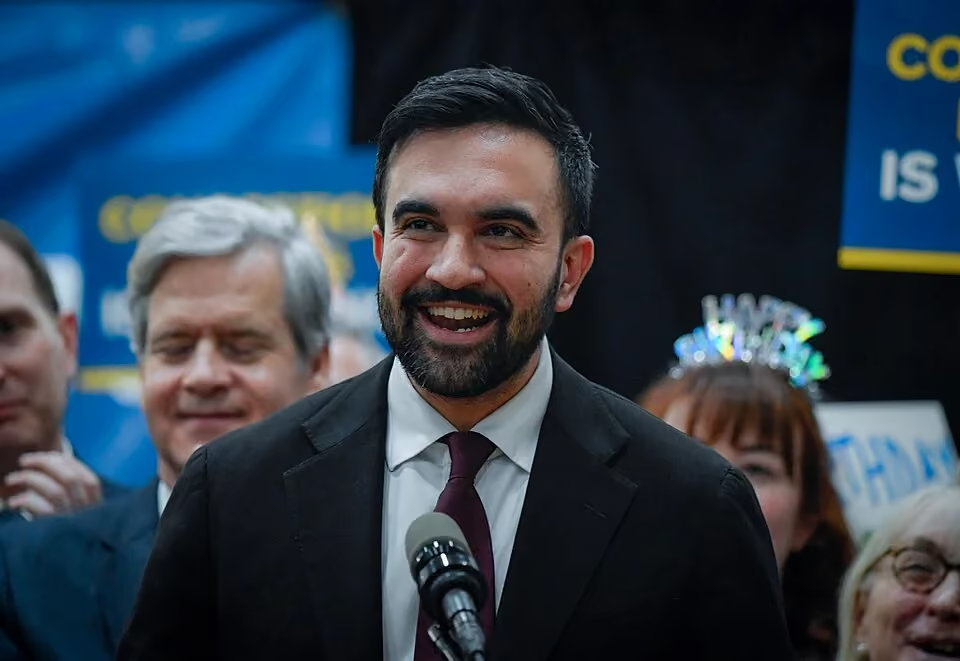
Amid this development, Americans would gain much if more understood just what socialism is, and how far it is even compatible with what we think of as “democracy.” Unfortunately, even conservatively inclined media such as the New York Post are failing in this task, simply by routinely referring to America’s currently most prominent expounder of socialist policies and attitudes, newly elected New York City mayor Zohran Mamdani, as a “democratic socialist.” The assignment of that label raises more questions than it answers.
At the time of the American Founding, many of the country’s leaders looked with disfavor on the term “democracy,” because they took it in the literal sense, derived from the Greek demokratia, to mean simply, “rule by the many.” In all historic cases, that meant unmitigated rule by the poor. Understood this way, democracy, even in its most celebrated phase in classical Greece, had proved inherently unstable; it was characterized by the oppression of the rich minority by the poor majority (led by demagogues). Democracies would quickly give way to oligarchic revolts that often ushered in the rule of a tyrant or despot.
The authors of our Declaration of Independence and Constitution, however, were not anti-democratic in the sense of wishing for rule by a rich elite over a (supposedly) ignorant multitude. The Declaration, after all, speaks of government’s purpose as securing the equal and inalienable rights of all human beings (not just a favored few), and holds that just governments derive their powers from the consent of the governed. Echoing that latter thought, James Madison, in Federalist no. 39, in upholding the Constitution’s “strictly republican” character, emphasizes that “no other form would be reconcilable with the genius” of the American people, with “the fundamental principles of the Revolution; or with that honorable determination, which animates every votary of freedom, to rest all our political experiments on the capacity of mankind for self-government…”. Farsighted statesmen, however, like John Adams and the delegates to the Constitutional Convention, echoing writers such as Aristotle, Polybius, and Montesquieu, perceived the need for popular or republican government to be embodied in a set of institutions designed to ensure stability and equal regard for the rights of all individuals, whatever their economic, religious, geographic, or ethnic background. For the Founders, this entailed devices such as representation, federalism, separation of powers, a bicameral Federal legislature, an independent judiciary, and a chief executive with sufficient powers and a long enough term of office to defend the nation against domestic uprisings and foreign threats.
At the time of the Founding, however, not all Americans were prepared to accept such a form of government. This included not only the Anti-Federalists, who opposed the Constitution’s ratification because they feared it created too strong a central government, but also mobs and popular uprisings, both during and after the Revolution, who threatened the preservation of due process of law. But over time, the vast majority of Americans (leaving aside the class of “aristocratic” Southern slaveowners) became sufficiently enamored of the form of government under which they lived to bestow on it—now in an entirely favorable sense—the label “democracy.” When today’s self-described American socialists call themselves “democratic” ones, as opposed, presumably, to the violent, tyrannical, and unaccountable rulers of Communist or self-described socialist nations like the Soviet Union, North Korea, and China, they are purportedly adopting that usage.
But how far apart are the democratic socialists’ policies from the undemocratic ones they claim to be against? A look at the public statements and policies Mayor Mamdani issued during his first months in office compels us to raise this question. First, he has openly professed his “hatred” of the rich. That is a species of class antagonism characteristic of the turbulent ancient republics, but not of the core American political tradition. He has proposed levying higher taxes on the city’s rich residents, who already pay a substantial percentage of its revenues, provide employment to many, and support the city through major philanthropic donations. He is seemingly oblivious to the likelihood that he will kill the geese that lay the golden eggs by encouraging them to move to less hostile states.
Among his more specific spending policies, aside from proposing free bus service to all residents (a service that will, of course, require raising taxes, especially on the better-off), Mamdani has announced a plan to create five city-owned grocery stores, ostensibly in nonexistent “food deserts.” Since these stores will pay no taxes, will be built at city expense, and will have no need to turn a profit, they will naturally tend to drive existing private markets out of business. The first such city-owned grocery is to be built at a cost of $30 million. Not only do informed observers say that a store of its size shouldn’t cost over $10 million to build, but it will also be constructed on a site previously approved by the City’s Economic Development Corporation for a $25 million redevelopment project, bringing the total cost to an astounding $55 million. Yet does anyone, recalling the long food lines in the Soviet Union, or noting the near-starvation under North Korea’s communists, think that publicly managed food stores are more efficient than private ones?
But the most outrageous of Mamdani’s “reform” proposals so far is his just-announced plan to have the City seize ownership of all apartment buildings it deems to be neglected, to be auctioned off to private bidders, among which “community land trusts, nonprofits, or even the tenants themselves” will be given priority. This labeling of some residential buildings as insufficiently maintained is nonsensical, considering that Mamdani, like his recent predecessors, has enforced rent-control regulations that prevent owners from earning enough to cover the cost of repairs—even when tenancy changes—along with a modest profit. Mamdani’s policy, as one of the few Republican members of New York’s City Council has pointed out, will provide inspectors with the incentive to find as many violations as possible to maximize the city’s confiscation of residential property.
Of course, public housing projects, a highlight of Lyndon Johnson’s “Great Society,” have proved to be a disaster; many of them, in cities like Chicago and St. Louis, have been torn down. But the long-term aim of Mamdani’s housing policy, like the public groceries and free transportation and universal free pre-K childcare, is in all cases to enhance government’s control over our lives. In all these and other respects, Mamdani has lived up to the promise he gave in his inaugural address: to “replace the frigidity of rugged individualism with the warmth of collectivism.” Karl Marx couldn’t have said it better. In the words of Cea Weaver, the newly appointed director of the Mayor’s Office to Protect Tenants, “Property is theft.”
In order to boost support for his policies, Mamdani has also borrowed a technique characteristic of Communist regimes: hiring forty employees (at a cost of nearly $5.2 million), with twenty-six more scheduled by 2027, for his “Office of Mass Engagement,” whose mission is to canvass voters to show up at public hearings on issues such as the mayor’s rent freeze, to tilt them in the mayor’s favor. No “engagers” will be assigned to Staten Island, the only one of the city’s five boroughs that leans Republican. While Thomas Jefferson, as Secretary of State, did subsidize Philip Freneau’s National Gazette to promote his own partisan program, nothing like Mamdani’s large-scale system of taxpayer-funded, political propagandizing is known to have existed in the U.S. Instead of enhancing the government’s accountability to the electorate, its aim is essentially the opposite.
We must then ask how far socialistic policies like Mamdani’s deserve the sobriquet of “democratic.” Surely, the rights to earn a living from investing in a grocery store, renting housing at competitive prices, or even growing rich through entrepreneurship and investment are among the fundamental liberties that distinguish a free society from an unfree one. History, of which today’s under-30s have learned far too little, demonstrates that societies that secure these rights provide prosperity for the multitude to a degree unrivaled by alternatives.
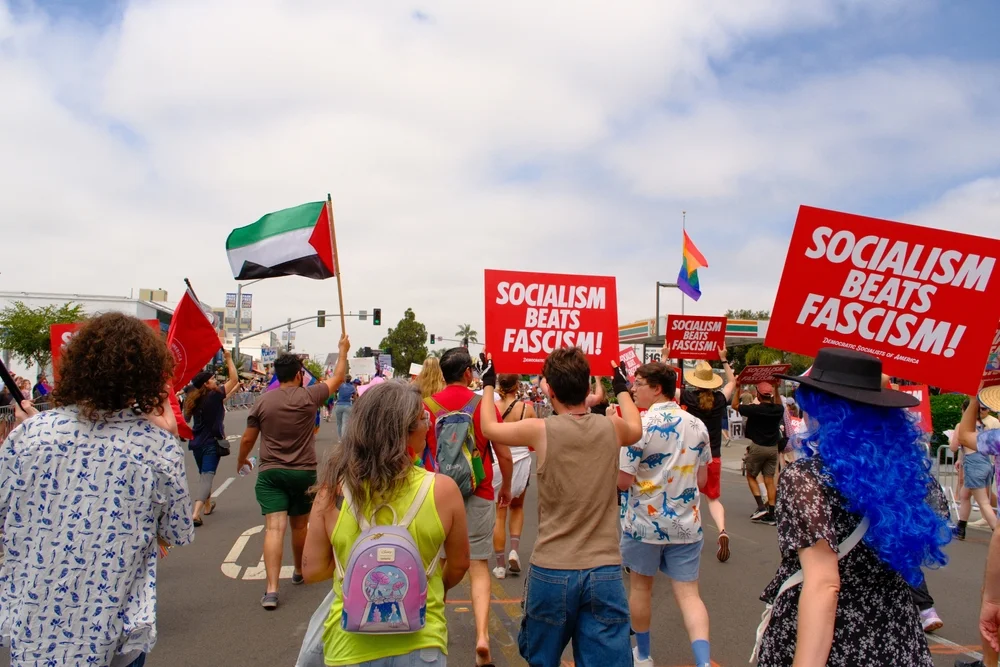
A word must be added in conclusion about the foreign policies that America’s socialists, exemplified by Mamdani, espouse. Six years ago, I first heard of the slogan “From the River to the Sea—Palestine Will All Be Free,” publicly chanted at an annual conference of the Democratic Socialists of America. The slogan means that the territory from the Jordan River to the Mediterranean should be free of Jews. America’s Socialist spokesmen, whether (nominally) Jewish like Sanders, or Muslim, or atheists, have proved themselves consistently hostile to the survival of Israel as a Jewish state. During his mayoral campaign, Mamdani declined to criticize the slogan “Globalize the Intifada,” which means spreading the practice of using terror against Jews throughout the world. He added only “That’s not language that I use.”
Aside from reflecting traditional anti-Semitism, a disease to which the U.S. has proved less susceptible, at least until now, than any other nation, contemporary socialists’ hostility to the Jewish state may reflect the fact that Israel is a nation that has combined a high degree of patriotic self-sacrifice with a remarkable degree of individual initiative. It is a nation that “made the desert bloom” and earned the title of “Start-Up Nation.”
Patriotism and individual initiative are two qualities that have long distinguished the United States from other major nations. Today’s socialists, by promoting class hatred, suppressing private initiative, and seeking enhanced control of our lives, would undermine those qualities. In the sense that America has long been an exemplar of democracy, that is, constitutional, representative government that aims to protect the rights of all individuals while enabling them to promote commercial prosperity that benefits the entire people, they do not at all deserve to be called democrats.
David Lewis Schaefer is Professor Emeritus of Political Science at The College of the Holy Cross.

.jpg)
Christian Zionists Aren't for Turning
Christian Zionists strong support for Israel and goodwill toward American Jews place them in the Republican majority.

Exodus and America
The American project can only long thrive if the American people are committed to preserving republican government.

Fentanyl’s Deadly Successor Emerges
Start by admitting both that there is a growing Novel Psychoactive Substances (NPS) problem and that responsibility for its harms lies not only with nations like China and Mexico, but also with our own drug users and society.


Get the Civitas Outlook daily digest, plus new research and events.
Get the Civitas Outlook daily digest, plus new research and events.