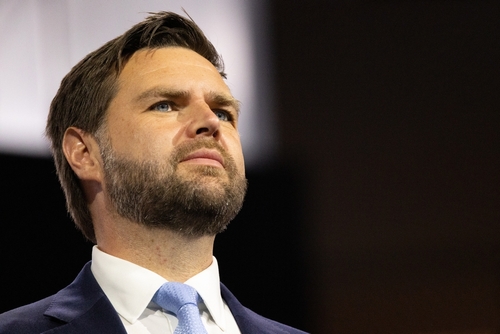
The Communions of JD Vance

Vance’s book is compelling when he is talking about his spiritual journey and his lovely family. It’s worse when he talks about politics. And it’s downright painful when he talks about economics.
Many people are talking about Vice President J.D. Vance’s new book Communion: Finding My Way Back to Faith. I am not a big Vance fan; I felt the need to give it a fair reading, even though his politics and style are not typically to my liking. There is some truth to the whole “derangement syndrome” thing in politics. He is the vice president of the United States and a man who converted to Roman Catholicism, and in this book and on many other public occasions, openly expresses his faith. Plus, I wouldn’t want anyone to think I am jealous that Vance is around the same age as me and has already written two autobiographies.
At one point in the book, Vance says he tried to publish an earlier version a few years ago. I wonder if that explains why the first 180 pages or so are much better than the rest. His account of his conversion and the little spiritual insights he had along the way struck me as sincere and, at times, thought-provoking. Vance is a good writer. We knew that. He leveraged his first book to gain a Senate seat and the vice presidency.
So, we shouldn’t be surprised that this book has its moments. He has some observations about what matters in life and the futility of mindless ambition, which he struggled with as a student at Yale Law. I am not entirely convinced that the man who began his campaign for president one day after he was elected vice president has overcome his own ambition, but nobody ever accused Vance of being self-aware. But back to the book itself, much of it represents insight and moral growth on Vance’s part. Some of the texts he cites along the way, from C.S. Lewis and G.K. Chesterton, spoke to me on my own journey.
The sincerity and credibility of his account also cast doubt on the theory that Vance merely feigns his public beliefs, as if he’s secretly a Mitt Romney Republican or even an Obama Democrat who says what he needs to say to attain power. We have no reason to doubt that his conversion is sincere. We also have little reason to suppose that his reactionary and conspiratorial political beliefs are not sincere. Susie Wiles even confirmed that, calling him a conspiracy theorist. We should also not be surprised that his political thought is a little radical when he has formed close friendships with people like Peter Thiel, Steve Bannon, Tucker Carlson, and the Catholic postliberal posse of Patrick Deneen, Chad Pecknold, Rod Dreher, etc. It is doubtful that half these people help him politically at all. At this point, they are, if anything, a hindrance.
What I see in Vance is, instead, what I see as a real risk for many new converts; I even experienced some of it when I reverted in my early 20s. After finding mainstream beliefs wanting, a new convert might indulge in esoteric ideas found among contrarians and conspiracy theorists. Many of us have chatted with a friend from church who claims that Putin is a good leader who has been smeared by the liberal media. These are nice people, but I wouldn’t want any of them to be elected president.
Vance celebrates in the book the US defeating the fascists in World War II, thus distancing himself somewhat from Tucker Carlson, who has promoted a guy who considers Winston Churchill the bad guy in that war. Vance also shares Charlie Kirk’s concern that many young people are letting their disagreements with Israel lead them to antisemitism. That’s a relief. Vance’s bigger issues in that area are his “no enemies to my right” attitude and his naivete about antisemitism, accepting the excuse of some antisemites, namely, that they don’t hate Jews. But most antisemitism doesn’t manifest as hatred of Jews but as intense suspicion and a propensity to scapegoat Jews, either by means of exaggeration or conspiracy theory.
Returning to the book, the far more problematic parts come when Vance is talking about politics. The frustrating thing about Vance’s public persona is that he talks aggressively in debates and interviews and sounds confident, but when he speaks about something one knows about, one recognizes that Vance does not know all that much. He so confidently rejects mainstream foreign policy experts in his chapter on his experience in Munich and rejects economists in his chapter on “The Dismal Science,” without anything that would approach a persuasive argument to either crowd. It’s either pure sophistry, hoping his reader does not know better, or a prototypical case of the Dunning-Kruger effect, where those who know little are nonetheless most confident in their false belief.
Particularly frustrating is the contrast between his handling of immigration from a Catholic perspective and his treatment of economic matters. Within the Catholic Church, there is ample room for disagreement among faithful Catholics over the application of moral principles in social matters. Good Catholics disagree all the time about matters of just war, capital punishment, and what constitutes prudent incrementalism in life issues. This will always be the case because the kind of judgments one makes in that sphere so often rely on factual (often disputed) knowledge, specialized expertise (e.g., political philosophy, economics, geopolitical strategy), or simply the political prudence formed from experience in politics. Vance understands this with immigration, recognizing that there are many complexities to consider for any statesman seeking to serve the common good of his or her community—I will ignore here how he argues as though the administration’s critics on immigration policy must all support open borders.
But when Vance turns to his understanding of economics, he is just a faithful Catholic, and the free-market-supporting Catholics are apparently not, as if economic policy didn’t feature similar complexity. His inability to show grace or just a bit of decency to his opponents is especially evident when he calls the position of former Cato Institute scholar Vanessa Brown Calder about paid family leave “psychopathic.” If you read her argument, though, whether you agree with it or not, there is no reason to consider it evil or bad faith. She is saying that paid family leave will lead employers, on the margin, to favor males for employment and advancement, taking opportunities away from women. She suggests other policies that would give women more options. It is clearly a technical disagreement about the effects of a policy.
Vance’s account of his trip to Munich is about how all the European leaders were in denial that the U.S.-led world order had obviously ended and that there was nothing the U.S. could do to help Ukraine. He leaves out that Ukraine is regaining territory and has taken the upper hand against Russia—more support from the U.S. clearly could have helped. Moreover, what is obvious to Vance, Tucker Carlson, and Under Secretary of War for Policy, Elbridge Colby, is not obvious to the rest of us, and they have given us zero reason these last two years to think they have any special insight into these matters. Perhaps Vance’s pathetic handling of the crisis in Iran over the last few weeks might humble him about how little he knows in this area. We all teased former president Jimmy Carter’s naivete for starting this problem, and Barack Obama for giving the Iranian regime “pallets of cash,” but both look like Churchill compared to the guy that the Iranian regime handpicked to lead negotiations for the U.S. (Vance).
Even worse is Vance’s screed against the entire economic profession in the chapter titled “The Dismal Science,” which is what Thomas Carlyle called economics—Carlyle was mad that economists were arguing against slavery. Anyway, Vance’s argument will not convince any economists. He complains that economists are given too much power in politics, that they rely too simplistically on GDP, and that they promote policies to maximize it. As a surprise to no one in these debates, he cites the lawyer Oren Cass and likely draws on the entrepreneur Charles Haywood’s own screed against GDP. But not only do economists frequently acknowledge the limitations of GDP as a measure, but it is also a pretty darn useful proxy for how well an economy is doing. He compares it to batting average in baseball, but for economic welfare, it is maybe more like OPS: there may be better measures of a country’s economic health, but it is easier to measure and correlates pretty well with those better measures. GDP, moreover, roughly tracks national income, which is a little harder to measure on its own. And GDP is undoubtedly a more relevant measure than the trade deficit, which was the indicator Trump’s team appealed to for trade policy.
But that is all beside the main point. Real economists understand this nuance a lot better than Vance, who thinks he has disproven economists by discovering $6 strawberries in Japan that taste better than the ones he buys in the U.S. If Vance wants to be president, he needs more intellectual humility than this.
That’s not to say there is nothing valuable in Vance’s handling of contemporary issues. He identifies real problems. He points to isolation and screen addiction among youth. He identifies harm to local communities from disruptions posed by innovation and global trade, all of which are real issues requiring a response from policymakers. But there are smart people out there addressing these issues, and—crucially—we are far more prosperous than he acknowledges. All that is bad is not nearly as bad as Vance says. One of the big talking points among national conservatives like Vance is that the middle class is shrinking. That’s partially true, but not for the reason he thinks. The middle class has gotten smaller because the upper middle class has gotten bigger over the last three decades. Yes, we have issues to address (like the cost of housing for people who didn’t buy earlier), but we are still, on net, much more prosperous than we used to be.
For the legitimate problems that Vance identifies, there are many more thoughtful solutions than those he endorses. For example, Brent Orrell at the American Enterprise Institute recognizes that we cannot stop innovation and that embracing protectionism to handle economic disruption would do far more harm than good—so he looks elsewhere. That Vance is better at identifying problems than solutions might not hurt him politically, though, because ordinary non-experts are the same. It behooves his opponents to show that they can address those same problems, but better.
In sum, Vance’s book is compelling when he is talking about his spiritual journey and his lovely family. It’s worse when he talks about politics. And it’s downright painful when he talks about economics. One wonders when the third autobiography will be published.
Thomas D. Howes is editor-in-chief of The Vital Center, founder of the Reagan Caucus and Reagan Caucus Action, and a lecturer in politics at Princeton University. He has co-authored, with James M. Patterson, a book titled Why Postliberalism Failed, (Acton Institute).

The Communions of JD Vance
Vance’s book is compelling when he is talking about his spiritual journey and his lovely family. It’s worse when he talks about politics.

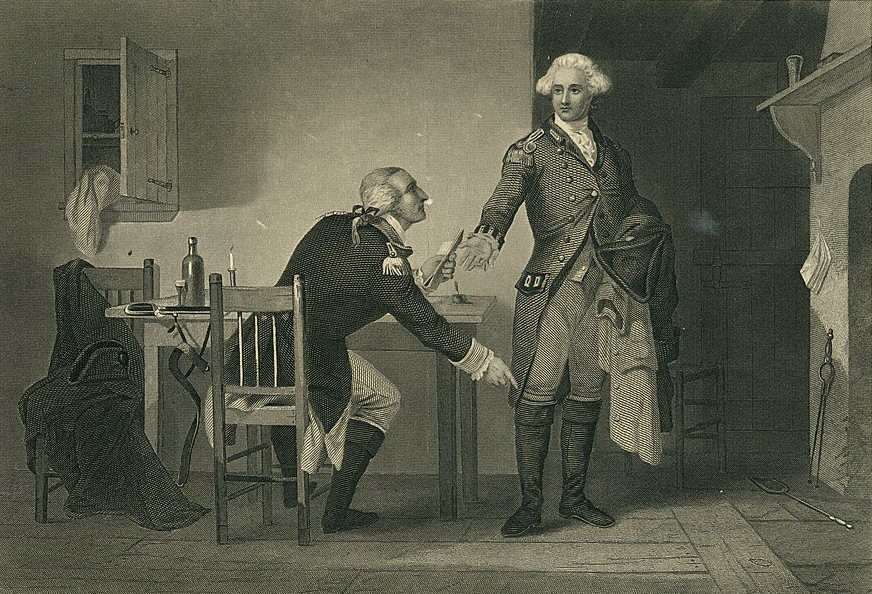
The Root of Benedict Arnold’s Betrayal
“Arnold has betrayed us,” Washington whispered. “Whom can we trust now?”


Get the Civitas Outlook daily digest, plus new research and events.
Get the Civitas Outlook daily digest, plus new research and events.