
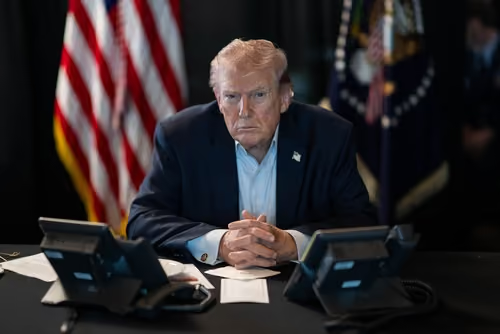
Can Trump Survive the Iran Debacle?
.png)
Trump won't survive the Iran debacle if he abandons his original goal of regime change.
This past February 28, Donald Trump authorized a joint effort with Israel to bring the Iranian government to its knees by leveraging their massive superiority in weaponry and firepower. There is no doubt that the initial strikes achieved considerable military success in knocking out much of what was left of the Iranian air force and its ground defenses, including much of its nuclear war chest. The bold objective of the day was to build on these past successes to secure a total regime change that removed from power the now-weakened Islamic state that had wreaked such horror on the world since it took over from the Shah in 1979 and has continued to follow a policy that shouted, and continues to shout, from the rooftops “death to Israel” and “death to the United States”. Trump’s stated aim was to end this war quickly and before the November elections, and to allay fears at home and to avoid a nasty confrontation that could arise against claims that that War Powers Act of 1973, required Congressional approval to continue the conflict, which is now at risk given that the Senate has passed by a 50-48 resolution an Iran War Powers Resolution of uncertain. This is a sudden turn of events given that the attack started well with the death of Iran’s Supreme Leader Ayatollah Ali Khamenei. But victory did not come quickly, and the question is first, why was the war attempted, and why did it fail?
On the American left, the verdict has been unsparing: the war was a disaster from day one. There was no authorization from Congress, and no buy-in from the American people. Just endless rhetorical falsehoods about the easy victory that lay ahead, coupled with dangerous mistakes on the ground that in turn converted Iran from its pariah status into a heroic nation that stood tall against the evil forces of the United States and Israel. Thus, the common verdict is that the disastrous war should never have been started. The best alternative, claims the New York Times, is a return to the 2015 deal that Obama had cut with the Iranians to slow down Iran’s march to becoming a nuclear power.
Today, however, the wheels have turned a second time. To the surprise of no one, the Iranians have muddied the waters of Hormuz once again by threatening to close the Strait of Hormuz “in response to the continuous violations of the ceasefire in southern Lebanon” without saying exactly when. The whole Memorandum of Understanding (MOU), which obligated Iran to open Hormuz, is in limbo, which makes it time to reassess what went wrong. Here, the conventional wisdom has it exactly backward. We have lost the war, so far, because we never fought it to win, but to win it cheaply.
The first major mistake was that Trump hedged his bets by seeking to limit the political blowback inside the U.S. by saying repeatedly that we would win this war solely with our powerful air force against all the relevant targets. No ground troops, we were assured, would be needed to win. He thus foolishly tied his hands politically when he was immediately confronted with an Iranian strategy that once again demonstrated the inherent limits of air power: for as long as the enemy controls its own territory, it can bury its assets to resist air attacks. That is exactly what was done by the Iranians with their long-term coherent strategy to use small speed boats, hidden in caves and inlets, coupled with mines previously laid to blockade the Strait of Hormuz. Iran’s actions have tied up about 20 percent of the world’s oil supply, with massive dislocations throughout the world. In addition, Iran lobbed some well-placed missiles at oil-producing nations that were locked into the Strait, including Qatar and Bahrain. Hence, the immediate consequences were an illegal Iranian takeover of a public waterway, coupled with an attack on parties that were initially noncombatants. America’s heavy-powered weaponry was the proverbial elephant whose foot was too big to crush the ant. The best the MOU can do is reopen for the moment a strait that should have been closed in the first place.
None of these Iranian responses were unpredictable. Indeed, no nation should ever wage war unless it has a suitable response to the strongest strategy of the other side. So the question is, why did this not work here? The first point is not to indulge in the illusion of a viable cease-fire. Lord Edward Halifax lost his nasty confrontation with Churchill, thankfully, when he put the proposal on the table in the darkest hours of 1940 in World War II. And today, when the United States is in a far stronger military position, it has to follow the same unswerving path toward regime change that ended in successful regime changes in both Germany and Japan. In these struggles, there must never be any time-outs from the war effort for negotiation with the enemy.
Just as it is possible to walk and chew gum at the same time, it is also possible to fight and talk simultaneously. To stop the former to engage in the latter gives the enemy the precious gift of time to replenish its supplies and to fix the various kinks in its strategy. It also allows it to try to form or resurrect relationships with its own allies, be they Russia, China, North Korea, or even Pakistan, a country that has long played both ends against the middle.
It is, moreover, no response to that objection to say that delay gives us the same opportunities, which, however, are of less value to us than they are to them. In addition, the gratuitous delays give the domestic opponents of the president’s plans the ability to turn up the political opposition, so the longer the uncertainty, the greater focus on the other side. There is, of course, the question of shipping dislocation in the Strait of Hormuz, but that clock keeps running so that the short-term dislocations get even greater. The net effect is that a decisive advantage goes to the opposition so that in Trump’s recent defenses of his hapless MOU, which he defends in part by confessing that the effective Iranian embargo has hurt both the US and world energy markets. This forces him to make some recalibration such that both his former allies and ever-present enemies view as an abject retreat the promises to help release some $300 billion in cash for Iran’s redevelopment, along with his bizarre appreciation that Iran may be entitled to have deadly missiles as well.
A distinctive alternative analysis as to the Trump failure has been offered recently by Oona Hathaway, who insists that the major source of Trump’s failure was his failure to recognize that no nation, no matter how powerful, can survive without the assistance of allies. Trump was certainly guilty of that massive oversight of that with his inexcusably high-handed treatment of both Canada on the one hand, and Denmark and Greenland on the other. But his real disgrace in this regard has been, as noted, the cavalier way in which Trump treated his most important ally in this whole episode, Israel, when he demeaned their perception of the military threat posed by Iran. For the rest, he did not need (or get) the military support of NATO this go-around, but he had a greater degree of freedom in how he operated because he did not have to cater to reluctant allies. The relevant example here is that the United States did not take after Iraq in the 1990-1991 Iraqi war because commitments to allies meant that the mission was limited to the liberation of Kuwait. In the second Gulf war in 2003-2011, the lack of allies meant that the United States could deliver a decisive blow to Iraq on its own (only to blow the management task in Iraq after the early military victory of 2003). The same is true here. Hathaway refers back to the halcyon early days of the United Nations, but that organization is a shell of its former self, which, under current leadership, sponsors the corrupt United Nations Palestinian Relief Agency in Gaza that has worked hand in glove with Hamas. Her vision leads to the failure of the United States effort at containment of Iranian nuclear and other ambitions, for if repeating the Obama 2015 deal with Iran is the best that can be done, the entire Western set of alliances is in deep trouble.
But her mistakes do not excuse how Trump went out front on the war, and thus has nowhere to hide, and no friends on whom to rely, given his brusque treatment of European allies throughout his entire second term. So, what should he do now? The first thing is to repudiate the mindset of Joe Biden, whose approach to Gaza was not to end hostilities with a decisive push against Hamas, but merely to keep some kind of weird parity between the two rivals. Like Trump, he failed to understand that the duration of any conflict is an accurate proxy for the total senseless loss of human life. Hence, Trump should use the Marines, if necessary, to shut down the sites for the patrol boats and open up the Strait as quickly as possible, using whatever public or private resources are needed to finish the job.
Next, he must reverse his policy toward Israel. One terrible habit of Trump’s erratic negotiating style is excluding necessary parties from negotiations. Thus, in his all-too clever deal in 2020, Trump negotiated with the Taliban, acting as it were on behalf of the Afghan government without including any of its representatives before setting the terms of the deal, and thus taking insufficient precautions to protect their interests. Trump was out of office when President Joe Biden hastened the premature withdrawal of American forces during the height of the summer fighting season, while withdrawing intelligence and air support from the Afghan government. More blood is on Biden’s hands than on Trump’s, but his dangerous unilateralism increased the risk of that failure. It is, in general, far better to include your allies in making deal than to act as though you are the perfect prism to reflect their needs.
We are today witnessing a rerun of Trump’s same kind of mindless unilateralism. To date, the ongoing war with Iran has gained most of its successes because of the close cooperation at the operational level with Israel. Yet at present, the relationship has reached a new low because, in essence, Trump said not to retaliate against Hezbollah because it had fired on Israel. Does he really think that any nation should relinquish its right to self-defense against an adversary so that an iffy deal might take hold in the face of such passivity? Trump had to back off, maybe; the latest news is that Trump is breathing fire at Iran for its efforts to duck any deal by shooting and talking at the same time in Lebanon. It would be nice to open the Strait of Hormuz; to neutralize the Iranian nuclear threat; to stop skirmishes in Lebanon and elsewhere. But none of this will happen if Trump follows his left-wing critics by seeking a cheap solution in the Middle East. In for a dime, then in for a dollar. There is no stable intermediate solution so long as Trump, his friends, and his foes think that they can patch together any ersatz deal that will survive the next news cycle.
Richard A. Epstein is a senior research fellow at the Civitas Institute.


Isolation Is Not an Option
The lesson the Trump administration ought to have learned by now is that Eastern Europe and the Middle East are two theaters of the same war, not separate conflicts.

A Deadly New York Parable
The public mood in New York City sharply changed when the Mamdani administration took one large and foolish step.
How the Weimar Republic Fell
The years from 1919 to 1933 were among the most calamitous and historically decisive in European history.



.jpg)
Get the Civitas Outlook daily digest, plus new research and events.
Get the Civitas Outlook daily digest, plus new research and events.