
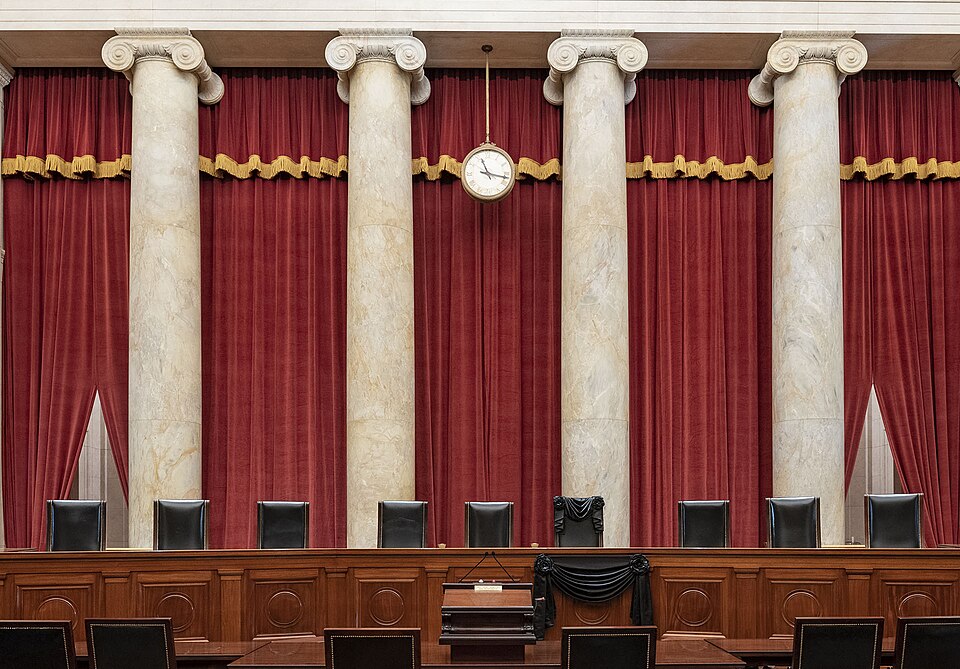
What a Packed Court Could Have Done in One Year

For the sake of our liberties, the structure of the Constitution, and the preservation of America’s principles, Americans should support a constitutional amendment to ensure that the Court can never be packed.
Not long ago, conservatives and liberals alike decried packing the Supreme Court as a threat to American liberty. Court packing was, as then-Senator Joe Biden called it, a “bonehead idea.” And yet, today, many on the left are ready to embrace boneheadedness.
For decades, in the post-New Deal period, the Supreme Court often crafted its opinions based on the personal philosophy, preference, or desired policy outcome of its majority rather than the law. Instead of interpreting the law as written and according to its original meaning, the Court leaned on “evolving standards of decency” and, in the words of Justice Antonin Scalia, tinkered with the Constitution to “do what the people want” instead of what the text demands.
The Supreme Court has slowly emerged from this period and has returned to its proper function: interpreting statutory and constitutional text according to its original meaning. Yet the left seems willing and eager to return to results-oriented judging. One method of doing this is to pack the Court with judges who claim no judicial philosophy, like Justice Jackson, but whose opinions will naturally reflect progressive philosophy.
By definition, a packed Court would be a political Court. The only reason to pack the Court would be to reach preferred outcomes of the Court’s rulings. Even if one party were to pack the Court with originalists, the one impartial branch would lose its institutional credibility as it would be depicted as, and likely would become after the following election, merely an extension of the majority party. The Constitution largely confines the frequent swings of majoritarian politics to the legislative branch, the branch most accountable to the people. If introduced into the judicial branch, America would cease to be a nation of laws.
Imagine the potential damage to our constitutional system if the left had already packed the Supreme Court before its most recent term. In the last year alone, a packed, political Court could and likely would have wrought havoc on fundamental constitutional rights, thus weakening the very structure of the Constitution, the strongest protector of American liberty.
Last year, a packed Court would have had several opportunities to undermine essential constitutional rights long recognized by precedent.
Had the left packed the Court, state governments may well have been empowered to enforce the left’s gender ideology through censorship. In Chiles v. Salazar, the Supreme Court considered whether a Colorado law could penalize Kaley Chiles, a mental-health counselor who provides talk therapy, for expressing a view of sex and gender contrary to the state’s. Specifically, Colorado’s law allowed her to counsel clients “undergoing gender transition” but only if she did not help her clients realign their identity with their sex. The case was straightforward, and eight of the justices agreed: States cannot compel therapists to espouse their preferred views.
Yet Justice Ketanji Brown Jackson, in a lone dissent, attempted to distinguish “medical professionals and their treatment-related speech” and First Amendment speech. According to Justice Jackson, the speech at issue in the case was professional medical conduct and therefore could be regulated by the state.
But “speech” is not “conduct,” and the Supreme Court has long rejected similar attempts to conflate the two. Neither the states nor the federal government can implement content-based restrictions to compel those who disagree to parrot the regime’s preferred views. Yet a packed Court may well have adopted Justice Jackson’s dissent as its official interpretation of the First Amendment.
In another recent case, Wolford v. Lopez, a packed Court likely would have upheld a restrictive Hawaii gun law, providing anti-Second Amendment states with a roadmap to largely disarm the public. After the Court held in New York State Rifle & Pistol Assn., Inc. v. Bruen that the Second and Fourteenth Amendments protect the right to carry firearms outside the home for self-defense, Hawaii sought to reverse the default rule for carrying firearms in private establishments open to the public.
Under the longstanding rule, gun owners are allowed to carry a firearm unless a private property owner expressly prohibits them from doing so. Hawaii’s law, on the other hand, prohibited anyone from carrying a firearm into places of public accommodation unless they first received express consent from the property owner. The Supreme Court majority found that Hawaii’s law “hobbles what the Second Amendment protects.”
Again, Justice Jackson dissented, although this time joined by Justice Sotomayor. Justice Jackson would have reframed the case, writing “[t]his case is about property rights, not gun rights” and arguing that “Hawaii’s law does not restrict the right to carry a gun at all.” Justice Jackson even suggested that Louisiana’s Black Code laws from 1865 could serve as precedent for Hawaii’s law.
A packed Court could also have usurped Congress’s constitutional role by effectively rewriting statutes. In another case in which a packed Court might have prioritized politics over plain meaning, the dissenters opted for the Humpty Dumpty approach: “When I use a word… it means just what I choose it to mean.” As the majority explained in Mullin v. Al Otro Lado, the case presented a “straightforward question”: whether an alien who seeks to enter the United States “arrives in the United States” while he is still in Mexico.
According to federal statutes, aliens are not entitled to inspection or to request asylum until they “arrive in the United States.” Just as “a guest does not arrive in a house when he knocks on the front door,” the majority reasoned that the words mean what they appear to mean “in ordinary speech.” Thus, applying the federal statutes, the majority ruled that noncitizens in Mexico are not entitled to inspection proceedings or asylum requests before stepping foot in the U.S.
In a dissent twice the length of the majority opinion, Justice Sotomayor complained that the majority’s “illogical interpretation” was motivated by “a fixation on a single word: ‘in.’” Additionally, Sotomayor argued that the majority’s interpretation would leave aliens who cross the border illegally—ignoring the “adverse legal consequences” of doing so—better off than aliens who wait and are denied at points of entry. The consequences of the majority’s decision, she says, “are predictable”: “More people will die” and “be subjected to violence because of something they cannot or should not have to change about themselves, such as their race, religion, nationality, or political opinion.”
Though Sotomayor may truly intend to minimize the suffering of illegal immigrants, a noble goal, the majority correctly emphasized that it is not the Court’s role to consider “the wisdom” of the administration’s “policy of metering alien arrivals at the border.” That a policy may bring unintended effects is not reason enough to rewrite federal statutes from the bench.
Finally, a packed Court could have maintained a significant blemish on the constitutional structure of government. In Trump v. Slaughter, the Court struck down Humphrey’s Executor, a 90-year-old case which allowed Congress to insulate the heads of certain administrative agencies from removal by the President. The Court in Slaughter rightly recognized that, since the Constitution vests “[t]he executive Power” in a “President of the United States of America” and since the Constitution’s Framers emphatically rejected a “plurality in the executive,” the President must be able to remove members of the administrative state.
Yet the dissenters, supporting a rogue fourth branch and demonstrating the likely majority position of a packed Court, argued that preventing the President from exercising authority over the Executive branch “upends rather than upholds the separation of powers.”
Unlike a Court packed by those seeking political outcomes, this Court has shown that it seeks to rule based on law, not politics. That is why, with the support of some of the justices President Trump appointed, several of its recent rulings have rejected the President’s preferred policies.
Often praising President McKinley and promising to usher in the “golden age,” President Trump has championed tariffs and made them a defining policy of his second term. Yet in February, the Supreme Court struck down the President’s illegal tariffs, ruling that they were not authorized under the International Emergency Economic Powers Act. In the case, Learning Resources v. Trump, Justice Gorsuch and Justice Barrett, both appointed by President Trump, joined the majority.
In Watson v. Republican National Committee, Justice Barrett authored the majority opinion upholding Mississippi’s law that permits the counting of absentee ballots so long as they are postmarked by, and received no later than five days after, election day. In response, President Trump said the “tremendous loss in the Supreme Court” emphasizes the need for Congress to pass the SAVE America Act, a priority for the administration that, among other provisions, would eliminate most mail-in voting.
Finally, on the last day of its term, the Supreme Court struck down another of the President’s favorite policies in Trump v. Barbara, the highly anticipated birthright citizenship case. In Barbara, the majority ruled that the Citizenship Clause of the Fourteenth Amendment bestows citizenship to all born within United States territory regardless of the parents’ legal status. Though this case was decided on a closer margin, five to four, the majority there, too, included Justice Barrett, a Trump appointee.
Regardless of whether one agrees with the majority in Learning Resources, Watson, or Barbara, the current Court cannot properly be dubbed a partisan body or an extension of the Republican Party. The fact that neither conservatives nor liberals are completely satisfied with the Court’s rulings last year indicates that the Court is doing its job, namely, to say what the law is instead of what the justices think it should be.
Had the left packed the Court, the dissenters in many of last year’s cases would likely have been in the majority, and their reasoning would be the controlling precedent for the lower courts. As a result, just last year, a packed Supreme Court would likely have empowered states to penalize speech that differs from their preferred view on gender, permitted states to enact laws that overwhelmingly restrict Americans’ right to bear arms, permitted gerrymandering based on race, granted all noncitizens a right to begin immigration proceedings despite a clear statutory qualification, and perpetuated the unconstitutional power of the administrative state by upholding a decision that illegitimately insulated bureaucrats from presidential oversight.
Those who find such outcomes appealing would do well to consider the words of former Supreme Court Justice Stephen Breyer, the left-leaning judicial pragmatist replaced by Justice Jackson: “What goes around comes around. And if Democrats can do it, the Republicans can do it.”
Thanks to the principled thought and dedicated efforts of former Attorney General Edwin Meese III, Justice Antonin Scalia, the Federalist Society, and many others, originalism has become the dominant interpretative theory on the Supreme Court. If the Court once again abandoned its responsibility to “say what the law is,” it would forfeit these hard-won victories which safeguard American liberty. For the sake of our liberties, the structure of the Constitution, and the preservation of America’s principles, Americans should support a constitutional amendment to ensure that the Court can never be packed.
J. Marc Wheat is General Counsel at Advancing American Freedom. Davison Drumm is a Research Assistant at Advancing American Freedom.

Regulating AI: Is the Rule of Law Possible?
The stakes of the AI race are too high to enact a framework rife with pitfalls that will inevitably result in legal challenges and political disputes, outcomes that do little other than assist our adversaries.
What a Packed Court Could Have Done in One Year
Thanks to the principled thought and dedicated efforts of former Attorney General Edwin Meese III, Justice Antonin Scalia, the Federalist Society, and many others, originalism has become the dominant interpretative theory on the Supreme Court.
.jpg)
The Best Escape from the U.S. Attorney Mess
The process for appointing U.S. Attorneys is sputtering, but there is a way out of this mess.


Get the Civitas Outlook daily digest, plus new research and events.
Get the Civitas Outlook daily digest, plus new research and events.