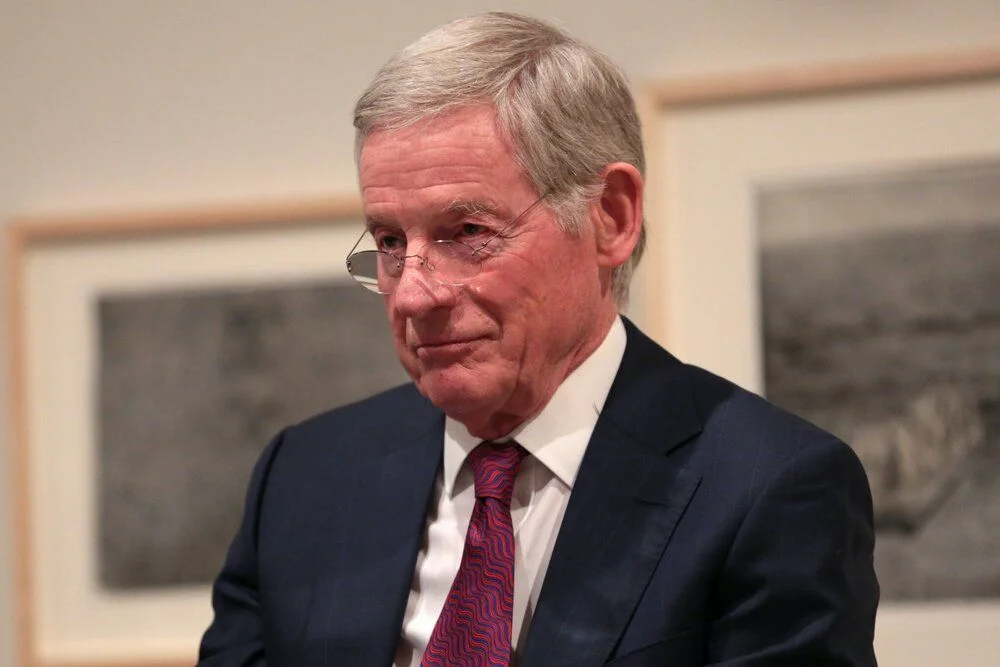
Harvey Mansfield, Radical

We all owe a great deal to Harvey Mansfield for shining a light on the permanent things.
Despite being a fixture in Harvard University’s ivory towers for almost his entire life, Harvey C. Mansfield, Jr., is an anti-establishment icon. From questions about feminism and same-sex marriage to the nature of constitutionalism and the meaning of modern freedom, he has never been afraid of voicing conservative opinions that cut across the conventional wisdom of liberal academia. In a recent interview with the Chronicle of Higher Education, the professor even accepted the label “annoying Socratic gadfly.”
Yet it would be a mistake to chalk up Mansfield’s dissidence to mere partisan politics. His scholarship itself is radical—not in the sense that he wants to tear down the status quo and replace it with something revolutionary, but rather in that he seeks to uncover the deepest roots of political phenomena. Mansfield rejects the dominant ideology of political correctness because he unflinchingly seeks to understand things as they really exist, and to understand the voices of the past as they understood themselves.
This approach also sets Mansfield against the utilitarian approaches prevailing in other corners of the academy. In another recent interview, for example, he became noticeably perplexed when the economist Tyler Cowen suggested students might legitimately use artificial intelligence tools to help read books. “That’s not good enough,” Mansfield said. “You want the best, and the best is in the original text. I don’t think you want to substitute for that original text trying to understand it. You need to pay careful attention to everything that is said in the way that it’s said and in the place that it’s said.” According to him, the greatest books are written carefully and, in turn, reward only the closest, most careful readings. Outsourcing that kind of work to an AI would deprive us of the actual benefits of education.
For decades at Harvard, Mansfield has been teaching students how to do this kind of reading for themselves. His new book, The Rise and Fall of Rational Control, is adapted from lectures delivered in his History of Modern Political Philosophy class from 1968 to 2022 and is dedicated to those not fortunate enough to have taken the course themselves. It is a brilliant introduction to Mansfield’s scholarship, perhaps his most bracing work since his 2007 work Manliness, and a real call-to-arms for liberal education’s defenders.
Mansfield proceeds by interpreting key texts by important thinkers, ranging from foundational social contract theorists such as Thomas Hobbes and John Locke to critics of modernity such as Karl Marx and Friedrich Nietzsche. The work as a whole can therefore teach us something about our present age—and perhaps why so many are left discontented by it. The modern goal of “rational control” somehow both lowers the aims of political life beneath the classical tradition’s concept of virtue and yet exalts human ambition to a level unknown to the ancients.
For Mansfield, modern political philosophy begins with the Renaissance thinker Niccolo Machiavelli. Though philosophers before the Florentine wrestled with the ugly realities of human life and politics, Mansfield contends he was the first to truly unveil the harshest truths. “For Machiavelli, the political truth that one must rely on one’s own arms is traceable to the cosmic truth that man is alone,” he writes. Careful attention to the way Machiavelli wrote, Mansfield argues, reveals the true intentions behind his sometimes-shocking reinterpretations of classical or biblical texts. These sorts of “typical Machiavellian contradiction[s]” are, according to Mansfield, “not evidence of a loose mind but meant to teach the reader something.”
Perhaps surprisingly, Mansfield does not devote the bulk of this opening chapter to either Machiavelli’s most infamous work, The Prince, or his most influential, the Discourses on Livy, (both of which he has translated), but rather to an extended reading of a more obscure play called Mandragola. The plot is somewhat complicated, filled with hidden identities and scheming priests worthy of William Shakespeare’s great comedies. Mansfield, though, ably guides readers through these intricacies and leads them to the conclusion that the Florentine sought to undermine what he called “our present religion,” Christianity, and replace the faith with “new modes and orders.” Like the characters in Mandragola, Mansfield argues, Machiavelli practiced a kind of “indirect government” to achieve that great replacement and effecting a kind of fusion between “the materialism of [ancient] skeptics with the politics of the Socratics, and thus avoiding, he hopes, the objection to each.” In some ways, this argument resembles a conspiracy theory.
Although the common perception is that Machiavelli is a “teacher of evil,” Mansfield links Machiavelli’s “new modes and orders” to Sir Francis Bacon’s famous declaration that science ought to aim at “enlarging of the bounds of human empire, to the effecting of all things possible” to achieve “the relief of man’s estate.” In other words, Mansfield argues, the modern project is the use of reason not only to understand the problems facing human beings, but to solve them—the introduction of “rational control.”
There is certainly a real nobility to the modern project. Suffering is a great evil, and providing cures for cancer or vaccines for polio is a true blessing. Inventing human flight, or even sending a man to the moon, fills us with wonder and awe. Our very humanity thrills at these conquests of nature. But especially in politics, the notion of “rational control” poses certain problems for thinking about human nature. The anti-teleological liberalism of Thomas Hobbes, for example, may have “helped to make Machiavellianism respectable” by introducing the theoretical “state of nature” as the basis for a science of politics derived from “Machiavelli’s effectual truth.” The Leviathan, empowered by the social contract, comes to represent the ways that, in modernity, “Human power has the absoluteness of divine power.
And yet, Mansfield also concludes that modern political science “has hindered our self-understanding.” There is something bloodless or spiritless about the social contract as envisioned by Machiavelli’s successors among modern liberals, leaving us feeling deflated. Their theories about the origins of politics may be well-reasoned and logically sound, but they seem to deny essential aspects of human nature ancients such as Aristotle put at the heart of their political science. Comfort and convenience replace virtue and even liberty as the chief social ends.
From this point, Mansfield tries to demonstrate the real consequences of the Machiavellian revolution in Western thought. “Historians will object, with some reason, that this book makes modernity too orderly, as if it were following a plan and were never interrupted by events or accidents,” he writes in the introduction. “We show an internal history of modern thought, however, more orderly than historians commonly suppose, that moves on its own in a sequence of thinkers, reflective of those past and instructive or inspiring to those ahead.” Although genius disdains a beaten path and these thinkers were often reluctant to acknowledge their debts—Hobbes, for example, never explicitly cites Machiavelli—Mansfield demonstrates quite conclusively that he is grasping a real thread through his close readings of the texts.
And yet not all the thinkers Mansfield profiles are exactly friends to the modern project of rational control. In the wake of Hobbes and Locke’s development of rational control into the ideology of liberalism, Jean-Jacques Rousseau sought to reintroduce some notion of morality without entirely embracing ancient metaphysics. Mansfield sees the Genevan as a kind of “defector” from the Enlightenment because he questioned reason’s ability to perfect human nature. Instead, Mansfield argues Rousseau offers the idea of “history”—or, more precisely, a notion of rational control that holds “human beings make themselves over history.” This concept would be further developed by German thinkers such as Immanuel Kant and G.W.F. Hegel, and ultimately inherited by Karl Marx and other totalitarians. Mansfield illustrates, in other words, how Machiavelli’s revolution in thought leads to the twentieth century’s revolution in deed.
Rousseau is often regarded, with good reason, as a theorist of democracy. His idea of government by a “general will” certainly found its way into the rhetoric of democratic revolutions after his time. And yet Mansfield also detects something profoundly undemocratic in his theory of history. There is a kind of contempt in Rousseau’s ideas about rational control that was not present in ancient philosophy:
The advantage of the older way is that Socrates, unlike Rousseau, engages in philosophy in the city and brings his philosophy down to the city. Rousseau seems utterly to divide the philosophic few from the nonphilosophic many, and the reason is that he has abandoned the conception of a common human nature.
That contempt remained a leitmotif in the great symphony of modern political philosophy. It can be heard in the strident moralism of Kant and the inhuman logic of Hegel’s historicism—dissonant notes Søren Kierkegaard (sadly not one of Mansfield’s subjects) hated to hear. But the contempt really reaches its crescendo in the ravings of Friedrich Nietzsche, the final figure profiled by Mansfield. If Marx is a critic of liberalism from the Left, he argues, Nietzsche is its greatest critic from the Right. “What Machiavelli began, Nietzsche brought to an end—and with both a bang and a whimper,” Mansfield writes, because “modern rational man proved to be what he called the ‘last man.’”
Although Nietzsche is often denounced as a kind of nihilist, Mansfield concludes that he, in fact, is a kind of “philosopher of morality.” In the face of the boredom that is the inevitable result of modern rational control, he offers a new excitement in pursuit of a certain sort of nobility and even beauty through vital creativity. Attractive as this may be, there is a kind of anti-humanism inherent to Nietzsche’s conception of the philosophic project that is dangerous. Mansfield urges us to “try not to fall in love with him,” and quotes P.G. Wodehouse’s great hero Jeeves: “Nietzsche is fundamentally unsound, sir.”
Instead of Nietzsche’s madness or Marx’s revolution, then, Mansfield leaves his readers with a “blessing” and a mission. Whatever claims its theorists make, modernity is not an end to all human questions—it is, rather, a work in progress. As Mansfield writes, “The purpose of this book and my course at Harvard is to help readers think further with the aid of the best books ever written. It is not to supply a reason to stop thinking!” He especially encourages us to study three more great texts: Aristotle’s Ethics, Tocqueville’s Democracy in America, and the U.S. Constitution. Without embracing Marx’s call for philosophers to change the world, Mansfield hopes that political philosophy can help us live better lives.
In an age of boredom and decadence, this charge is precisely what makes Mansfield a radical. His colleagues in the academy would turn students’ attention to utilitarian policy questions or activist notions of absolute justice. To them, students are mere tools to advance an agenda. Mansfield, however, is part of an older tradition that cares more about their souls. His work, including this latest book, directs our attention to the questions that matter most—questions that may never be fully answered and yet are the worthiest of all. We all owe a great deal to Harvey Mansfield, then, for shining a light on the permanent things.
Michael Lucchese is the founder of Pipe Creek Consulting, an associate editor of Law & Liberty, and a contributing editor to Providence.


Spielberg’s Empty Hope
'Disclosure Day' should have been called 'Hope and Change,' or rather 'Change and Hope.'
.jpeg)
Deliberative Republicanism and the Triumph of the American Founding
Instead of rejecting the moral urgency of the postliberal right and left, it is fitting and proper that we redirect it through the right kind of education—both formal and informal—that can inspire affection for our Constitution.
Can Civic Friendship Save America?
Start with “civic assimilation” on the way to a more peaceful Union.

.avif)


Get the Civitas Outlook daily digest, plus new research and events.
Get the Civitas Outlook daily digest, plus new research and events.