Can Socialist Fantasies Overtake the World?
.png)
The Global Justice Project's dangerous proposal for wealth redistribution should be ignored by everyone before it is too late.
The persistent attraction of egalitarian principles rests at root on one well-accepted intuition: the diminishing utility of wealth. If the dollar means less to the rich man than to the poor one, then, so the logic goes, moving toward equality is a way to obtain higher levels of social satisfaction and social cohesion wholly independent of any new wealth creation. The underlying vision is that wealth differences always burden the less fortunate across the globe, and that these inequalities result in social segmentation that, in turn, leads to social alienation by the less fortunate.
But, at this point, reality starts to creep in, or at least it ought to. To see the Achilles heel of egalitarian views, ask what is preferable: an overall reduction in wealth differences among people, or an overall increase in total wealth across those same people? Choose the first, and you find that the easiest way to create equality is through a combination of wealth destruction and wealth transfer—via stiff taxes on income and capital, or outright confiscation. How that improves social cohesion, even as it creates deep resentments, is not answered.
To see how the new regime works, let two people start with 10 and 20 units of wealth, respectively. A social dictator could try to reduce inequality by going from 10/20 to 15/15, so that the same dollars generate higher utility without any new wealth being created. But what should be done if taxing and transferring wealth is costly? Would the egalitarian prefer a society that goes from 10/20 to 13/11—eliminating inequality but only reducing overall wealth by 20 percent? What about taking that next step by moving to 5/5, achieving perfect equality while cutting total wealth by two-thirds?
Nothing about these grim illustrations of economic futility seems to faze the multiple authors of the so-called Global Justice Project (led by a trio of redoubtable French economists, Thomas Piketty, Emmanuel Saez, and Gabriel Zucman). Their fundamental premise is that it is possible to couple a massive redistribution of wealth with an improvement in overall prosperity in the richest societies, so that by the year 2100, the world’s prosperity map looks optimistically as follows:
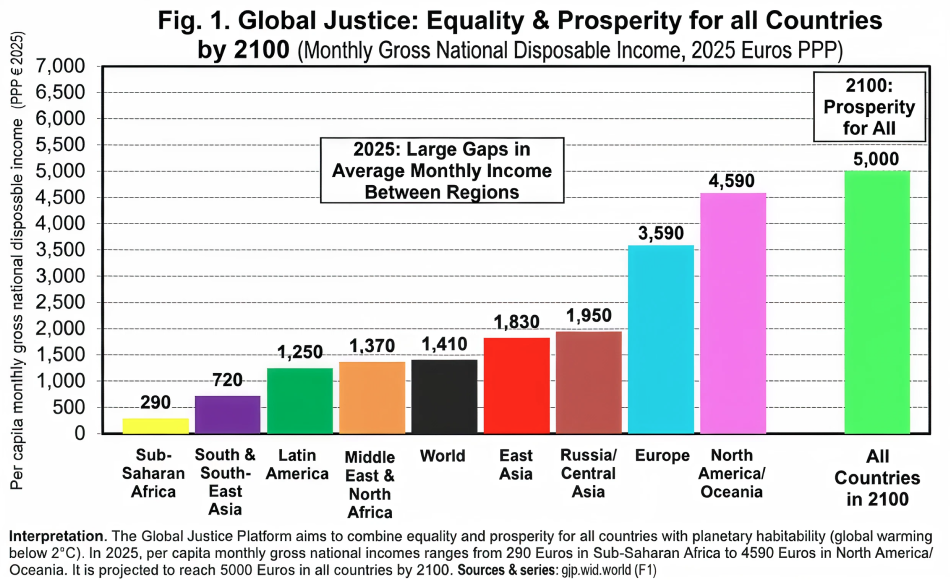
Indeed, this tremendous degree of improvement is only the first part of the grand plan, because the second, and equally ambitious, part of the plan, is a huge project to increase “planetary habitability” by insisting on “fast decarbonization” (bold in the original) which is then accompanied by a “drastic reduction in inequality of income, wealth and power, both between countries and within them.”
Per capita monthly national income converges to €5,000 in every country, closing a 16-fold gap. The share of the bottom half of global wealth increases from 2% to 30%, while the share of the billionaire class decreases from 6% to 0.05%. Nearly 90% of the world’s population double their income while working roughly half as many hours as they do today. Warming reaches 1.8°C by 2100, rather than over 4°C under baseline macroeconomic and policy trends.
The most obvious question to ask is how will these cosmic changes be implemented? Start with the most prosaic objection: there is currently no worldwide organization that has powers of this sort. The UN is a farcical shell that cannot be expanded to accomplish any of these three tasks, let alone all three. National sovereignty is virtually impossible to displace, more so because the supposed universal gains (including for most rich nations and their people) are unsustainable. Under this scheme, investment in private businesses will be driven toward zero, replaced by some public international investment body funded in large part by a wealth tax that could reach 20 percent per year, supplemented by steeply progressive income taxes. Most of that existing wealth is now fully invested, directly or indirectly, in current ventures, which would have to be liquidated or turned over wholesale, without any compensation, to its many investors and firms, all of which would face the prospect of bankruptcy of major companies.
Critics of the far lower wealth taxes now proposed for California (with a big assist from Piketty, Saez, and Zucman) have noted the exodus of prominent billionaires—think Sergey Brin, Larry Page, and Peter Thiel, for starters—joined by people of multiple levels of wealth, all in anticipation of the California November ballot measure that is said to impose a “one-time”—hold the gallows humor—wealth tax that will make, at most, a small dent in the state’s ever larger looming deficits that will burden those foolish enough to stay behind to be taxed anew in future years. A worldwide tax of four or five times that amount will require reversing the projections in the Global Wealth Project’s graphs, as the world will careen toward average incomes in sub-Saharan Africa. This brave new international order would leave the wealthy no place to hide—even after the SpaceX IPO that made Elon Musk the world’s first trillionaire, with the successful $1.8 trillion SpaceX public offering, leaving him owning 42 percent of the company’s shares. Under the plan, he would simply stop working once he lost 99 percent of his wealth.
Others are gunning for Musk. Typical of the recent panic is the journalist Patricia Cohen, whose frantic story in the New York Times of June 14, 2026, laments that the billions held by today’s billionaires are “increasing faster than ever,” as if more wealth were a plague on the rest of the world. If you are confident that they did little or nothing to earn what they have acquired, why not take it away and give it to those no less deserving? And the case becomes even more compelling if the wealth of the few created an oligopoly that can buy its way to political influence, which is exactly what did not happen when a miscast Mr. Musk made a mess of his highly visible Department of Government Efficiency program in the early months of the Trump Administration.
But what of his triumph? To listen to Ms. Cohen and other boobirds, the gains to Musk and his cronies have come at the expense of us all, given the created inequality. But just how is that done? Not through the gains of the many individuals who also received stock in the company, none of whom appear dismayed that the dollar gap between themselves and Musk has widened. But that lucky group is only a small fraction of the total population. Are the rest poorer now because Musk and his merry band of insiders are richer? Hardly so: the relevant comparison for most individuals is the value of their holdings after the IPO (or SpaceX’s earlier activities), not the ratio of their wealth to Musk or anyone else.
So what is the structure of these soft externalities? No one has suggested that any of SpaceX’s activities should be stopped because they are the sources of pollution or disease. And if they did, it would be far better to address that local, isolated danger by regulating specific practices known to pose such a risk. It is just overkill to shut down any firm or industry when targeted remedies are available.
It is on the benefit side that all the action takes place. The simple truth is that even those who take holy vows never to use any product supplied by SpaceX or other companies run by billionaires will violate those vows many times each day. Refuse to fly on any plane using advanced guidance and electronic systems? You still benefit from those advances when relatives travel to visit you or when a friend sends you a FedEx parcel. Open any application on your computer, or read an AI summary of a complex topic, and you are again in the thrall of new technological advances.
The question remains: how could anyone in his right mind lend the slightest attention to the GJP’s madcap proposals, which promise only years of turmoil as they try to persuade people that the path to wealth and security lies in letting a group of spoiled visionaries wreck every productive institution in society?
One great irony here is that any program that prizes equality misses the real tragedy: poverty. Poverty should not be tied to the broader, inconclusive debate about inequality that extends far beyond these groups. Yet here the GJP makes the unpardonable mistake of trying to reform the world. Instead, it should focus on two types of issues. First, reducing the many burdens—from minimum-wage laws to tariff barriers—that block poor people from entering the marketplace. Second, concentrating on specific scourges correlated with poverty to help reduce their incidence: water purification, refrigeration, and other low-cost measures with unambiguous payoffs. The American left should take note of what Johan Norberg wrote in his book Progress: Ten Reasons to Look Forward to the Future (2016): Much progress has been made by taking this modest approach to everything from longevity and sanitation to childhood diseases. But the point is too often missed, as when Times reporter Ben Casselman grimly connects the dots with this headline: “Wages Fall but Trillionaire Gets a Windfall.” Both halves of the headline are misleading. Wages are falling not because of Musk, but because of the mindless efforts to impose high taxes on capital and unwise restrictions on labor. Musk’s gains did not fall from the heavens but were the result of decades of planning and working. The Global Justice Project needs to recant, and until it does, its dangerous proposal should be ignored by everyone else before it is too late.
Richard A. Epstein is a senior research fellow at the Civitas Institute.

Can Socialist Fantasies Overtake the World?
Yes, if the unworldly philosophers at the Global Justice Project are allowed to have their way.

An AI Commencement Address That Might Not Elicit Boos
Someone has to dare to point the path forward in those communities. We need many more Nehemiahs.
The Green New Dependency: How China Captured Western Climate Agendas
With the help of universities, Net Zero’s rules were quietly written to save China’s export model—with the West as the customer.




Get the Civitas Outlook daily digest, plus new research and events.
Get the Civitas Outlook daily digest, plus new research and events.