
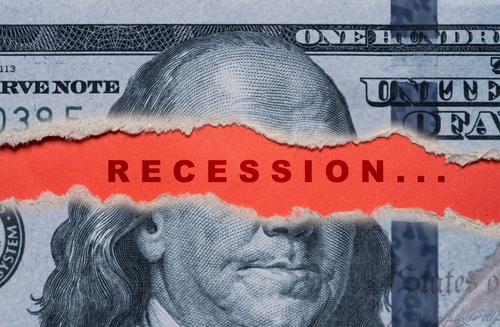
Diagnosis: Recession

Recession diagnoses government-as-arsonist without fully explaining the mechanism, and that is precisely the gap public-choice analysis exists to fill.
Tyler Goodspeed is unusual. He is a scholar of the history of economic thought who also spent time inside the policy machine he studies. Most notably, he served as acting chairman of the Council of Economic Advisers until January 7, 2021 — he resigned the day after the Capitol riot. He enigmatically told the New York Times’ Jim Tankersley that “the events of yesterday made my position no longer tenable.”
He has since kept a foot in both worlds, writing serious economic history while remaining a regular presence in the press as a policy commentator. That combination shows up directly in the method of Recession: it reads less like a technical macroeconomics monograph and more like intellectual history conducted with an economist’s data discipline — long on primary sources and quarterly output series, short on model derivations.
Goodspeed’s target is the folk theory of the business cycle. One must be careful here: our notions of business cycles are a hodgepodge of moralizing financial journalism and a veneer of formal economic theory. The standard narrative, as Goodspeed states it, is that expansions carry the seeds of their own destruction, and that busts are payback for booms. (One version of this, the Keynes-Hayek “rap battle” where I play a security guard, is commended to the reader.)
Recession asks whether recessions follow a cyclical or semi-cyclical pattern, or whether they are better understood as the product of essentially exogenous shocks. To answer, Goodspeed examines data assembled by Steve Broadberry and coauthors and, using US data, extends the analysis back to 1700, applying a consistent methodology across both countries. He concludes that recessions are almost always “plucks” rather than the corrective phase of a cycle. That framing is borrowed explicitly from Milton Friedman’s “plucking” model, in which the economy travels along a stable upward trend and is periodically yanked below it by negative shocks. The economy then recovers to the trend rate of growth, though it may never “make up” the output lost from the effects of the shock.
What is the Orthodox View?
But which orthodoxy is Goodspeed challenging? The book’s marketing suggests a much bigger insurgency than the argument delivers. The mainstream model taught to central bank staff today is a synthesis of the New Keynesian Dynamic Stochastic General Equilibrium (DSGE) model with financial frictions. If you examine theories side-by-side, DSGE is a much closer cousin to Goodspeed’s shock-based story than the book’s framing implies. Even given the histrionic impulses of a trade press like Hatchette, I was a little surprised at the extent of the misrepresentation.
The lineage of the new orthodoxy had several stages. Real business cycle theory, dating to Finn Kydland and Edward Prescott’s 1982 paper, treated business cycles as the economy’s optimal response to real technology shocks — no market failure, no role for stabilization policy, the cycle simply is the efficient outcome; if anything, government actions can be one of the shocks that cause recessions, but such actions can almost never be cures. Many Keynesians responded by arguing that this definition of “shocks” was too encompassing, leading to a “New Keynesian” synthesis that elevated exogenous effects but preserved some role for policy. This synthesis was elaborated to account for concentrated industry structure and adjustment frictions that restored a place for policy relevance.
This New Keynesian synthesis, for better or worse, is the current state of the art. If you look at the actual models used today at the U.S. Fed, the European Central Bank, the Bank of England, and the International Monetary Fund, you’ll find versions of Soskice-Woodford’s canonical three-equation treatment with allowances for optimal monetary rules and some differences in empirical specification.
For an outsider, it is important to remember that macro-models have two functions: forecasting and explanation. “Exogenous shocks,” by definition, are unpredictable and are not “priced-in” by financial markets. Without a crystal ball, for example, it would have been impossible for a model calculated in late 2025 to account for the effects of energy price increases caused by the closing of the Straits of Hormuz. That doesn’t mean that such models discount the effects of shocks, but rather that future random events are not part of the data available to make the forecast.
Explanation, on the other hand, adds in the effects of exogenous shocks, and such influences are key parts of the macro-models used by both government agencies and large private econometric models. Any discussions of the origins and impacts of recessions in current models rely heavily on shocks, once the magnitude and effects of those shocks become measurable.
Saying, as Goodspeed alleges, that forecasts ignore shocks is true, but that is because shocks lie in a future that is yet unknown. Criticizing forecasting models for not focusing on shocks is like thinking students should have studied for a pop quiz. The whole point of a pop quiz is that it’s unexpected! If you announce, “tomorrow there will be a pop quiz,” students will study for it. If a shock is expected, it will be “priced in,” so it’s not a shock.
Seen against this lineage, the older orthodox view Goodspeed is arguing against turns out to be two things bundled together. The first is the popular boom-bust morality story no serious macroeconomist holds in the crude form Goodspeed alleges. The second, academically more defensible versions — Austrian business-cycle theory and my old professor Hyman Minsky’s financial instability hypothesis — do in fact locate the cause of recession in the character of the preceding expansion.
But neither of those models is orthodox at this point. The professional mainstream is shock-driven almost by construction, with frictions determining how a shock propagates and how much policy can do about it. Friedman’s plucking model, and Goodspeed’s book with it, sit closer to this mainstream than to either Hayek or Minsky. Goodspeed’s real quarrel is less with the New Keynesian three-equation consensus than with the endogenous-cycle traditions that persist at the margins, as well as the folk narrative common in financial journalism and central-bank post-mortems.
There is one exception worth conceding: modern DSGE models still generally treat the length or “overheating” of an expansion as informative about subsequent downside risk — the logic behind Bernanke’s “financial vulnerabilities build during good times” framing, and the “vulnerable growth” literature on GDP-at-risk. That tradition is arguably the most direct mainstream rival to Goodspeed’s finding that expansions don’t die of old age, but it sits outside the Hayek-Schumpeter-Minsky frame the book engages most directly.
The Structure of the Argument
Goodspeed builds his case in stages, opening by attacking the standard narrative attached to famous panics and treating recessions as idiosyncratic events rather than morality plays. The Panic of 1873 is conventionally blamed on railway mania and the collapse of the Northern Pacific Railroad; Goodspeed instead points to the 1873–76 grasshopper plagues, a locust swarm larger than California that devastated the plains the railroads were meant to open to settlement. He treats 1857 similarly, tracing it to a grasshopper plague that hit western land values alongside the loss, in a hurricane, of a ship carrying California gold needed for liquidity. The message: panics are not staged dramas of greed and comeuppance but idiosyncratic collisions of unrelated bad luck.
From there, he turns to testing the “hangover” theories against the data, with Hayek and Schumpeter as his chosen antagonists — Hayek for an Austrian business-cycle account that rivaled Keynes’s in the 1930s, Schumpeter for treating recessions as the mechanism that sorts out a boom’s misallocations. Against both, Goodspeed finds that the relationship between an expansion’s age and its probability of ending is essentially zero, that increased investment during a boom does not predict the severity of the subsequent downturn, and that longer expansions do not produce longer recessions. He also reports that reallocation of resources across firms and sectors happens more aggressively during expansions than during contractions — the reverse of what Schumpeter’s “creative destruction” story would predict.
He then argues that recessions are fundamentally unpredictable and that the standard leading indicators are overfit to particular national samples: yield-curve inversions and the Sahm rule, calibrated to US data, fail when applied to the UK, and the Phillips Curve, a strong UK correlation from 1860 to 1960, broke down once governments tried to exploit it for fine-tuning.
The government then enters as both firefighter and arsonist. Goodspeed argues that policymakers can smooth shocks but have often instead caused them — the Federal Reserve’s passive tolerance of a collapsing money supply during the Depression being the paradigm case. He extends the argument into a granular account of 2008 as a confluence of largely independent, partly avoidable shocks — a run-up in gasoline prices to a then-record real level, a spike in fertilizer costs, and a Fed and Bank of England that tightened or failed to ease at exactly the wrong moment — rather than a story purely about subprime greed.
Energy is the book’s recurring resource shock explanation, and the chapters built around that explanation are where the book’s originality is strongest — unsurprisingly, given Goodspeed’s own background in the subject. He traces early-eighteenth-century British and European downturns to weather and harvest failure, the 1815 Tambora eruption’s “year without a summer” to a roughly three-degree temperature drop caused by ash blocking sunlight, and the 1879 British agricultural depression to a wheat fungus that coincided with a wet season, making peat — then supplying nearly a third of British energy — impossible to harvest. He carries the same lens through coal, in the 1926 General Strike and the 1902 US anthracite strike, and through oil, in the 1973 Yom Kippur War embargo and a 2005 Gulf hurricane season, combined with post-invasion Iraq disruption, which he treats as a significant contributor to the run-up to 2008.
The policy implications follow naturally from this account. Goodspeed is critical of both Hoover-era austerity and the 2008 bailout apparatus, and his conclusion converges with what most reviewers take away from the book: rule-based policy that limits and cushions shocks, rather than policy that attempts to identify and pop bubbles in real time.
Reach Exceeds the Grasp
Recession is worth reading, but it accomplishes rather less than it claims. For one thing, the empirical tests here don’t really come close to engaging the theory it claims to refute. Austrian business cycle theory is more subtle and more carefully reasoned than Goodspeed’s dismissive “long expansions produce deep recessions.” The Austrians view it as compatible with short, credit-fueled expansions generating enormous malinvestment, but that happens at the level of the firm, not the “economy,” which Austrians claim (with good reason) doesn’t really exist except as a mental construct of the febrile imaginations of Keynesian economists. Testing Austrian theory properly would require firm-level investment and capital-structure data that Goodspeed’s aggregate output series does not contain. That’s okay in this context, but it means that there is no “test” worth talking about, since the aggregation fallacy corrupts Goodspeed’s conclusions.
A similar problem afflicts the treatment of Minsky: Goodspeed concedes that recoveries from financial-crisis recessions are slower, but neither his framework nor Friedman’s plucking model can explain why. But that is exactly what the financial-fragility theorists claim: orthodox models suffer from the omitted variable of the degree of financial interconnectedness and contagion.
Consequently, aggregate time series can always reject a caricature of Austrian and Minskyite theory more easily than they can reject the theories themselves. Goodspeed’s urging of an emphasis on plucking and shocks is persuasive; his claims for the exclusivity of his theory are not persuasive in the least, because they leave out other explanations without really testing them fairly.
Another problem with the treatment here is that the country coverage is far too thin to license the book’s sweeping claims. The dataset covers only two countries, and a broader cross-national sample might well reveal a larger role for financial overextension and capital-market distortions than the US/UK comparison suggests. Given that the whole argument rests on the claim that recessions are national rather than synchronized, this is a real vulnerability: two economies sharing an unusually similar common-law, Anglo-financial institutional heritage are not a strong test of whether recessions in general are idiosyncratic, as opposed to whether the US and UK specifically happen to diverge. Adding France, Germany, and Japan would either strengthen the “national” thesis considerably or complicate it in interesting ways; as it stands, the claim is more suggestive than demonstrated.
Most curiously underused, for a book whose central complaint is that governments act as arsonists, is the public-choice literature on why that might be true. There is a long tradition of achieving originality in academia by ignoring relevant prior work, but here the omission is striking. Goodspeed narrates the Fed’s 1930s passivity and its 2008 mistiming as errors, but he does not draw on the public-choice account of why central banks and governments systematically make these particular kinds of errors — incentive structures, political business cycles, the political economy of bailouts, the Buchanan-Tullock tradition, or the political business cycle literature running from Nordhaus onward. The book diagnoses government-as-arsonist without fully explaining the mechanism, and that is precisely the gap public-choice analysis exists to fill.
Michael Munger is Professor of Political Science and Economics at Duke University. His research focuses on the relations between political and commercial institutions.

Diagnosis: Recession
'Recession' reads less like a technical macroeconomics monograph and more like intellectual history conducted with an economist’s data discipline.

From Milton Friedman to Alexander Hamilton: Why J.D. Vance’s Economic Vision Needs James Madison
Loftily stated goals do not remove the risks of concentrated benefits, dispersed costs, and political capture.



.png)


Get the Civitas Outlook daily digest, plus new research and events.
Get the Civitas Outlook daily digest, plus new research and events.