Maine Smackdown: Trump to Schools—Break Your Contract, Lose Your Title IX Funds

The Department of Education has never revoked a recipient’s funding for violating Title IX, but that might soon change.
State and local education associations who want their millions from the U.S. Department of Education (USDE) must certify that they will comply with all applicable federal civil rights laws enforced by the Department, including Title IX of the Education Amendments of 1972, the law prohibiting sex discrimination in any federally funded education program.
But in its nearly 53-year history, USDE has never revoked a recipient’s funding for violating Title IX. Instead, these violations have always resulted in a resolution agreement between a complainant and the school or, if negotiations are unsuccessful, a case transfer to the Department of Justice for litigation. These have consistently been the outcomes even though Title IX establishes explicitly the government’s capability to cancel a state’s federal funding for recipients insistent on flouting federal law.
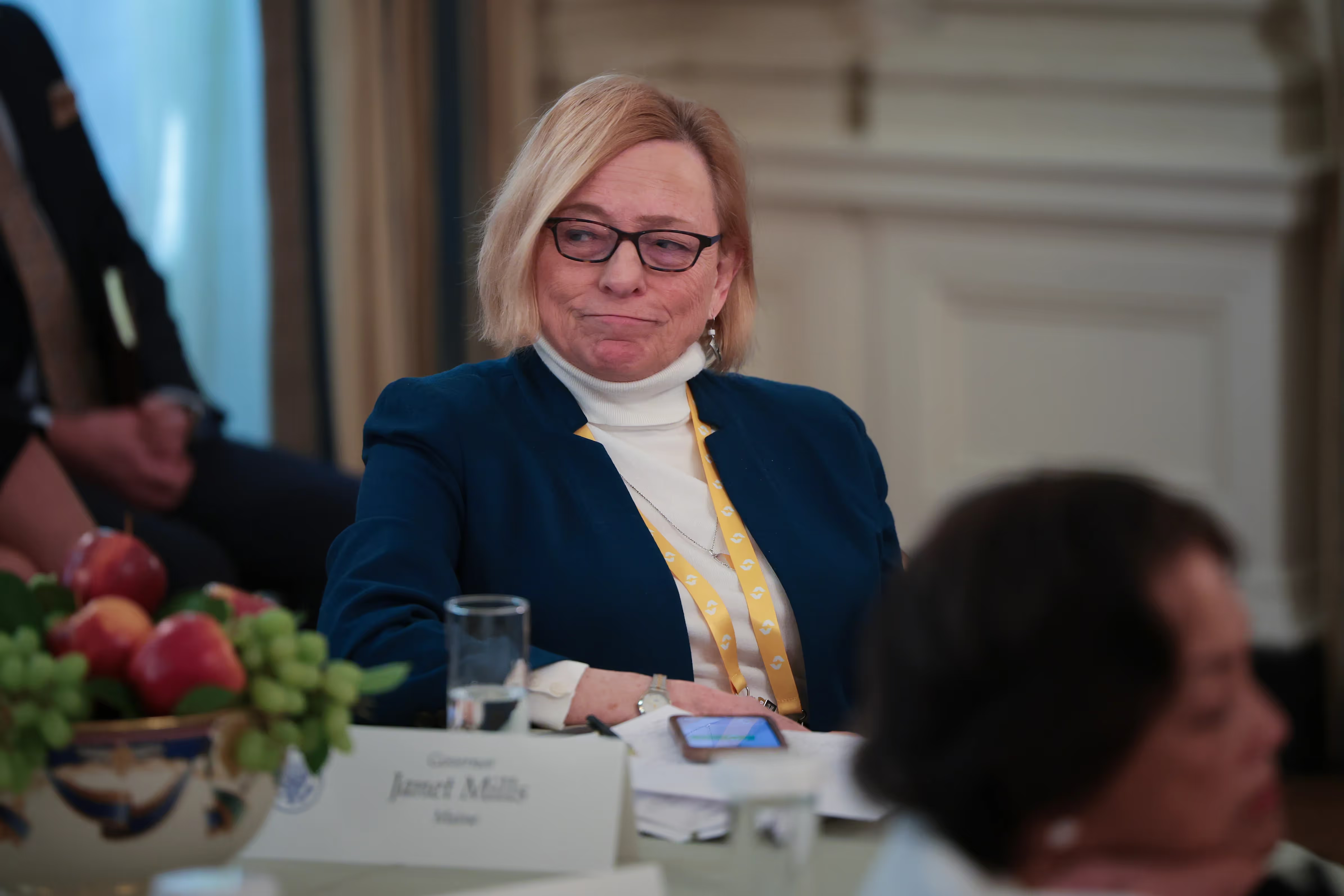
Based on a recent colloquy between President Trump and Maine’s Governor Janet Mills, however, that streak might soon be over.
In an executive order entitled “Keeping Men Out of Women’s Sports” entered on February 5, 2025, President Donald Trump pledged to protect female-only athletics in accordance with Title IX, citing recent federal litigation striking down former President Joe Biden’s gender-expansive approach to women’s equality in publicly funded education programs. The EO notes that “ignoring fundamental biological truths between the two sexes deprives women and girls of meaningful access to educational facilities” and promises to “rescind all funds from educational programs that deprive women and girls of fair athletic opportunities.”
The Maine Principal’s Association, however, which governs school sports in the state, said it would continue to allow trans-identified men to compete with girls because the EO conflicts with state anti-discrimination law. The issue became a public controversy at a White House event last week when Governor Janet Mills confronted President Trump directly after he referenced pulling the state’s Title IX funding for its stance by retorting: “See you in court.” Mills seems perfectly content to put a $250 million government handout at risk for virtue signaling and political grandstanding, but the law is not on her side.
The Article I Spending Clause authorizes Congress to provide for the “general Welfare of the United States,” which includes granting funds to the states. As a condition of these grants, Congress may require states to undertake actions that Congress could not otherwise require of them, such as making changes in state law. For example, in South Dakota v. Dole the Supreme Court held that Congress may condition the award of federal highway funds on a state’s adoption of a minimum drinking age. At the same time, as the Court noted in NFIB v. Sebelius, “[s]pending Clause legislation as ‘much in the nature of a contract,’” means that Congress cannot impose unforeseeable conditions on a contract once it is executed.
Here, the text of Title IX has not changed, only the federal government’s interpretation of its meaning. Regardless of whether the Education Department’s revised interpretation can be applied to funds already dispensed, Maine has no good argument that it may continue to receive federal funds under a now rescinded construction of federal law. As the Supreme Court explained in American Trucking Associations v. Atchison, Topeka & Santa Fe Railway Co., “[r]egulatory agencies do not establish rules of conduct to last forever”; “faced with new developments or in light of reconsideration of the relevant facts and its mandate, [an agency] may alter its past interpretation and overturn past administrative rulings and practice.” So, too, for contracts. The Education Department certainly may adopt a new interpretation of “discrimination” for all future contracts with the states. That is all that has happened here.
First, the Education Department’s new interpretation should come as no surprise to Maine. During the past year, eleven courts halted the Biden Administration’s attempt to rewrite Title IX to include gender identity or gender expression discrimination. Then-candidate Trump made clear that he would rescind the Biden Administration’s transgender interpretation of Title IX, and he has done so. Maine cannot say that it wasn’t warned.
Plus, Maine voluntarily certified to the Education Department that it would follow all Title IX dictates in exchange for federal education funds. That law prohibits discrimination based on sex, and no more. Mills was under no obligation to contract with the government for education funding or to continue to contract with the federal government going forward. But once she did, her state was bound to the dictates of Title IX, which now clarifies the need for and organization of male and female sports teams.
Finally, Maine cannot claim it may follow a state law inconsistent with Title IX and still receive federal funds. As noted above, the Supreme Court held in South Carolina v. Dole that that isn’t how federal contract law works. Maine can keep its law, but the rest of the nation does not need to pay for Maine’s choice. Under the Constitution’s Supremacy Clause, federal law supersedes state law. That also cannot surprise Maine because that clause has existed since 1789.
In sum, Maine’s position lacks merit. Like the highway patrol officers who tell passing motorists at a highway construction site, “There is nothing to see here. Move on. Move on”
Some scholars have expressed concern that revocation of federal funding for violating Title IX would violate anticommandeering principles rooted in the Constitution’s Tenth Amendment. The Tenth Amendment states, “The powers not delegated to the United States by the Constitution, nor prohibited by it to the States, are reserved to the States respectively, or to the people.” Anticommandeering principles, the argument goes, prevent the federal government from directly forcing states or state officials to implement or enforce federal laws or “commandeering" state governments to carry out its policies.
Those scholars are correct that there is a so-called Anticommandeering Doctrine, but they err in claiming that it prohibits the federal government from withdrawing federal educational funds for a school or school system that violates Title IX.
Three Supreme Court decisions are relevant here. In New York v. United States, the Supreme Court held that Congress may not “commandeer” state regulatory processes by ordering states to enact or administer a particular federal regulatory program. Later, in Printz v. United States, the Court expanded that doctrine, holding unconstitutional the Brady Handgun Violence Prevention Act insofar as it directed state law enforcement officers to act as if they were federal officers and conduct federal firearms background checks required by federal law. Finally, in New Jersey Thoroughbred Horsemen’s Ass’n v. NCAA, the Court held that Congress may not forbid a state legislature from revising its state codes to legalize sports gambling. None of those cases involved conditions on the receipt of federal funding, and none of them is inconsistent with South Carolina v. Dole. Each case simply denies Congress the right to treat states like federal agencies by ordering them to enforce (or not enforce) federal law. Title IX does no such thing. It requires a state not to discriminate against women if the state voluntarily elects to receive federal funds. Congress may condition the receipt of federal funds on a state’s willingness to assist in enforcing a legitimate federal policy.
There is a distinction between lawful preemption and unlawful commandeering, to be sure. But the President need not fear Maine’s threat to sue. Revocation of Title IX funding is not only lawful, it’s long overdue.
Sarah Parshall Perry is a Senior Legal Fellow at The Heritage Foundation. Paul J. Larkin is the John, Barbara & Victoria Rumpel Senior Legal Research Fellow at The Heritage Foundation.


Originalism and the 'Barbara' Dissenters
When one steps back and assesses the methodological approach of 'Barbara' dissenters, it’s clear that it was, at its core, originalist.

.jpg)
The Declaration Symposium
Civitas Symposium featuring Gregory Collins, Aaron Nielson, Joseph Postell, and John Yoo


.png)


Get the Civitas Outlook daily digest, plus new research and events.
Get the Civitas Outlook daily digest, plus new research and events.