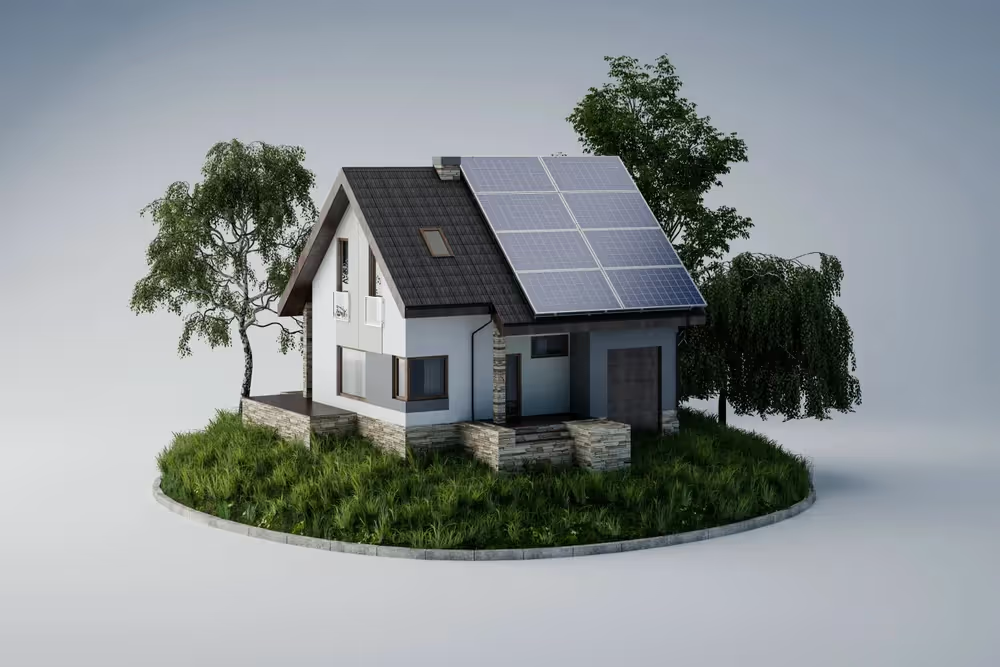
Energy Efficiency Codes Threaten Housing Affordability

Well-off consumers and regulators demand that the rest of America follow their climate and energy preferences. Most Americans shouldn’t have to listen to them.
Building codes are supposed to serve a simple function. They should assure buyers about the safety and functioning of a new home or apartment. Yet in recent years, building codes have become another front in the climate wars, with the government using them to reduce America’s energy use.
Many officials believe that home buyers refuse to recognize the energy costs of a new home, both for themselves and the planet. They think the government should use building codes to mandate energy efficiency requirements, from increased insulation to new types of framing. These mandates substantially drive up housing costs while bringing much lower energy savings than the government assumes.
In America, private associations issue model building codes that are updated every three years. State and local governments adopt these model codes and sometimes add their own requirements. In 2000, the largest of these private groups, the International Code Council, created the International Energy Conservation Code, or IECC, for those who wanted more energy-efficient homes.
Although few governments initially paid attention to the IECC, more states and local governments began adopting it in the next two decades. The IECC became more elaborate and required more costly changes over time. For instance, since 2012, the IECC has required a “blower door” test to see how airtight a house is. One contractor notes that just placing the blower in the door, sealing the house, and measuring the air loss can cost hundreds of dollars. If a home fails for some reason, it can cost hundreds of dollars more to find the problem. After spending even more money to fix that problem, the test must be repeated, which means another charge.
The 2021 IECC update added many costly requirements, such as requiring double-walls or walls with two layers of wood framing. The National Association of Homebuilders estimated that this framing requirement alone would increase housing costs by about $20,000. The rest of the mandates could increase costs by another $10,000. Even government advocates for the codes, in one estimate, assume the 2021 code would add up to $8,000 to the cost of some new homes.
Twenty states and several local governments have adopted a version of the 2021 IECC, but some have gone even further. Rhode Island adopted the 2024 IECC codes before they were finalized. In Minnesota, Governor Tim Walz signed laws requiring that new commercial buildings use eighty percent less energy by 2036 and residential buildings use seventy percent less energy by 2038. One advocate said that by then, Minnesotans will live in a “’near zero’ home” regarding energy use. If homes cannot meet these energy efficiency requirements, they will have to install solar panels or find another way to create their electricity. The costs of these mandates will be much higher than those of the IECC.
State and local governments manage building codes, so the federal government shouldn’t have any role. But in recent years, the federal government has leveraged its vast spending powers to encourage the adoption of more energy efficiency. One method is simply bribing other governments to act. The Inflation Reduction Act provided $1 billion to governments that adopt the latest energy efficiency code or other “zero energy” codes.
Since the federal government provides mortgages for most of the housing market, it can leverage its loans to promote energy efficiency. In 2024, the Biden administration required housing funded by the Departments of Housing and Urban Development and Agriculture to adhere to the 2021 IECC or other new codes.
There is one area where the federal government directly controls building codes. In 1974, Congress allowed HUD to set building codes for mobile or “manufactured” homes to standardize the production of something that looked more like a manufactured product than a typical house built in one place. For years, those codes focused on basic safety, but the Biden administration proposed to apply the 2021 IECC to manufactured homes, even though the code was not designed for them. The Biden administration admitted that the rule could increase the cost of homes by nearly $5,000 in some places, or almost 10% of the purchase price of a “single-section” manufactured home.
Like advocates for all sorts of regulations, advocates of energy efficiency codes claim that the costs are more than offset by the benefits. Advocates of the IECC claim home buyers will make back the extra cost in energy savings in as little as a year or two.
There are many problems with these energy savings claims. For one, they ignore studies that show consumers are aware of energy costs when purchasing. The assumption that regulation brings “gains” to the consumer is based on a belief in fundamental and profound consumer ignorance that is not in evidence as often as regulators think. Studies also show that energy efficiency standards often lead to a “rebound effect,” whereby energy efficiency gains are offset by increased energy use. People use more heat when you make a home more airtight, thus reducing the cost of heating. Regulators also simply and consistently underestimate costs and overestimate benefits.
Finally, energy efficiency rules often fail to differentiate between different types of people and thus disproportionately impact lower-income families. Regulators assume that people value a dollar of energy saving in the future at a certain, stable discount compared to an extra dollar spent on a new home or new product today. The problem is that while well-off people can certainly spend lots today to save later, a person who can’t afford a new home or is on the edge of bankruptcy would really like that money now.
Building codes should return to their basic function of ensuring the safety and functioning of new homes. Those who want to build homes to more energy efficient standards could still do so, but they should not force their preferences on the rest of the nation. Today, well-off consumers and regulators demand that the rest of America follow their climate and energy preferences. Most Americans shouldn’t have to listen to them.
Judge Glock is the director of research at the Manhattan Institute and the author of The Dead Pledge: The Origins of the Mortgage Market and Federal Bailouts, 1913-1939.


On Debt: Two Honest Measures, Two Different Questions
A response to Thomas Savidge's '“Full Faith and Credit” Means a Claim on America.'

Social Mobility Wins
When people live within an environment offering good jobs, good education, social networks, and a culture of self-improvement and hard work, they experience progress in a way that undercuts the philosophical rationale that socialists need to justify the policies they advocate.
Kevin Warsh and the Future of Fed Communication
Warsh is right that the Federal Reserve should not speak so loudly that it hears only its own echo.




Get the Civitas Outlook daily digest, plus new research and events.
Get the Civitas Outlook daily digest, plus new research and events.