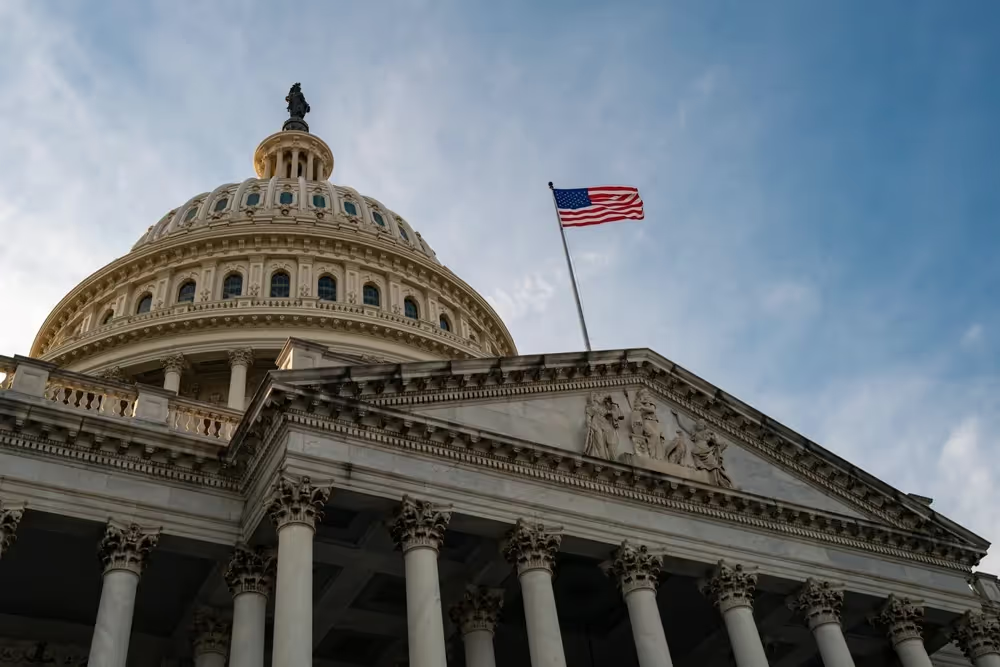
The First Amendment Vise

Congress should seize the opportunity to protect the speech of Americans from both political parties.
It’s been a rough ride for freedom of speech lately. The First Amendment reads, “Congress shall make no law…prohibiting the free exercise thereof; or abridging the freedom of speech.” But tell that to late-night host Jimmy Kimmel or the many Americans removed from various social media platforms during the Biden administration’s efforts to control “misinformation” online during the COVID pandemic.
People on both sides of the aisle are outraged about infringements on speech in legacy media and in the digital sphere. Rightly so.
When Federal Communications Commission Chair Brendan Carr threatened the broadcast licenses of local affiliates if national programmer Disney’s ABC didn’t take action against Kimmel after his remarks about slain conservative activist Charlie Kirk, all hell broke loose, mainly from the political left. But as the law stands, the FCC is empowered to act in “the public interest” regarding news distortion when it comes to renewing broadcast licenses. That now-broad standard began in the 1920s and 1930s, when Congress nationalized broadcast spectrum and placed the FCC in charge of its distribution. The Supreme Court then broadened those powers in 1943 to allow the agency also to determine the “composition” of the content carried over those airwaves.
But what the government giveth, it can certainly take away. And it should.
It's time for Congress to close the FCC. The scarcity argument used to justify government involvement in spectrum licensing in a 1969 Supreme Court case is undoubtedly a relic of the past, if it ever made much sense. We currently speak and hear in a vast world of cable television, social media (I’ll come back to this one), online streaming, podcasts, and satellite radio – none of which are licensed by the government. More generally, the existence of the FCC has been a nearly hundred-year-long failed experiment resplendent with examples of delayed innovation for consumers (decades for the commercialization of cellular phones) and crony capitalism.
It might feel good to some on the right to crush their enemies by using the powers of the FCC to muzzle them, but not only is it barbaric behavior unbefitting public servants of this great nation, but those same powers will surely be used against them when the levers of power change hands.
Congress can ensure this never happens again. The legitimate functions of the FCC can be easily delegated by Congress to the courts to enforce spectrum property rights and to other agencies for specific tasks.
The other free speech news comes from the brave new world of social media. Google’s YouTube sent a letter to the House Judiciary Committee acknowledging that they had, under pressure from members of the Biden administration, removed content from their platform that didn’t violate their own content moderation policies.
YouTube joins Meta’s Mark Zuckerberg in regretting bowing to government pressure to remove “misinformation” from its platform. A patriotic spirit doesn’t inspire the actions of these Internet companies to defend speech, but to be fair, having a federal gun pointed at your head and shareholders expecting to be satisfied is a position few would envy.
Content providers, mostly those of a conservative or government-skeptical bent, who were removed from YouTube or various other social media platforms, are understandably irate. While platforms were affirmed in their right to moderate their private property as they wish by the Supreme Court's decision in NetChoice v. Paxton in 2024, the involvement of government officials makes this a significantly different situation.
Congress also has an opportunity to significantly reduce the likelihood of this happening again. The Foundation for Individual Rights and Expression, a stalwart defender of the First Amendment, has model legislation that would require disclosure of all government communications with social media companies that involve matters of content moderation. Transparency would illuminate who is behind content moderation decisions for millions of Americans and give social media companies some leverage to push back on these government requests.
Members of Congress must put down their speech weapons pointed across the political aisle and act in the interest of the First Amendment rights of every American.
Jessica Melugin is director of the Center for Technology and Innovation at the Competitive Enterprise Institute and a 2023 Innovators Network Foundation Antitrust and Competition Policy Fellow.


On Debt: Two Honest Measures, Two Different Questions
A response to Thomas Savidge's '“Full Faith and Credit” Means a Claim on America.'

Social Mobility Wins
When people live within an environment offering good jobs, good education, social networks, and a culture of self-improvement and hard work, they experience progress in a way that undercuts the philosophical rationale that socialists need to justify the policies they advocate.
Kevin Warsh and the Future of Fed Communication
Warsh is right that the Federal Reserve should not speak so loudly that it hears only its own echo.




Get the Civitas Outlook daily digest, plus new research and events.
Get the Civitas Outlook daily digest, plus new research and events.