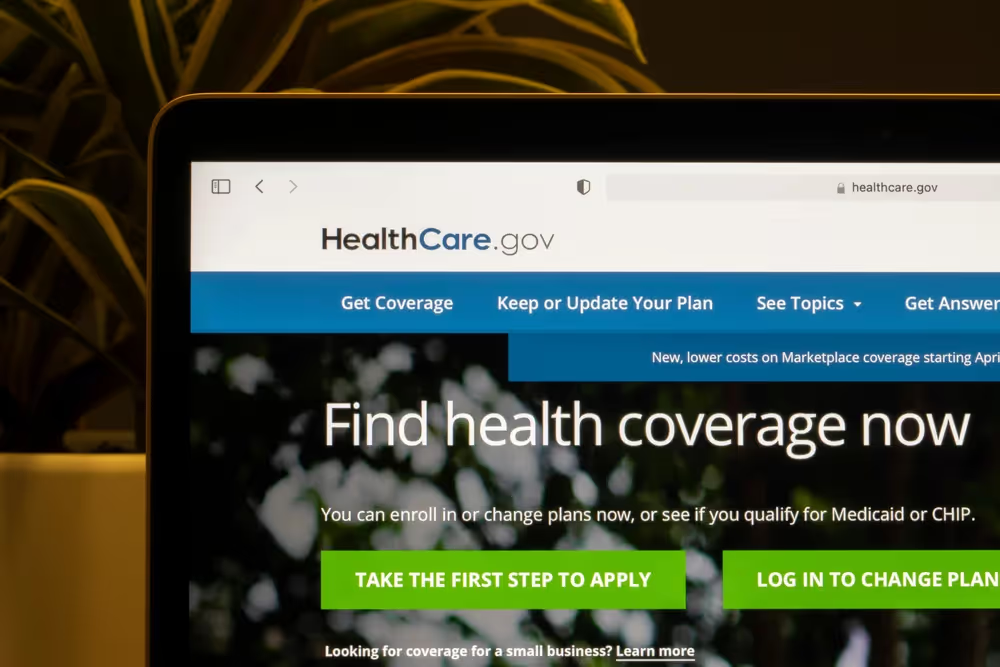
Obamacare Needs Life-Altering Surgery

Obamacare further compromised a faltering healthcare system.
If you think healthcare is expensive now, P.J. O’Rourke once quipped, just wait until it’s free. The recent federal government shutdown over Obamacare once again proves O’Rourke right. The Affordable Care Act (ACA), Obamacare’s official name, has repeatedly shown to be anything but affordable.
To understand the showdown over the ACA’s expiring tax subsidies, it’s important to remember that, as the Washington Post recently reported, Obamacare’s creators counted on uninsured healthy people to flock to the new healthcare exchanges. The enrollment of this group was so crucial that the then-incumbent Obama administration revived voter turnout strategies that twice helped elect the former president — data-driven microtargeting, Internet ad campaigns, door-to-door canvassing, phone banking, and a network of allied nonprofits supporting both paid and volunteer workers. However, even in places like Broward County, Florida, where organizers identified nearly 300,000 uninsured individuals under 45, the Obamacare rollout was described as a “painfully slow grind,” according to a 2014 front-page story by the New York Times White House correspondent Michael Shear.
The young were reluctant to sign up for Obamacare because the law prevented insurers from offering affordable coverage to healthy enrollees. The ACA exchanges were based on the idea that young enrollees would pay higher premiums “to cross-subsidize the deficit created by the enrollment of older people,” according to a 2013 Kaiser Family Foundation report. As a result, neither the Obama Administration’s sophisticated get-out-the-vote targeting nor the law’s (later repealed) penalties for not carrying insurance could “bend the cost curve,” as the ACA’s supporters claimed. Young, healthy people weren’t willing to pay enough for expensive health insurance to make the cross-subsidy scheme succeed. Four years after the ACA was enacted, only 27 percent of enrollees were young adults, well below the Obama Administration’s 40 percent target for that age group.
Instead of addressing the root causes behind rising health insurance premiums, Congress injected funds into the issue. In 2021, lawmakers adjusted the ACA’s income eligibility limits, which had phased out subsidies under the original law for individuals earning over 400 percent of the federal poverty line (FPL), equal to $62,600 for a childless adult and $128,600 for a family of four. In 2022, the Foundation for Government Accountability found that under the new caps, a family of four in West Virginia making $550,000 — twenty times the annual poverty rate—could now obtain insurance that costs taxpayers around $30,000 in subsidies paid directly to private insurance companies. That eligibility ceiling has only increased over the past three years.
As expected, the number of higher-income Americans obtaining insurance through ACA exchanges skyrocketed, rising fourfold from 400,000 in 2021 to 1.5 million in 2024. The COVID-era policy also increased subsidies for lower-income individuals. As a result, private insurers received subsidies that covered the full premium costs for households with incomes between 100 and 150 percent of the federal poverty line. Overall, the Obamacare subsidies provided during COVID are projected to cost $450 billion over the next decade, more than the entire budgets of the EPA and NASA. Whether to extend these subsidies, which are set to expire at the end of the year, is at the center of the federal shutdown.
Healthcare reformers are urging Congressional leaders to leverage the current impasse over COVID subsidies to boost transparency and competition. While few can oppose expanding coverage for low-income Americans, the Foundation for Government Accountability has pointed out that enrollment figures reveal a more complex picture. In Florida, nearly 3 million people within the 100 to 150 percent FPL range are enrolled in Obamacare, which is free for enrollees at that income level. The issue is that this number is four times higher than the total population in the state earning between 100 and 150 percent of the FPL, raising clear concerns about widespread fraud and abuse.
Meanwhile, Avik Roy, chairman of the Foundation for Research on Equal Opportunity and a former policy advisor to Mitt Romney, Rick Perry, and Marco Rubio, is urging lawmakers to loosen the Obamacare regulations that “drive premiums skyward.” Roy explains that the ACA prevents insurers from charging young people age-adjusted premiums. Consequently, young people leave the exchanges, which raises premium costs for everyone and increases political pressure for subsidies.
Roy and other reformers are right that transferring more than half a trillion dollars to private health insurers is not a solution for reform. Besides the flawed incentives of Obamacare, the U.S. healthcare system is full of regulations that raise costs and force Americans to accept expensive, low-quality coverage. One example is regulations that prevent business owners who work for themselves and have no employees from getting private health coverage through professional employer organizations, or PEOs. Many early-stage startups and small businesses offer health benefits through PEOs, which reduce costs by allowing employees to be “co-employed” by the PEO. This shifts the employees from small companies into a larger risk pool composed of employees from various other companies who are also co-employed by the same PEO.
However, business owners with no employees cannot access the PEO marketplace because rules prevent PEOs from considering the owner an employee of their own business. Well-known PEOs like JustWorks instruct business owners to hire at least one full-time employee to gain access to the private benefit marketplace.
However, hiring another employee is a cost that millions of business owners cannot justify. In 2022, the Small Business Administration reported that 27.1 million owner-operated businesses in the U.S. had zero employees. This number includes a wide range of professions, from single-person law and real estate firms to home-repair contractors and gig workers. The ranks of self-employed workers are expected to continue growing as AI and other advanced technologies both reduce employment at large companies and create new opportunities for small business startups. Sadly, the current rules leave many of these sole owners with no viable options besides the ACA exchanges. PEOs should be permitted to compete by offering private health coverage to these business owners.
The inclusion of potentially millions more low-risk insured individuals into the private PEO marketplace will help expand affordable coverage options. It would also encourage more Americans to start new businesses, as concerns about health coverage constitute a major barrier to new business starts. The affordability crisis in healthcare and elsewhere is most effectively addressed through economic growth and entrepreneurial solutions.
Michael Toth is the director of research at the Civitas Institute.


On Debt: Two Honest Measures, Two Different Questions
A response to Thomas Savidge's '“Full Faith and Credit” Means a Claim on America.'

Social Mobility Wins
When people live within an environment offering good jobs, good education, social networks, and a culture of self-improvement and hard work, they experience progress in a way that undercuts the philosophical rationale that socialists need to justify the policies they advocate.
Kevin Warsh and the Future of Fed Communication
Warsh is right that the Federal Reserve should not speak so loudly that it hears only its own echo.


.png)


Get the Civitas Outlook daily digest, plus new research and events.
Get the Civitas Outlook daily digest, plus new research and events.