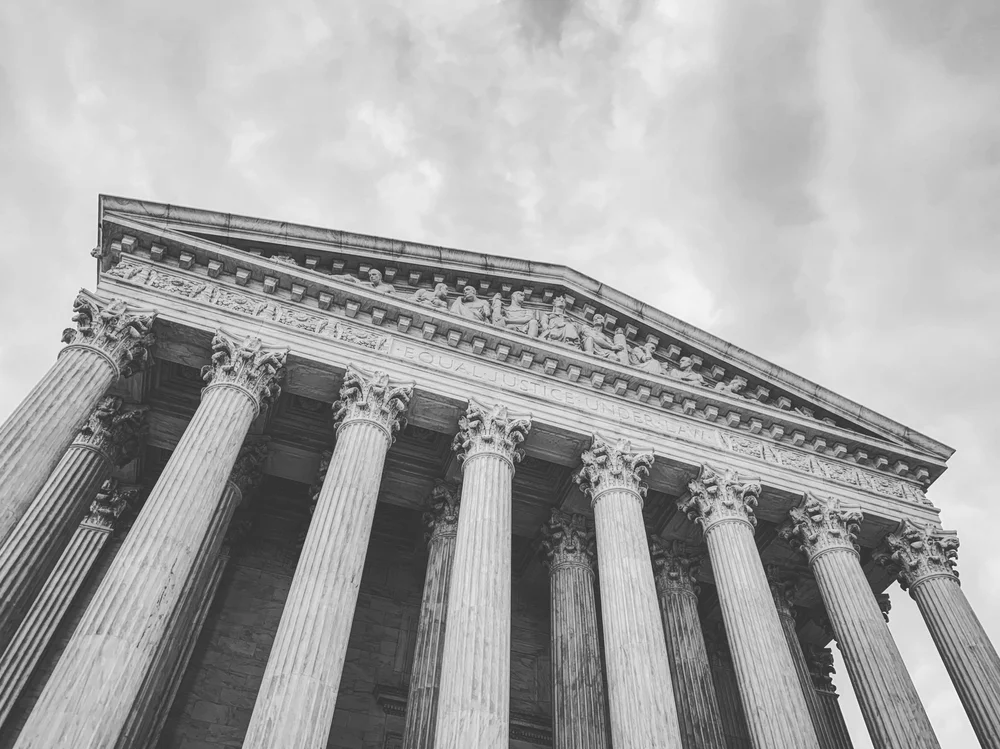
Supreme Court Justly Skeptical of Trump Administration’s Anti-Birthright Citizenship Executive Order

The easiest way for the Court to reject the Administration’s position does not require reaching the underlying constitutional question.
President Donald Trump made the unusual and unprecedented decision to attend the Supreme Court oral argument in United States v. Barbara, the challenge to his Executive Order narrowing birthright citizenship. Trump likely sought to show the justices how much this case matters to him personally. Yet his presence is unlikely to have had the desired effect. Indeed, it may have only underscored how much the case is about his broad assertion of executive power, and not just the Constitution’s view of citizenship.
Section 1 of the Fourteenth Amendment provides “All persons born or naturalized in the United States, and subject to the jurisdiction thereof, are citizens of the United States and of the State wherein they reside.” This language, and the federal statutes enacted by Congress to operationalize it, have long been interpreted to provide birthright citizenship to all born within the territory of the United States without regard for the citizenship, foreign allegiance, or lawful presence of the child’s parents. The only exceptions, recognized since the Amendment’s ratification, were for children of foreign ambassadors, invading armies, and Native American tribes. Therefore, if a child is born in the United States, there is no need to establish the parents' citizenship to recognize that child as an American.
President Trump has long opposed the traditional conception of birthright citizenship. On his first day in office, he issued Executive Order 14,160, “Protecting the Meaning and Value of American Citizenship,” which purported to limit birthright citizenship to the children of U.S. citizens and lawful permanent residents. The EO instructs federal agencies not to issue or accept citizenship documents for children born to temporary visitors or illegal aliens. While prospective only in its application, the EO sought to rewrite the law of citizenship by executive decree, claiming that the decades-old understanding of the Fourteenth Amendment and relevant U.S. statutes was wrong.
The oral argument demonstrated that the argument that children of foreign citizens unlawfully present in the United States are not entitled to birthright citizenship, while ultimately unconvincing, is not as frivolous as some suggest. What it means for one to be born “subject to the jurisdiction” of the United States is not self-evident. At the same time, the oral argument made clear that even if one accepts the revisionist account of the Fourteenth Amendment’s citizenship clause, the Trump Administration’s position remains untenable.
According to Solicitor General John Sauer, the Fourteenth Amendment only extended birthright citizenship to the children of those aliens with “direct and immediate allegiance to the United States,” such as can be demonstrated by “lawful domicile.” Under this interpretation, the Amendment “does not extend citizenship to the children of temporary visa holders or illegal aliens.” Under this interpretation, the Amendment achieved its purpose of guaranteeing the citizenship of freed slaves and their children—overturning the Court’s abominable and ahistorical opinion in Dred Scott v. Sanford—but did not guarantee citizenship for the children of “temporary visitors or illegal aliens.”
While U.S. law has never been applied or enforced consistently with the Trump Administration’s position, Sauer insisted that late nineteenth century scholars agreed with its position. Sauer also urged a narrow interpretation of United States v. Wong Kim Ark, a 1898 decision in which the Court held that a child of non-citizen Chinese parents born in San Francisco was a citizen by birth, and could not be deported under the Chinese Exclusion Acts. While the decision affirmed the longstanding principle that “all children born within the dominion of the United States of foreign parents holding no diplomatic office became citizens at the time of their birth,” Sauer insisted the Court’s holding was limited because Wong Kim Ark’s parents were domiciled in California at the time of his birth (even if they never disavowed their allegiance to China and had returned to China before the case was argued in the Supreme Court).
An extensive body of academic literature, including important articles by originalist scholars such as Keith Whittington and Michael Ramsey and this essay by Judge James Ho, rejects the revisionist view of the Fourteenth Amendment. This research provides strong support for the traditional understanding that the Fourteenth Amendment embraced the common law rule that, with a few narrow exceptions, citizenship follows from the soil and counters the Administration’s crabbed interpretation of what it means to be “subject to the jurisdiction” of the United States. For good or ill, the language of the amendment focuses on the status of the child, not its parents, and has always been enforced as conferring citizenship on the children born on American soil, without regard for their parents’ lawful or prolonged presence in the country.
The easiest way for the Court to reject the Administration’s position does not require reaching the underlying constitutional question, however. Under 8 U.S.C. §1401, any “person born in the United States, and subject to the jurisdiction thereof,” is a citizen of the United States. When enacted in 1940 and again in 1952, this language was understood to adopt the conventional understanding of birthright citizenship and “every statute’s meaning is fixed at the time of enactment,” as the Court reaffirmed in Loper Bright Enterprises v. Raimando (2024). Throughout World War II, children born to Japanese citizens were recognized as citizens, even as their parents were considered enemy aliens. This conflicts with the Trump Administration’s emphasis on “allegiance.”
For decades, all three branches have consistently interpreted Section 1401 to embody the conventional understanding of birthright citizenship. The U.S. Reports are filled with Supreme Court decisions that simply assume that all born in the United States are citizens, without regard to their parentage. Accordingly, that interpretation should be entitled to statutory state decisis even if one believes the conventional account is wrong. Thus, the Court could simply hold that the Trump EO conflicts with federal law and leave it to another day whether Congress could enact a law withdrawing jurisdiction over illegal aliens or temporary visitors. After all, the Constitution entrusts Congress with the power to make laws concerning naturalization and to enforce the Fourteenth Amendment. Such enactments cannot be adopted by executive fiat.
Although resolving Barbara on statutory grounds would seem to be the path of least resistance, few of the justices (other than Justice Gorsuch) pressed the point. Asked by Justice Kavanaugh whether Congress had room to adopt legislation defining what it means to be subject to the jurisdiction of the United States, Sauer confessed he was “thinking about it for the first time,” and that it did not matter because the Administration insisted the Constitution and Section 1401 mean the same thing. Sauer also effectively conceded that the Administration should lose it if the Court did not accept its crabbed interpretation of Wong Kim Ark, too.
As one might have anticipated, Justice Samuel Alito seemed most inclined to accept the Solicitor General’s arguments, but some of his questions nonetheless revealed the weakness of the Administration’s case. At one point, he pressed the ACLU’s Cecilia Wang on the implications of accepting that the Fourteenth Amendment’s “subject to the jurisdiction” as equivalent to “not subject to any foreign power,” which is the language contained in the Civil Rights Act of 1866. He offered a hypothetical: “A boy is born here to an Iranian father who has entered the country illegally. That boy is automatically an Iranian national at birth, and he has a duty to provide military service to the Iranian government. Is he not subject to any foreign power?” However, one responds to this hypothetical, there is no question how such cases have been handled under federal law. The treatment of the Japanese during World War II is again instructive. The citizenship of those born on U.S. soil has long been recognized without regard for the parents’ alleged—or even demonstrated—foreign allegiance. And even under the Trump EO, lawful permanent residents are not required to disavow their allegiance to the countries from which they hail for their children to be recognized as citizens (though there may be consequences for those who enlist in hostile foreign armies).
An obvious question for the SG was what upholding the EO would mean for those in the country who cannot trace their lineage back to a lawful permanent resident. Pressed on the point, Sauer stressed that the Administration was only asking for prospective relief. That may be, but it is no answer to the constitutional question. If the reason for the EO’s validity is that only children of citizens and lawful permanent residents are birthright citizens under the Constitution, a ruling in favor of the government would cast a pall over millions of Americans whose citizenship has long been taken for granted. Sauer’s pledge that the Administration would not pursue such claims is cold comfort, as legal questions about the citizenship of such people would inevitably arise (as would questions about how to determine “domicile”—as Justice Amy Coney Barrett noted at the oral argument).
President Trump may have attended the argument to shore up votes for his position and avoid a replay of the tariff case, in which a top administration priority was rejected by a majority of the Court. After the argument, he appears due for another disappointment. While one should be careful reading too much into oral argument, it is hard to see how the Administration can count to five votes for its position. It will be lucky to get more than two. Whatever one thinks of the policy merits of the Administration’s citizenship position, the legal case presented to the Court is weak.
Jonathan H. Adler is the Tazewell Taylor Professor of Law and William H. Cabell Research Professor at the William & Mary Law School.

.jpg)
The Declaration Symposium
Civitas Symposium featuring Gregory Collins, Aaron Nielson, Joseph Postell, and John Yoo
The Birthright Citizenship Decision Will Not End the Birthright Citizenship Debate
It is unlikely that Trump v. Barbara ended the debate over birthright citizenship. It may have truly started it.
The Declaration and Tradition
As we approach America’s 250th anniversary, we should reflect upon and appreciate the Declaration’s opening paragraphs—but we should not forget to remember the rest of the document or the context in which it was created.

.JPG)

Get the Civitas Outlook daily digest, plus new research and events.
Get the Civitas Outlook daily digest, plus new research and events.