Celebrating Passover in Communist Exile

Celebrating Passover under communism was a dangerous endeavor. Author Julia Geran Pilon offers a vivid recollection of events in an excerpt from her upcoming book.
Editor’s Note: This is an excerpt from the author’s upcoming book Notes from the Other Side of Night: From Communism to a Fragile Freedom (Creed & Culture, 2026).
Although it wasn’t Sunday, my father didn’t go to work. I liked the day because we could spend it together and we would have a special dinner, with food we could not always afford. My father would bring home some delicious biscuit called “pasca,” packed in a box with strange letters on it. He would buy it in an unusual place, a dark little room in a building quite far from where we lived. The room was not at all like a store—only boxes of this biscuit everywhere—and the people were all very quiet, hardly looking at each other. My father would pick up the package quickly then leave, holding me by the hand very tightly, as if afraid he might lose me. For the special dinner we also had a large piece of meat for a main course, and even wine. I really would have liked to know what this festivity was all about.
My sister was curious about the funny letters on the matzo box, so my father told her it was Chinese. Zionism, like fascism, was considered illegal; it would have been dangerous to let her know there was “Zionist” writing in our house, since she was too small to remember what not to say. I trustingly, if unimaginatively, took the “biscuit” to be some kind of especially nourishing imported food, though it did seem strange that we ate it only once a year. “Maybe that’s the only time it’s available,” I reasoned, well versed in socialist rules of supply and demand.
I admit it did seem a bit strange that my father did not go to work for a whole day, but I didn’t demand any explanation. Since it was not always on the same date, I couldn’t consider it a regular holiday like November 7, the anniversary of the Soviet Revolution. I did notice it was a spring-time celebration, and wondered whether such a special dinner was possible only when “pasca” was sold. But why make a big fuss over a mere cracker? I might have understood it better had we celebrated some fancy dessert, or tangerines, but “pasca”?!
Yet undoubtedly a holiday it was: my mother risked her best white tablecloth, so easily stained by diners like me and my sister, whose appetite was exceeded only by our oft-demonstrated clumsiness. Scrubbed and starched, the white linen seemed stiffly uncomfortable with us children, its own venerable identity reflected in an elaborate (and very difficult to iron) pattern of three letters. My mother had told us it was a “monogram”— which reminded me of “telegram = a very important message.” What enigma did the tablecloth conceal? Maybe it could not be revealed to just anyone, such as mere kids. The same cipher appeared on the napkins, providing one more (if not the only decisive) reason my sister and I consistently shunned them.
And then, of course, the curious candles. We especially liked the way they were lit: three little candles placed close together to be kindled at once. It made for an unusual effect. (I assumed there had been no larger candle in the store, and this was my mother’s way of improvising. How such practical explanations eliminate the need to wonder about symbol. . . .) Their peculiar smell stayed with us throughout the special dinner, blending with the others, yet never fully obliterated.
What smells they were, too! First, it is true, we had to finish some odd appetizers: radishes (with stems; my mother never allowed it on other days . . .), parsley, which I pretended to eat but managed to hide under my spoon when no one was looking, and part of a boiled egg (divided in four so that everyone could have some; usually my sister and I were given all of such scarce wholesome food). Then the real feast began. Chicken soup with several whole dumplings, richer than usual. And then a whole chicken, for only one meal, prepared with wonderful spices and a thick sauce. (My mother was an expert at using one chicken for at least three meals; but this time she really splurged!) Last came the biggest treat: dessert. My sister and I were given a small bar of chocolate each—the only time we had it, the whole year. Knowing how expensive it was, we munched on it slowly, waiting for it to melt from the heat of the tongue. I remember now that we never offered even a bite to my parents. It seems that we simply assumed grown-ups don’t like the same sorts of things kids do. After all, they drank that wine we didn’t particularly care for, and they seemed to enjoy it a lot. Remarkable, what rationalizations we selfish little creatures were able to believe.
It would have been impossible, of course, to overlook the importance of the special dinner. But it was especially difficult to do so in light of my father’s peculiar behavior at the table. Before the meal, and also at the end, he would read from a book something we couldn’t understand. He didn’t seem to be addressing anyone, just whispering to himself. The book, I noticed, was full of the same kinds of letters as the ones printed on the “pasca” box. I was so curious about the coincidence, I kept hoping to get the book off the shelves and examine it at my leisure for some clue. Since my father had many unusual volumes, including some leather-bound ones which, he said, had “Gothic letters,” I was already used to eccentric reading tastes. But why could I never find that book? Somehow I knew there had to be a reason, and asking about it would not have been wise. Then one day, very unexpectedly, part of the mystery unraveled. While searching through an old box at my grandma’s house I found a magnificent tome, with golden-edged pages, its cover made of thick ivory. As I opened its finely sculpted clasp, I froze: there they were, the same letters. I ran to grandma to ask what it was, this lovely book. “Why, the Bible!” she answered, and put it away immediately, in a safer drawer, which she locked twice. I had never seen a “Bible,” but I knew it was some kind of forbidden object. “It probably shouldn’t be translated,” I thought. But what would my father be doing with a book written like the Bible? And why the strange writing on that biscuit?
Perhaps it was best not to wonder.
So I did not know that what my father said as he drank the wine was this:
Blessed art Thou, O Lord our God,
ruler of the world,
who has kept us alive, maintained us, and enabled us to reach this occasion.
And as he uncovered the matzo:
This is the bread of distress which our forefathers ate in Egypt.
All who are hungry—let them come in and eat.
All who are ready—let them come in and celebrate the Passover. Now we are here.
Next year may we be in the land of Israel! Now we are slaves. Next year may we be free men!
And why do we eat the bitter herbs?
It is because the Egyptians embittered the lives of our fathers in Egypt.
As the Holy Scriptures say:
“They made their life bitter with hard labor: with bricks and mortar, with all kinds of work in the fields, all of this forced labor being rigorous.”
In every generation a person must see himself as though he, personally, came out of Egypt.
As the Holy Scriptures say:
“You shall tell your son on that day
‘This is because of what the Lord did for me when
I went forth from Egypt’.” It was not only our forefathers that the Holy One, blessed be He, redeemed, but He redeemed us, too, with them.
As it is said:
“He took us out from there, in order to bring us hither and to give us the Land which He had promised to our fathers.”
My sister and I didn’t like the parsley. My parents ate it slowly, as if savoring each leaf.
The prayers went on:
I wish the lord would hear my voice, my supplications.
For since He has listened to me, in all my days I shall call on him. When the pangs of death are upon me, when I find nothing but trouble and sorrow, then I shall call out the name of the Lord: “O Lord, release my soul!”
For the Lord is gracious and righteous, the Lord is merciful.
The Lord guards the simple; when I was poor He helped me.
Let my soul return to rest, for the Lord has done well with it. Since Thou hast saved me from death, my eye from tears, my foot from stumbling,
I shall walk before the Lord in the lands of the living. I have believed in Him even when, deeply hurt, I spoke and said in haste: “All men are deceitful.”
The words could not have been meant literally. If “all who are hungry” had come in to eat, even if that referred only to people we knew, we would have had a small crowd: the ex-language teacher, a widow who lived across the street, whose sole income was a state pension that did not stretch far beyond her daily potatoes; my classmate with ten siblings—most of them male and endowed with voracious appetites—who never brought lunch to school (when I once tried to help her with homework she smiled a little sadly and said: “I’m just too tired . . .”); the sweet blue-eyed woman who ironed our large sheets for a nominal fee, who had been in prison a year for stealing a loaf of bread. (She had been charged with “sabotage.”)
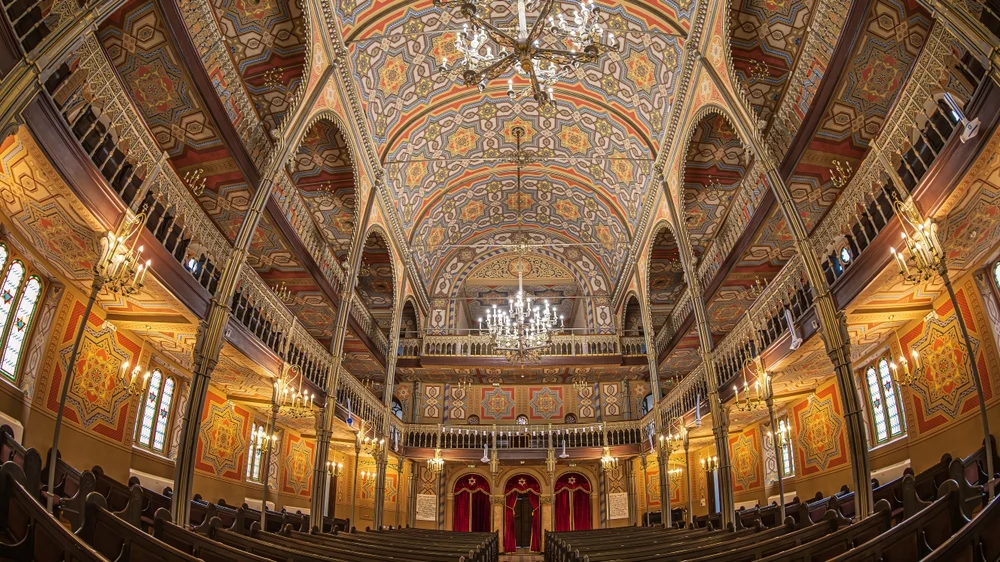
“All who are ready” to celebrate the Passover—I had never realized how many people were not only ready but eager to celebrate it, until the entire family went to the largest synagogue in Bucharest. (My sister and I were not told it was a “synagogue”; it was still too soon to be entrusted with such ideas, especially as it would have meant having to tell us so much more, and there was no easy way. . . .) Hundreds, perhaps thousands of people were there. No one moved, so as to hear everything that was being said inside. My family could not get even a glimpse of the interior but had to stand in the courtyard. I remember nothing of the building, because of the darkness and the fascinating impact of the people: their faces are imprinted on my memory indelibly, with the hard ink of shock and exhilaration. Strong, determined faces, thick eyebrows crowning angry eyes. They sang, too, and I so wanted to join in! We were so many, many more than I had thought! All ready to celebrate.
At the time of our visit to the synagogue, I had not been aware of the fact that for seventeen years or so my father had always chosen the same day to go to inquire about the progress of our emigration proceedings. That day was Yom Kippur, the Day of Atonement. In 1961, this would have been the start of 5722. It so happened that the purpose of our going to the synagogue had been to celebrate that particular holiday. We had never done it before, but suddenly we had a special reason: on that very day we had received our permission to emigrate to the West. My parents were no longer afraid for us.
“Blessed are Thou, O Lord our God, ruler of the world, who has kept us alive, maintained us, and enabled us to reach this occasion.” The words of the Passover feast had no immediate meaning for me at the time; and yet, even without knowing what my father was saying, even without explanations, we all shared the knowledge that we had our very own holiday, that the state could not—however much it wanted to, for the sake of public unity—destroy our private celebration; it could not deny that we felt very special about the occasion. When we children found out the name of our feast, we had already crossed the big sea, eaten lots of bread dipped in sour milk, and the bitter herbs were beginning to taste quite sweet. We learned about the prayers, too, and were not in the least surprised that the Lord had no name.
Juliana Geran Pilon is Senior Fellow at the Alexander Hamilton Institute for the Study of Western Civilization.


Mansfield’s Insufficient Protest
Harvard’s failings are not episodic but systematic and rooted in a view of the human person that Mansfield himself has consistently tried to resist.
Anger Management
Jonathan Turley’s 'Rage and the Republic' stands out as a worthwhile addition to the growing list of books on the Revolution.
.jpg)
Ivy League Miseducation
Stefanik is not wrong at all in pointing out what ails higher education. However, her scope is extremely limiting, and her approach rather superficial.
.jpeg)



Get the Civitas Outlook daily digest, plus new research and events.
Get the Civitas Outlook daily digest, plus new research and events.