
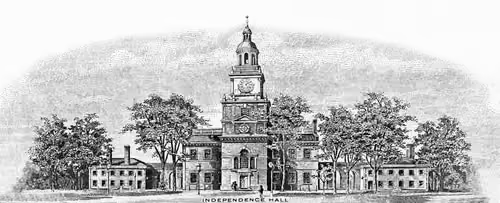
The Declaration and Tradition

The Declaration’s principles cannot be isolated from its practical, political circumstances.
As the Declaration of Independence’s 250th anniversary approaches, Americans are confronted with fundamental questions about the document’s role in our nation’s identity. Do the Declaration’s assertions that we are all “created equal” and “endowed by our Creator with certain unalienable rights” commit us to anything besides abstractions? Are they supposed to shape America’s political and legal development? 250 years later, we are not so sure about any of this. As we celebrate our nation’s anniversary, we can restore a proper appreciation of the Declaration by reading it in light of its historical context. Doing so doesn’t limit the Declaration but reminds us that its principles are grounded in a rich Anglo-American tradition, which provides concrete context for how the Framers understood the Declaration’s ideals to manifest in practice, and for how they approached their resistance to the tyrannical proclivities of British parliamentarians. It should also guide our deliberations as a self-governing people.
In our contemporary public discourse, many ignore the Declaration’s opening claims. That attitude was displayed last year by Virgina Senator Tim Kaine, who found it “extremely troubling” to hear that our rights do not come from government. Kaine later explained that “claiming that all rights come from the Creator and not from laws or government [allows] dictators to ignore the law and simply proclaim that they are doing God’s will.” For those like Kaine, then, the Declaration’s claims are mere abstractions that are “essentially meaningless.” On the other hand, there are those who try to stretch the Declaration’s principles far beyond their true meaning, thereby turning the Declaration’s commitment to liberty into a justification for moral relativism. This sort of overreading is captured by Justice Anthony Kennedy’s notorious statement in Planned Parenthood v. Casey that “at the heart of liberty is the right to define one’s own concept of existence, of meaning, of the universe, and of the mystery of human life.”
These attitudes take sharply different approaches to the Declaration—one ignoring it, the other overreading it—but they start from and end up in much the same place. Both approaches fail to recognize the practices that gave character to the Declaration’s principles, and thus neither one appreciates the Declaration for what it is. The result is that many Americans today miss what Professor James Stoner identifies as having made the Declaration’s truths self-evident to the founding generation: “the English constitutional tradition, or at least the common law rights and liberties of that tradition, which the Americans claim as their rightful heritage.”
The History and Tradition of the Declaration
The Declaration’s first two paragraphs articulate a noble vision of our nation’s commitment to individual liberty—a commitment that asserts the equal and God-given right of every person to life, liberty, and the pursuit of happiness. This understanding makes clear that our most fundamental rights do not come from the government. They are inherent to us as a matter of “the laws of nature and of nature’s God,” rooted in a duty to pursue virtue, and, in Lincoln’s words, “applicable to all men at all times.”
These commitments did not simply emerge in 1776, but follow from what the Declaration calls “the forms [of government] to which the [Americans] are accustomed.” As Thomas Jefferson himself expressed, “the object of the Declaration of Independence” was not “to find out new principles” or to aim “at originality.” Rather, “it was intended to be an expression of the American mind.” To fully appreciate the Declaration’s principles, we must look to the customs, practices, and institutions that shaped the “American mind.” Indeed, the colonists themselves relied on English constitutional tradition, devoting much of the Declaration’s focus to specific infringements on their way of life.
Among the colonists’ complaints were Parliament’s actions “depriving [them] … of the benefits of trial by jury,” “altering fundamentally the forms of … government” through impositions such as the Massachusetts Government Act and the Administration of Justice Act, and “imposing taxes … without … consent.” In each of these cases, the colonists deployed sophisticated legal arguments to explain how Parliament had violated longstanding British practices and constitutional standards on royal charters, judicial independence, and the limits of parliamentary authority. These tradition-based arguments for independence, alongside widespread admiration for the British system, have led scholars to often frame the American Revolution as a “restoration.”
To be sure, certain colonists were deeply ideological and populist. However, John Adams’ iconic representation of redcoats after the Boston Massacre embodies the American Revolution’s tremendous respect for the rule of law. And Alexander Hamilton’s principled defense of loyalists, both before and after the revolution, highlights a similar commitment. Both men may have been staunch advocates of independence, but for them, revolution could not be justified on purely rationalistic grounds; the preservation of institutions, legal order, and tradition was equally important. Time and again, America embraced that disposition.
With British common law as a template, the new nation incorporated crucial elements of the British system. As Prof. Stoner has pointed out, “nearly every grievance detailed in the Declaration is addressed and prevented by a specific provision of the Constitution.” After ratification, George Washington’s administration, energized in large part by Hamilton, advanced a prudential approach to governing that created institutions modeled on those of Britain—including the First National Bank and the presidency itself. And by rejecting Jefferson’s hyper-rationalist commitment to Enlightenment ideals, which led him to prefer “see[ing] half the earth desolated” to the French Revolution failing, Washington’s pragmatism allowed him to remain clear-eyed in foreign policy decisions.
There is much to learn from this history of the Declaration and the early founding: philosophical principles are important, but they can, and should, be illuminated by our longstanding practices. Our Founders knew this. Uncovering the scope of our rights and applying them to a political context requires gleaning insight into human nature—and that, in turn, requires drawing on our experiences and traditions. When we overlook the Framers’ practical and tradition-focused approach to independence and how the Declaration ties individual liberty to a way of life possessing long roots in Anglo-American history, we risk treating the Declaration’s principles as an invitation to define individual liberty as something completely divorced from its foundation—namely, “the laws of nature and nature’s God.”
Implications: Free Exercise Law as a Case Study
The abstracted approach to individual liberty encouraged by conventional misunderstandings of the Declaration has practical consequences. As our conception of natural rights has strayed from their origins, their rationales have become more ideological, excessively individualistic, and increasingly out of touch with the understanding of rights that America inherited. Such was the case in the mid-twentieth century, when the Supreme Court began the “rights revolution.” The result was a First Amendment that was dissonant with its original meaning.
In 1943, the Supreme Court decided West Virginia Board of Education v. Barnette, justly protecting Jehovah’s Witness children from being forced to salute the U.S. flag against their religious beliefs. Although the Court clearly came to the correct conclusion and rightly sought to avoid the “coercive elimination of dissent,” elements of its discussion cast the Founders as espousing “a philosophy that the individual was the center of society.” That framing, however, was unfounded. Whereas the colonists invoked the Declaration’s principles with reference to concrete and longstanding practices, the Court did not ground its claims in the history underpinning the First Amendment. The Court’s individualistic approach failed to grapple with how the Western tradition has long understood religious liberty: not as a freedom of “self-determination in matters that touch individual opinion and personal attitude,” but an understanding of religious duty as transcending civil authority and therefore falling outside its jurisdiction entirely. In the American context, it is most prominently reflected in James Madison’s Memorial and Remonstrance’s recognition of “the duty which we owe to our Creator and the manner of discharging it.” That “unalienable right” cannot be “abridged by the institution of civil society.” Rather, “religion is wholly exempt from its cognizance.”
By replacing the jurisdictional understanding of religious liberty with an individualistic one, Barnette’s rhetoric opened the door to pushing the First Amendment’s guarantees beyond their intended scope and embracing a kind of moral relativism. The Supreme Court’s reasoning that “one man’s comfort and inspiration is another’s jest and scorn” would be echoed decades later in Cohen v. California—where the Court suggested that “one man’s vulgarity is another’s lyric.” This logic has been extended to protect activities clearly lacking virtue or value—including, perhaps most notably, videos depicting the torture of animals. Such thinking, however, is clearly at odds with states’ early practices and runs contrary to the framework that informed the Founding generation’s views on natural rights.
The outgrowth of overly individualistic conceptions of liberty, buoyed by moral relativism, begot an abstract idea of government “neutrality.” This is in part what Father Richard John Neuhaus famously called “the naked public square.” It is epitomized by Supreme Court decisions such as Lemon v. Kurtzman and Employment Division v. Smith, both of which divorced religious freedom from its historical roots and instead conditioned the First Amendment’s Religion Clauses around abstract tests that sought to push religious life out of the public sphere. As the Lemon Court asserted, “the Constitution decrees that religion must be a private matter.”
Although the Court has recently abandoned its ahistorical Lemon test, Smith continues to hinder the protection of free exercise by permitting laws burdening religious exercise to pass constitutional muster so long as state officials can frame them as “neutral” and “generally applicable.” This one-size-fits-all approach to adjudicating religious liberty cases further cemented a legal understanding of religious duty as one of many rights for which the state issues a permission slip, rather than a transcendental obligation that lies entirely outside the state’s authority.
The Court has in recent years circumvented Smith and moved toward a more historically rooted approach to the Free Exercise Clause. In Hosanna-Tabor v. EEOC and Our Lady of Guadalupe, for example, the Court restored a sphere of autonomy for religious institutions. There, the Court refused to apply Smith’s neutrality and general applicability criteria, instead looking to “the background that the First Amendment was adopted” against. More recently, the Court again bypassed Smith in Mahmoud v. Taylor. Drawing on an “enduring American tradition,” the Court explained that the ability of parents to direct the religious formation of their children receives special consideration. These decisions have reanchored religious liberty protections in the Court’s original meaning and allowed for lower courts to follow suit.
Still, the consequences of twentieth century precedent persist. Just as we tend to overlook the historical tradition underpinning the Declaration, Smith’s lingering presence continues to abstract the First Amendment’s commitment to religious liberty, unbounded by the tradition that gave it meaning. As the Court corrects its errors by embracing text, history, and tradition, American law and culture should be inspired to approach the Declaration in a similar way. Our principles cannot be discerned in a vacuum; that is as true for American culture as it is in legal cases.
In many circles, it has become fashionable to treat the Declaration of Independence as a pocket-sized philosophical treatise aimed at proclaiming universal truths a priori—a kind of appendix to Locke’s Two Treatises of Government. But the truth is that the Declaration’s principles cannot be isolated from its practical, political circumstances and the rich history and tradition that the people who drafted it were invoking and seeking to preserve. When America has failed to appreciate that reality, it has strayed from the very ideals the Declaration champions. As we approach America’s 250th anniversary, we should reflect upon and appreciate the Declaration’s opening paragraphs’ beautiful language and lofty ideals—but we should not forget to remember the rest of the document or the context in which it was created. By looking at the Declaration more fully, we can reorient our natural rights framework to align with our Framers and learn how to live out its ideals. And we would set ourselves on the path of fully restoring the First Amendment to its proper place in our ordered system of liberty.
Edward Zelikman is a paralegal at the Becket Fund for Religious Liberty and an incoming J.D. candidate at Harvard Law School. The views expressed in this piece are his own and do not necessarily reflect the views of the Becket Fund or its clients.

.png)
Farewell to the President’s New East Wing
Both Congress and the President have acted in violation of the public trust doctrine.
The Constitution and Birthright Citizenship: A Rejoinder to Professor Yoo
Foreigners can come to America and become “Americans” not by their mere presence on American soil but by embracing the principles upon which this country was founded.

.jpg)




.png)
Get the Civitas Outlook daily digest, plus new research and events.
Get the Civitas Outlook daily digest, plus new research and events.