Justice Thomas’s Bulwark of Liberty
Justice Thomas rightly regards natural rights as the foundation of our civilization.
Associate Justice Clarence Thomas, in his remarks at the University of Texas at Austin, offers a passionate defense of a strong theory of natural rights that he rightly regards as the foundation of our civilization. The theory of natural rights, which he defends, has been in retreat for at least one hundred years, as he notes, because of the strong progressive theories of government, first embraced on these shores by Woodrow Wilson, that seek to place the state first and the individual second. Regrettably, that embrace leads to the view that the rights of individuals within the state derive from the government in a two-step process. First, the political institutions determine what the preferred set of rights should be through a dubious, undemocratic process, after which a team of administrative experts figures out the key moves that translate that grand vision into a powerful on-the-ground reality.
Justice Thomas is right to express his disdain for this process because it lacks the one ingredient that makes the creation of a prosperous, free, and democratic state possible. It is natural right precepts that ground the protected rights of all individuals, great and small, which then offer the only bulwark against a political system that constantly seeks to undermine these rights through various egalitarian desires, ploys, and exercises of majority power. There is much written about voting rights, and it seems clear that a “Republican Form of Government,” which Justice Thomas did not explicitly reference in his speech, goes to great length to avoid the earlier democratic ideal that allows the preferences of a simple majority to overrule the rights of any-and-all minorities within the state or territory which is why so much of Jim Crow started around the ballot box. Republicanism, which in both classical liberal theory and the Guaranty Clause, Article IV, Section 4, begins with these words:
The United States shall guarantee to every State in this Union a Republican Form of Government
At the founding, there was much disagreement over the safeguards required to prevent simple majorities from wiping out minorities: two houses of government, federalism, an electoral college, the indirect election of senators, and an independent jury system. As is so often the case institutional safeguards in one generation are regarded as sources of abuse in the next, so that even within the class of electoral, structure, and substantive guarantees, there are huge debates as to how these are best protected, but the Wilsonian synthesis gave no quarter to any of these protective devices and so we had under the Wilson administration, a premonition of the dangers of civilization to come. It was Woodrow Wilson who thought that the separation of powers just slowed down the wise experts who ran the government. It was that same Wilson who decided in 1913 to resegregate the Civil Service, and it was the newly formed NAACP that concluded that no legal remedy was available under the current law. It was the Wilson administration that led the criminal prosecutions during the Red Scare that led to the imprisonment of Eugene Debs, but it was Warren Harding, far less admired today, who released him on the recommendation of his own Attorney General, Harry Daugherty. It was also Wilson who, with the Webb-Pomerene Act, allowed American industries to form export cartels that could only disrupt the sensible flow of international trade. But those results can be expected when the new administrative state gives at best lip-service to the Declaration of Independence’s claim that: “We hold these truths to be self-evident, that all men are created equal, that they are endowed by their Creator with certain unalienable Rights, that among these are Life, Liberty and the Pursuit of Happiness.”
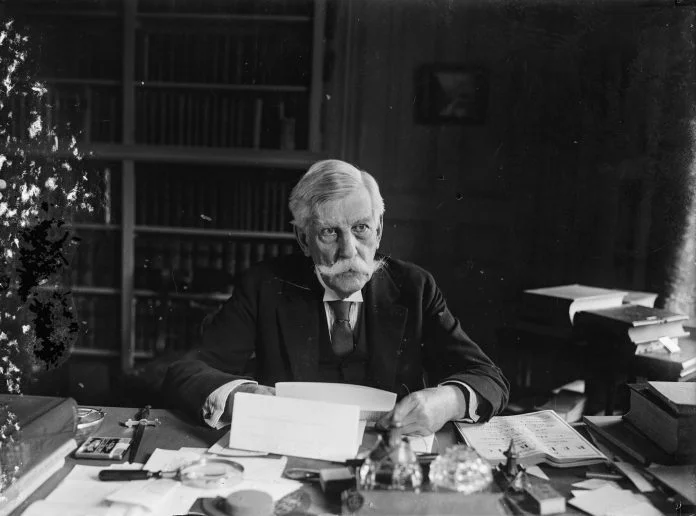
But it was not just the political organs that changed the rules of the game; it was also the increasing skepticism about the universal durability of legal principles. Throughout the nineteenth century, American jurists, led by Justice Joseph Story, recognized the universality of the principles of natural law as embodied in customary international law. These rules were the glue that helped stabilize relationships across nations through constant contact, some friendly, some not. But in a sentence in one such case, Justice Oliver Wendell Holmes dismissed all that accumulated with wisdom, one well-turned barb when he wrote that “The common law is not a brooding omnipresence in the sky, but the articulate voice of some sovereign or quasi-sovereign that can be identified.” Holmes set the stage for ignoring this body of laws, shifting the needle toward a system of explicit positivism that removed the conceptual glue and thus one bulwark against Wilson’s reliance on the administrative state. Justice Thomas’s speech reminds us of how much we have lost.
Richard Epstein is a senior research fellow at the Civitas Institute at the University of Texas at Austin. He is also the inaugural Laurence A. Tisch Professor of Law at NYU School of Law, where he serves as a Director of the Classical Liberal Institute, which he helped found in 2013.
Symposium on Associate Justice Clarence Thomas’s Remarks on the Declaration of Independence
.webp)
Reclaiming Our American Inheritance
Thomas’s message is the same insight Abraham Lincoln invoked against Chief Justice Taney’s sophistry in the Dred Scott decision.

Three Generations of Living Constitutionalists Is Enough
Justice Thomas radiates a fundamental sense of decency, humility, and respect for the dignity of every human being—he lives the virtues of which he speaks.

.webp)
The Declaration’s Truths Heal a Multitude of Errors
Attacks on the Declaration from both the left and the right deny the universal character of its self-evident truths and their foundation in natural law.

.jpg)
.jpeg)


Get the Civitas Outlook daily digest, plus new research and events.
Get the Civitas Outlook daily digest, plus new research and events.