
An AI Commencement Address That Might Not Elicit Boos

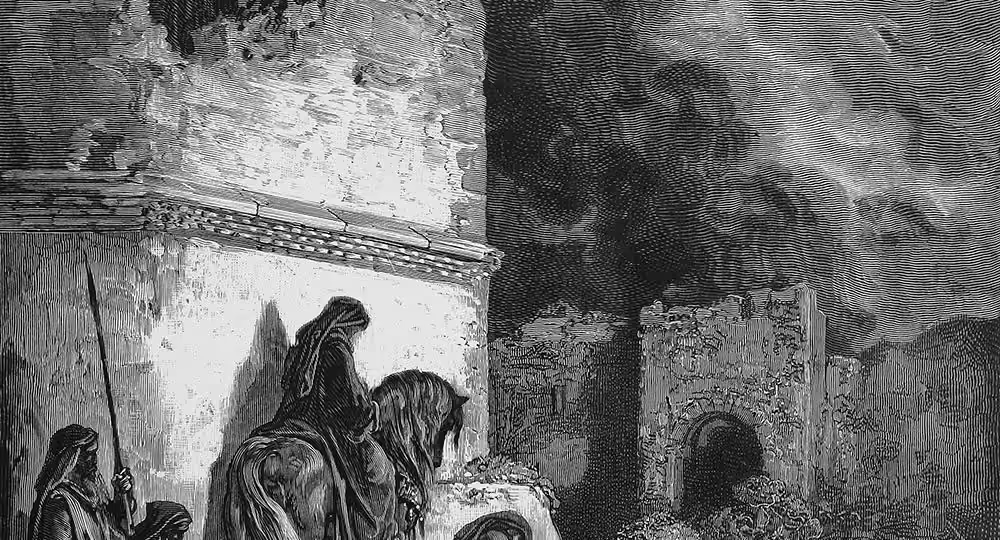
Nehemiah was not just a builder. He’s better characterized as an architect.
The decisions made in the next two to three years around AI governance will have decades-long consequences. That’s why Pope Leo wrote an encyclical on the topic. That’s why state legislators have introduced thousands of AI-related bills. And that’s why Congress seems to spend more of its time debating the AI tech stack—from energy production to chip exports. Young, energetic, and patriotic Americans can and should shape those decisions. That means you. You are the ones who will live with the consequences for the longest, and you are the ones who have grown up with technological tools of tremendous promise and peril. You are also less saddled by the entrenched views and commitments that more senior Americans may hold and owe. You are in the best position to creatively lead us toward another 250 years of this great American Experiment.
As Pope Leo made clear, this moment calls for builders. He pointed to the story of Nehemiah leading the effort to rebuild Jerusalem’s walls as his primary guide for how we should approach AI governance. Nehemiah, explained the Pope, “convened the families, assigned each of them a section of the wall to rebuild, listened to their concerns, coordinated their efforts and addressed any opposition.” Under Nehemiah’s leadership, the city was “reborn.” But, critically, Jerusalem’s revival was not solely due to this one inspired man. The Pope clarified that such projects only succeed “through the shared responsibility of all: men, women, priests, artisans, heads of households and young people all play a part.”
Building, however, must be for the common good. Self-promotional construction, such as the Tower of Babel, does not qualify. Pope Leo faulted those builders for “above all [seeking] to ‘make a name’ for themselves.” Projects “built on pride and the claim to self-sufficiency,” warned the Pope, will lead to dispersion and failure.
While there’s an obvious difference between those two projects, it’s not always clear, especially during disruptive and divisive times, to know what to build. Humbly, I’ll suggest that the Pope could have provided additional guidance. A close reading of the encyclical uncovers specific principles that he thinks builders should respect and consider as they build, but he paints with a fairly broad brush when it comes to what institutions, movements, and ideas need to be constructed to respond to this moment.
Unsurprisingly, he omitted a detailed roadmap for those seeking to contribute. The Pope rightfully noted that the needs and aspirations of communities may vary tremendously. He continually emphasized that it’s those communities that ought to be allowed to solve their own problems and chart their own future. He’d be contradicting himself if he had mandated a cookie-cutter agenda for parishioners to implement. It’s unclear that anyone — even the Pope — can devise such an agenda, because it would need to be revised, refined, and even rescinded regularly as AI, humanity, and our planet change. Yet, someone has to dare to point the path forward in those communities. We need many more Nehemiahs.
The AI Moment Needs More Than Builders
But Nehemiah was not just a builder. He’s better characterized as an architect. First, he identified a need. Despite living thousands of miles from Jerusalem, when he learned of the decimation of the city, Nehemiah asked God if he should go assist with restoring the crumbled city. That’s the first point I want to stress to you all: you must not only pay attention to what matters (learning about and understanding pain, need, and suffering) but also dare to believe that you can contribute. Nehemiah had a vision for a brighter future and the courage to see himself as an active participant in bringing about better days.
Second, he dedicated his full energy to the project. Though Nehemiah lived thousands of miles from Jerusalem, he uprooted himself to work on this project. I’m not a historian, but I doubt any of us would volunteer to embark on an arduous journey, leaving our friends and family behind, to preside over an even more arduous task. Nehemiah’s vision compelled him to persist through those struggles.
Third, he devised and adhered to a specific plan to ensure the vision came to fruition. Like architects today, he had to deal with his own fair share of red tape and pre-work. Nehemiah went to the necessary authorities to head to Jerusalem. Once there, he surveyed the scene to gauge the magnitude of the task before him. Some historians allege that nine walls required repairs. Individuals of less fortitude and dedication may have fled the scene then and there. It’s one thing to patch a few holes; it’s another to restore a city’s entire defense system. Nehemiah was undaunted, though not unaware of the challenges ahead.
Fourth, upon realizing this was no task for a single man, he shared his vision and invited others to join him. Families from around the city, as well as local religious officials, joined Nehemiah. It likely helped that he assigned them meaningful work — work that would serve their short- and long-term interests.
Identifying a need, pouring your heart and soul into addressing it, closely analyzing how best to tackle it, and executing the solution through collaboration and community — those are tasks that exceed the humble title of builder. Again, with my respect to the Pope, Nehemiah was an architect.
What It Means To Be An Architect
So what does this mean for all of you in the Age of AI? You all, by luck, by circumstance, or by fate, are being dared to become architects. Just as in the case of Nehemiah, you’re aware of the fact that the preservation of the values and principles we hold dear is something that requires collective action. Others are aware of that too, but have opted to carry on as is. I hope that you all will resist the temptation to expect others to step up. In fact, I expect that you all will not. But I want to provide a bit more guidance on how you can act in your newfound role as an architect.
Let’s start with identifying needs. The encyclical described many institutions that have become ineffective in the face of the social, economic, and spiritual changes afoot because of AI. A quick survey of those institutions confirms that, like the walls of Jerusalem, they require immediate attention. Three walls already show visible cracks: family life, meaningful work, and democratic accountability. The family, as the fabric of a strong society, is under threat. Fewer people are having kids. And, among those who do become parents, they’re finding it harder to be the sort of parent to which they aspire with bills to pay, work obligations to fulfill, and commutes to get through. The remaining hours in the day are far fewer than any parent would like to spend with their kid.
The availability of meaningful work is shrinking. When folks find themselves on the wrong side of a W-9, they often become a part of the gig economy. Many of these opportunities are literally life-saving — in that they prevent people from hitting rock bottom and provide them with income when better work may simply not be available. For many gig workers, this fragmented and flexible approach to making a living ends up improving their quality of life. Yet for too many others, it is hard to cobble together the wages, benefits, and vacation and sick days necessary to be a good parent, a good community member, and simply a contented individual. It’s expected that even if AI results in more jobs — better jobs to boot — in the long run, the transition period will leave many Americans in a tough spot.
Architects Must Design Solutions
Our governing institutions are suffering a crisis of confidence as well as a crisis of competence. They were not designed for an era in which a handful of private actors wield incredible control over our information ecosystem, politicians, and economy. Consider that a decision made by Google employees impacts 2.7 billion YouTube users, 4 billion Search users, 1.8 billion Gmail users, and, soon, more than 1 billion Gemini users. Those changes occur with minimal public scrutiny and can be made in a matter of hours if necessary. OpenAI, Anthropic, and Meta can similarly alter key sectors and processes with no direct public oversight. The answer is not to inject state actors into those decision-making processes; excessive state control presents a different set of issues. Nor should it be assumed that this is simply a matter of breaking these companies up. The present methods for training and diffusing advanced AI models require incredible scale. A mandate that the leading labs do not exceed a certain size could impose a cap on the nation’s AI capabilities and delay discovery of advances in science, healthcare, and beyond.
Something has got to give, though. The status quo is untenable. The undersea cables that carry our data, the satellites that provide Internet during times of war, and the vehicles that connect us to the stars are all predominantly under private ownership. This conflicts with a republican form of government in which you and I — we, the people — have the means to hold those with power accountable and to ensure their actions align with our will. We are a long way from the days when corporations could not obtain a charter to operate without approval from the state legislature. The path forward — one that preserves our corporations as accelerants of technological progress and engines of economic growth — is uncertain. It’s another area in which we need architects to design and implement new systems and strategies.
Architects can guide that work
Our own humanness is being drawn into question. Whole communities today discuss living for well over a century as if it's inevitable. A few individuals believe they can use technology to manipulate their brains and bodies to achieve superhuman feats. More broadly, our collective capacity to think critically, communicate, and collaborate is under threat. It’s for these reasons that Pope Leo decried individuals' willingness to sacrifice core beliefs at the altar of efficiency and optimization.
Due attention, however, must also be paid to the fact that these tools are important and even invaluable to individuals who have too long been left on the sidelines of society and been treated as less than in the labor market. Wearable glasses, for instance, have already transformed the lives of the visually impaired. AI tutors have unlocked literacy progress at a speed and scale that would not have otherwise been possible. Medical AI tools carry the potential to cure diseases that have taken far too many of our loved ones.
Architects will need to find a way through this tension.
By now, I am optimistic that you’re thinking of yourself as an architect. You have incredible resources, knowledge, and networks at your disposal. You’re a person of immense talent and even deeper faith. You are ready to set a vision for your community.
But which need will you focus on? No one can answer this for you. It may be the case that you can’t answer that question right now. Ultimately, you should pick the need that would motivate you to walk 1,800 miles from Susa to Jerusalem. What need inspires that level of dedication?
If you’re unsure, then go in search of a need. It may sound odd, but that’s the reason Pope Francis urged people to go see suffering. If you witness someone in dire straits or a community on the verge of a death spiral, then it’s highly likely a flame will ignite within you to get involved as part of the solution. My hunch is that you’ll know this feeling pretty quickly upon seeing the need you’re called to address.
When that moment occurs, don’t shy away from it. Find a piece of paper or a phone and write down exactly how you feel and why. That’s your fuel. That’s what’s going to sustain you when the easy way out starts to look appealing. If you’re worried you may change your focus down the road, that’s fine but lean into what you’re feeling now. Any progress you can help bring about in a domain that’s begging for vision and energy is a positive worth celebrating and sacrificing for.
Develop a Thoughtful Design
With that fire identified, you need to start devising a plan of action. Recall that Nehemiah surveyed the city before getting to work. Had he just started building, he might have committed all sorts of mistakes that would have set the effort back. For example, he may have underestimated the scope of the work ahead. If Nehemiah proceeded with one or a few folks, then they may have quickly tired and abandoned the whole project. It’s important to avoid the temptation to rush into the work, especially when you’re passionate about it.
The best architects understand the context in which they are building. In fact, there’s a whole type of architecture called “contextualism.” It’s grounded in the idea that you’re operating in an environment with a lot of history and with unique considerations. You can only pick up on those nuances if you do the requisite research. Depending on your chosen need, this may look like immersing yourself in a specific community, attending workshops and retreats, and talking with people who have chipped away at related projects, perhaps since well before you were born.
This work may delay you a little. You may find yourself itching to get started. Be patient. As Nehemiah proved, your effectiveness may depend on your willingness to take a breather before fully diving into the work ahead.
Share Your Vision and Recruit Others
Your understanding of the task at hand will also help you marshal others' assistance. Thanks to a more complete understanding of the project, you’ll be in a place to not only explain your vision but also to explicitly detail how others can assist you. And, trust me, people will want to lend a hand. Nehemiah experienced just that when people of all different backgrounds and statuses responded to his call to repair a specific section of the city’s protections. They wanted to be a part of making their community safer and more resilient. People have changed a lot since the days of the Persian Empire and walled cities, but their desire to contribute to important work has endured. You can and should tap into that.
People support what they helped build. If you give people a chance to be a part of something, they’ll never forget that they are part owners of that new institution, process, or system. That ownership stake will drive them to help you ensure it lives up to its promise.
My Own Section of the Wall
Let me share a quick vision of something I plan to architect: Prompt for America. Pope Leo discussed at length his concern that too few people will benefit from all AI has to offer. He cited prior technological waves that did not reach the shores of some countries, delaying their access to the tools of the future and often triggering a cascade of political and economic turmoil. It’s a disparity that characterizes the United States, too. My job takes me to states across the country. Many communities are effectively operating as if it’s 2022. AI has yet to meaningfully change daily life. Missed uses of AI are leading to missed opportunities for better lives, cheaper, more personalized healthcare, and more effective, widespread educational and retraining programs.
This is an issue that’s long fired me up. At the height of the pandemic, I rallied some of my friends to start No One Left Offline — a nonprofit that aimed to close the Digital Divide by sending hotspots to communities seeking affordable, high-speed Internet. I’ve continued to think about how best to spread the benefits of emerging technology ever since. That’s why I’ve logged more than 40 flights in just six months in 2026, traveling across the country to discuss how to govern AI without undermining its potential to improve the quality of life for many people worldwide.
Based on those travels, it’s clear we need trusted messengers (neighbors, friends, community leaders) to become AI ambassadors. The polarization of AI has led many to reflexively avoid the technology to signal their fidelity to their respective political tribe. Labs are unlikely to resolve this tension; Americans increasingly lack faith in the so-called tech bros building these tools. Yet, imagine if that small business that has leaned into AI decided to host an AI 101 at the local library. That’s what Prompt for America would strive to make commonplace: normal people helping other normal people learn the ins and outs of this transformative technology.
I’m at the early stages of advancing this idea. I’m sharing it here because part of being an architect is repeatedly sharing your vision in the event that it resonates with others. My hope is that, like Nehemiah, I find many more builders willing to contribute to this effort.
One final recommendation: heed the advice of Daniel Burnham:
Make no little plans. They have no magic to stir men’s blood and probably themselves will not be realized. Make big plans; aim high in hope and work, remembering that a noble, logical diagram once recorded will never die, but long after we are gone will be a living thing, asserting itself with ever-growing insistency. Remember that our sons and grandsons are going to do things that would stagger us. Let your watchword be order and your beacon beauty. Think big.
You have the tools and means to think big. You can and should aspire to be architects. I cannot wait to see what you build.
Professor Kevin Frazier leads the AI Innovation and Law Program at the University of Texas School of Law and is a Senior Fellow at the Abundance Institute.

Diagnosis: Recession
'Recession' reads less like a technical macroeconomics monograph and more like intellectual history conducted with an economist’s data discipline.

From Milton Friedman to Alexander Hamilton: Why J.D. Vance’s Economic Vision Needs James Madison
Loftily stated goals do not remove the risks of concentrated benefits, dispersed costs, and political capture.



Get the Civitas Outlook daily digest, plus new research and events.
Get the Civitas Outlook daily digest, plus new research and events.