Can Civic Friendship Save America?

By first pursuing the civic assimilation assumed by the Declaration of Independence, we may find the best means of recreating an enduring civic friendship among diverse Americans.
I have always wanted to have a neighbor just like you,
I’ve always wanted to live in a neighborhood with you.
–“Won’t You Be My Neighbor” (Music and lyrics by Fred Rogers)
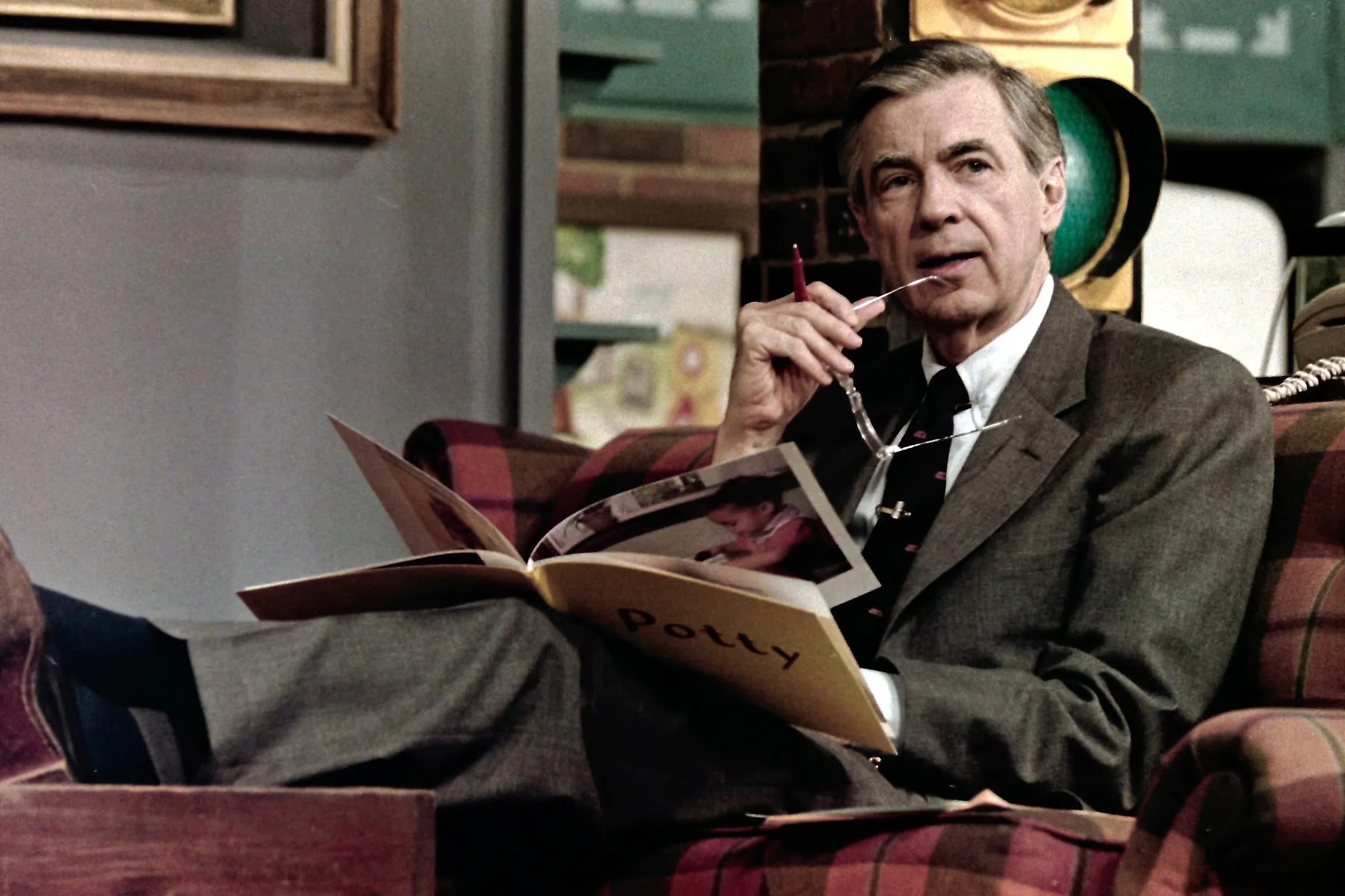
All I know about civic friendship, I learned from Mr. Rogers. Easier to understand than Aristotle, and certainly more melodic, the theme song from Mr. Rogers’ Neighborhood contains the essence of the ancient philosopher’s teaching on how citizens should live together. Next to Schoolhouse Rock’s “We the People,” Rogers’s iconic tune remains a touchstone for a generation of now-middle aged adults and their geriatric parents. Perhaps it should be adopted as an official song for America’s 250th celebrations. Invoking Mr. Rogers is not frippery. There is substantial evidence that Americans no longer like their neighbors. The Semiquincentennial of Independence is darkened by the shadow of hyper-partisanship in Washington and violent clashes over government immigration enforcement in cities like Minneapolis. We are not just polarized over political and social questions; we seem to be hurtling towards permanent civic enmity, driven by forces that have spent decades demonizing political opponents and atomizing citizens into identity groups based on class, race, ethnicity, or religion, exponentially magnified today by ubiquitous social media technology.
Our current tattered social fabric is an inverted world of the one Fred Rogers portrayed in his neighborhood. Though it was a make-believe world, like all great visions, it imagined a better present and future and assiduously taught ways to achieve them. The Pittsburgh native not only revived a classical focus on character, self-control, and virtue but also made his “neighborhood” a modern, televised imagining of the polis, the classical city of Socrates, Plato, and Aristotle (even if there was a king, Friday XIII). Next to the cultivation of the individual, the creation of a united society was perhaps Mr. Rogers’s main concern. The core of his social vision was the concept of civic friendship.
The first stop on the road to civic friendship may be “civic assimilation,” a way to preserve the public square for all Americans and ensure a more peaceful Union.
In response to our time of troubles, the concept of “civic friendship” has made a comeback. It is invoked as a means of calming the poisonous atmosphere roiling the country. Advocates often point to the famous late-life friendship between John Adams and Thomas Jefferson, after years of bickering, or more recently, between Ronald Reagan and Tip O’Neill.
The idea of civic friendship is ancient. It is most famously described in Aristotle’s well-known discussion in the Politics and in both of his Ethics. In what he labels a “friendship of utility,” citizens (freeborn males, in his time) share a love of the same thing: the good of the city (polis) and their fellow citizens in it. This leads to a feeling of civil concord or harmony, making possible the flourishing of their city and all in it, from which each benefits. Since all respect one another and, out of self-interest, make the good of all their goal, the political goal is to get citizens to accept the reality of ruling and being ruled in turn, and to hesitate to abuse their privileges when ruling for fear of the tables being turned in the future. Ultimately, such reciprocity and fair play create the condition of civic equality. It’s not all that different, really, from Mr. Rogers and his constant reminder that in the neighborhood, we’re friends.
Today, however, such unanimity, let alone basic respect between citizens in America, is all but absent on social, political, and economic issues. The acceptance of ruling and being ruled in turn has been shredded by decades of delegitimizing political opponents and denouncing their character, not just their ideas. A March 2026 poll by Pew found that 53 percent of Americans viewed their fellow citizens as morally bad—not just mistaken or ill-informed, but bad.
Perhaps all this would not matter if it were kept bottled up in private conversations and group chats. But today’s ill-will is disrupting civil society. A shared sense of being American is fractured, and identity politics substitutes disunited affinity groups for a united citizenry.
Even if the majority of Americans are not politically radicalized (which most of us would like to believe), extremists, particularly on the political left, have attempted to occupy the public square to the exclusion of opposing views. This not only undermines basic constitutional rights, but it is now fomenting an increasing radicalism on the right and is leading us down a dangerous path into open civil conflict.
Among hundreds of examples of intolerance, a look at the 2023 Stanford Law School heckler’s veto of U.S. Fifth Circuit Court Judge Kyle Duncan and the 2024 illegal encampment at Columbia University, culminating in the violent and destructive takeover of Hamilton Hall, highlights the threat. Ditto University of Wisconsin-Eau Claire professor José Felipe Alvergue, who violently overturned a conservative student organization’s table in April 2024. In all cases, the most educated and privileged class of American society, whether native born or foreign student, acted to deny the public square to perceived enemies through violence and intimidation. It is no accident that all of this took place on university campuses. These three examples, among dozens over the past decade, many of them violent, have now inundated civil society, as identitarian ideologies have moved beyond the classroom. Worst of all, of course, was the assassination of Charlie Kirk on the campus of Utah Valley University in September 2025, a blow aimed directly at civil society and justified by the now-fashionable doctrine that “words are violence,” justified by being countered with a bullet.
Just as dangerously, since the Hamas massacre in Israel on October 7, 2023, antisemitic movements now target synagogues, Jewish businesses, and even neighborhoods in American society. Poisonous antisemitic ideologies are fueling attacks on publicly identifiable Jews and the targeting of Jewish children, yoking religion to politics, and threatening Kristallnacht-like outbreaks and a fundamental violation of the American social compact that may begin but will not end with demonizing Jews.
If unchecked, this breakdown in civic solidarity threatens to make the country not simply ungovernable, but at risk of widespread civil strife and conflict. It is not hyperbole to say that the threat to the public square is a threat to our basic concepts of liberty and equality.
This attack on the public square has happened despite the formation of dozens of civics institutes and programs aimed at students and adults alike. Dozens of conferences, especially in this jubilee year, explore ways to deepen, strengthen, and spread civics education. And yet, the distrust and confrontation continue to grow. Demographic change may explain some of the breakdown, as immigration increases from societies lacking American-style liberal values or a sense of civic solidarity. But when young lawyers are arrested for throwing Molotov cocktails at police or for attacking Hebrew-speaking diners, or when medical professionals refuse to deal with Jews, clearly something broader isn’t working, despite the best intentions of those committed to a liberal democratic order.
Civics programs seem to be a more long-term approach, and while ultimately beneficial and needed, are not powerful enough presently to counter anti-American education in the schools and online communities. Leftist funding of extremist movements that delegitimize the very existence of the United States, denigrate its history, culture, and traditions, and call for constant disruption of public life is paralleled by White supremacist groups that intimidate and threaten non-White citizens and culture. The extremes continually press in on the weakening center.
It does no good to try to teach the basis of the American constitutional order, the mechanism of the legislative process, or the richness of the American past when citizens and foreign residents alike have been marinated in pseudo-history like the 1619 Project or false origins of World War II and the violent fantasies of both Antifa and Nick Fuentes.
Since we’re together we might as well say,…
Won’t you be my neighbor?
As Mr. Rogers sings, we’re all together, whether by birth or by choice to immigrate. Since we’re here, we have no choice but to get along if the country is to avoid a bloodbath and survive. Civic friendship, in the Aristotelian sense of disparate citizens loving the same things for one’s city and country, has always been a utopian goal. Yet civility and the sharing of the public square, enforced if necessary by impartial application of the law, is not.
At a minimum, “fellow citizens may reasonably demand from each other basic respect and toleration,” in the words of the scholar Jason Scorza. Yet in a 2025 Foundation for Individual Rights and Expression survey, 34 percent of college students said it was acceptable to use violence to stop speech on campus in certain cases. In the wake of Kirk’s assassination, a YouGov poll revealed that a third of Americans aged 18-44 agreed with the statement that “violence can sometimes be justified to achieve political goals,” including 26% of self-identified liberals and 7% of conservatives. While this does not ensure violent actions will occur, it reveals that intolerance and extremist thought are now mainstream among America’s youth.
It thus puts the cart before the horse to wave about the concept of “civic friendship” like a magic wand, expecting passionate, angry, and often ill-informed partisans to suddenly beat their swords (rhetorical or otherwise) into plowshares. More realistically, an intermediate step is necessary in staunching the blood flowing in the public square. If rebuilding civic friendship is our ultimate goal, we should focus first on ensuring “civic assimilation.”
“Assimilation” is traditionally used to describe the process by which immigrants adopt the mores and values of their new society. It is how the famous metaphor of the “melting pot” becomes a reality. Yet in today’s environment, civic assimilation is not aimed at immigrants alone, but at all Americans, especially the younger generation, whether Mayflower descendant or this year’s immigrant. Civil behavior must be modeled and taught, just as Mr. Rogers–and Aristotle–showed. It must also be enforced, if necessary, by the state.
In pursuit of this goal, there is no more powerful exemplar of civic assimilation than the Declaration of Independence.
The Declaration implicitly identified civic assimilation as the glue that would hold the Nation together. As I discuss in my book, National Treasure: How the Declaration of Independence Made America, our founding document begins by asserting that the thirteen colonies comprise one people, a statement of civic unity despite different religions and cultures in the colonies in 1776. Similarly, the Signers’ pledge to each other of their lives, fortunes, and sacred honor was transformed over time into an expression of Americans’ covenant with each other over the generations, ultimately to women and Blacks. By the time massive immigration from Eastern and Southern Europe began changing America’s demographics in the late-19th and early-20th centuries, such civic unity was seen as the goal that the far more multicultural and multiethnic nation needed to maintain.
Without such a protected and strengthened public square, open to all and where citizens or groups exercise their legal rights to free speech, free association, and free exercise of religion, American democracy is in mortal peril, for the meanings of American liberty and equality can quickly be forgotten in an atmosphere of constant distrust and confrontation. Without a sense of democratic connectedness or civic solidarity, there will be no civic harmony and ultimately no civil society. There will be no “one people” as called into existence by the Declaration of Independence, thus ending the American experiment as we have understood it.
In the Declaration, the promises of freedom and equality, themselves a balance throughout American history, are subsumed under an umbrella of unity that is possible only through an agreed compact of civic cooperation. Though strained today, this basic alchemy of civic assimilation is the great integrator in American society. By first pursuing the civic assimilation assumed by the Declaration of Independence, we may find the best means of recreating an enduring civic friendship among diverse Americans and maybe even building Mr. Rogers’ neighborhood.
Michael Auslin is the Payson J. Treat Distinguished Research Fellow at Stanford’s Hoover Institution and the author of National Treasure: How the Declaration of Independence Made America (Avid Reader Press/Simon & Schuster).


%2C_Ancient_Rome%2C_1757.jpg)





.png)
.png)
Get the Civitas Outlook daily digest, plus new research and events.
Get the Civitas Outlook daily digest, plus new research and events.