Draining the Ivory Tower

The path forward is clear: revalue teaching, redirect research, and reconnect with policymakers.
The disconnect between the public and academics is near a historic low. Just one in five voters have a “great deal” of trust in academic institutions to act in the public interest. This divide is the product of flawed incentives and institutions. Science research is published behind paywalls and written in inaccessible prose. Tenure-track law professors pursue research topics likely to interest second- and third-year law students, who run the law journals in which professors are expected to publish. More generally, a publish-or-perish mentality drives academics to prioritize quantity over quality and to pursue research agendas that please their colleagues rather than address the most pressing societal problems.
Under this status quo, scholars are in flagrant violation of the social contract expressed in Vannevar Bush’s Science—The Endless Frontier. Bush’s 1945 report, as summarized by Alondra Nelson and Jenny Reardon, outlined a simple arrangement: “government funding in exchange for research autonomy, with the expectation of broad societal benefits[.]” Academics are parties to that deal. They have not upheld their end of the bargain.
From my vantage point in the legal academy, I can attest to the fact that public funds today too frequently go toward academic research that’s unlikely to contribute to expanding the bounds of human knowledge and improving collective well-being. Scholars treat their position in the Ivory Tower as one that has been gifted, rather than one that should be continually earned. Absent a significant shift in incentives, the incredible mental capacity in academic halls will fail to fulfill its potential and delay our ability to achieve a better future sooner via creative, rigorous research across all disciplines.
Three foundational alterations to academic institutions can help bring scholars back into compliance with the bargain agreed upon by the public. These reforms are not meant to strip academics of their intellectual freedom but rather to realign that freedom with the responsibilities that justify public investment.
First, we must reorient universities around their most immediate and indispensable function: instruction. For too many professors, teaching has slipped into the background—viewed as a necessary chore rather than a primary duty. Tenure committees reward publication counts far more than classroom excellence. The result is a professional culture in which the worth of a scholar’s career is measured not by the hundreds of students they equip to think critically, innovate, and lead, but by how many times their articles are cited in journals with circulations smaller than many rural newspapers.
This hierarchy of values is not only backward but also self-defeating. A brilliant lecture that sparks curiosity in a room of fifty students can yield decades of compounded benefit as those students contribute to research, policy, and practice. By contrast, the marginal law review article—however polished—will rarely shape the lives of more than a handful of peers. If academic institutions redirected incentives so that excellence in teaching carried equal, if not greater, weight than publication records, the impact of the academy on society would grow exponentially.
Consider, too, the broader democratic effect. Students are among the most direct beneficiaries of public funding for higher education. When their professors treat them as an afterthought, it undermines confidence not only in universities but in the promise of education as a public good. Making instruction the centerpiece of academic life is therefore not a parochial reform; it is a restoration of the academy’s public mission.
Though I am only entering my third year in the legal academy, I am not ashamed to admit that the most consequential thing I’ve done is inspire at least a few dozen students to continue their studies and believe in their capacity to make a difference. Two examples. One of my students recently transferred to an institution better aligned with their academic aims and professional potential—they claimed my letter of recommendation and teaching style played a part in that change. I’m not sure it did, but I’m sure she has the potential to make a huge difference in the lives of many communities presently being underserved by the profession. Another student shared that they earned a position on law review and plan to use that experience to start researching AI regulation in earnest. I am optimistic that they have good odds of uncovering novel solutions that have gone unexplored by my colleagues due to a collective tendency to write in a similar style and on similar topics. This isn’t to tout my own teaching capabilities but to stress that one good professor can inspire hundreds of brilliant minds. But instruction alone cannot restore the public’s trust if research continues to drift into irrelevance.
Second, academic research must be brought into closer alignment with the priorities of the public that funds it. To be clear, research autonomy is not the same as research anarchy. Scholars should retain the freedom to pursue unexpected insights and untested theories—after all, some of the most transformative discoveries have come from inquiry that initially appeared esoteric. But autonomy does not absolve academics of responsibility. When entire careers are built on topics that bear little connection to the urgent challenges facing society, the spirit of the public’s investment is violated.
Too often, scholars confuse obscurity with rigor and novelty with value. The result is an abundance of publications that are impressive in method yet irrelevant in substance. Meanwhile, pressing issues—from the regulation of artificial intelligence to maintaining strong democratic institutions amid geopolitical and cultural swings—remain underexplored or left to policy staffers with neither the resources nor the time to conduct serious analysis. This imbalance is not simply an intellectual failing; it is a civic one. Taxpayers do not fund universities so that faculty members may endlessly debate questions that matter only to other faculty members. They fund them to advance knowledge in ways that make life safer, fairer, and more prosperous.
A better equilibrium is possible. Public officials—whether through agencies, legislatures, or research committees—routinely identify areas where additional expertise is desperately needed. Academic institutions could develop mechanisms to encourage scholars to respond to these calls for insight without compromising intellectual freedom. This might take the form of fellowships tailored more specifically to public priorities or tenure recognition for projects with demonstrated positive impacts on social ills. Such incentives would not force conformity; rather, they would broaden the definition of prestige beyond the insular applause of disciplinary peers.
Re-centering research on publicly signaled priorities would also strengthen democratic accountability. It would make clear that scholarship is not an end in itself but a means to collective advancement. Yet even when research addresses pressing public priorities, its value is lost if it never leaves the page.
Third, universities must create new forums where academics, policymakers, and innovators can engage directly and productively. The current distance between these groups is both ironic and damaging. Scholars produce knowledge meant to inform governance and create new markets, yet their work too often languishes behind paywalls or in jargon-heavy journals. Policymakers, meanwhile, are compelled to legislate on matters of staggering complexity—such as climate change, biotechnology, and digital surveillance—without sufficient access to cutting-edge expertise. Similarly, entrepreneurs await research breakthroughs that they can transform into viable businesses, driving the economic growth associated with human flourishing. The result is a public square where sound bites outweigh scholarship, and an economy that lags behind its innovative potential.
The solution is not for every professor to become a pundit, lobbyist, or corporate advisor. Rather, academic institutions should sponsor structured forums for sustained exchange between scholars, founders, and public officials. This is not a call for simply more tired, traditional conferences filled with a never-ending set of panels. Imagine a standing council, housed within universities but open to representatives from government agencies, congressional offices, and state legislatures, as well as private sector stakeholders. Such a forum could serve two crucial purposes: first, channeling public funding toward the most pressing and promising fields of inquiry; second, ensuring that lawmakers and innovators have access to knowledge distilled into usable, timely forms.
Some of this already exists in piecemeal form—think tanks, blue-ribbon commissions, or occasional congressional testimony. But these mechanisms are episodic and uneven. A permanent, transparent venue would foster ongoing dialogue, reduce duplication of effort, and build trust between academics and the rest of society. It would also give scholars an incentive to write and speak with clarity, since their audience would extend beyond a narrow circle of disciplinary peers to the policymakers tasked with shaping the nation’s future.
Establishing such a forum would not eliminate political disagreement or prevent misuse of research. But it would at least ensure that the best available knowledge is part of the deliberative process. That, after all, is what the public expects when it invests in higher education: not Ivory Tower isolation, but active participation in the work of democratic self-government.
In 1944, President Franklin D. Roosevelt foresaw the potential of a research community operating in pursuit of the public interest. “New frontiers of the mind are before us,” predicted Roosevelt. But he qualified that prediction. Roosevelt knew that such gains would only be realized “if they are pioneered with the same vision, boldness, and drive with which we have waged this war[.].” Academics today too frequently are waging the wrong wars. They find themselves ensnared in political debates, cultural skirmishes, and faculty squabbles. Their vision, boldness, and drive are being misdirected. The new frontiers hoped for by Roosevelt and Bush are still attainable—but only if academics reimagine what it means to serve the public interest. The path forward is clear: revalue teaching, redirect research, and reconnect with policymakers. Anything less risks an academy that fails the very public on which it depends.
Kevin Frazier is the AI Innovation and Law Fellow at the University of Texas School of Law and co-host of the Scaling Laws podcast.


Nolan’s Odyssey and the Search for Wisdom
Nolan’s 'Odyssey' will be a tremendous success, but it is also a work of decadence.
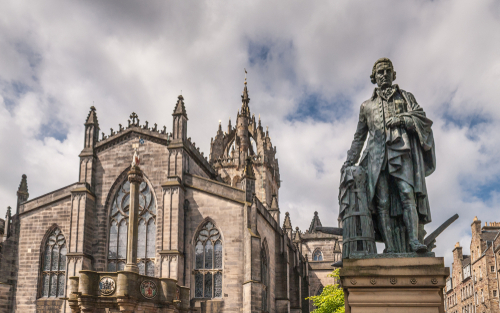
Adam Smith, Economist of the American Revolution
Clear-eyed economic thinking remains one of humanity’s most powerful instruments for understanding our problems and advancing our possibilities for improvement.

Made in the Image of Nothing
We need a sequel to Carl R. Trueman's 'The Desecration of Man: How the Rejection of God Degrades Our Humanity.'

.jpeg)


Get the Civitas Outlook daily digest, plus new research and events.
Get the Civitas Outlook daily digest, plus new research and events.