Eliminating Liberal International Asymmetries
The effect, if not purpose, of modern international law is to obstruct American foreign policy.
Over the course of the twentieth century, progressives captured many American institutions. Regardless of which way popular opinion shifted, there was a persistent left-wing tilt. During his second term, President Trump has taken steps to eliminate many of these liberal institutional asymmetries, including in the civil service, the judiciary, the academy, the legal profession, and more. However, these liberal imbalances do not exist only at home. Modern international law is structured around progressive idealism that will always oppose conservative principles. President Trump is now taking steps to eliminate liberal international asymmetries. He has announced that the United States will withdraw from scores of global progressive entities that embolden small countries to push back against American foreign policies. And Trump continues to negotiate peace deals for Gaza, Ukraine, and other hotspots with the important parties, without engaging international institutions. Trump’s actions make plain the reality: the effect, if not purpose, of modern international law is to obstruct American conservative foreign policies. Once internationalism is viewed as merely another form of progressive politics, it can be treated accordingly.
International law, classically known as the law of nations, dates back to time immemorial. Nations have long sought relations with other nations according to settled legal principles. In times of conflict, countless civilizations have employed diplomacy to resolve disputes, but when negotiations failed, a state of war was declared. Negotiations were most effective between nations of equal stature, as the threat of bloodshed brought both sides to the table. But as Thucydides explained two millennia ago, a weaker nation will likely have to surrender when threatened by a stronger nation. Of course, there are exceptions to this rule.
In this 250th year of our independence, we should remember how our forefathers employed international law and defied the odds. For generations, the American colonists submitted humble requests to the British Crown, only to face even greater oppression. When those diplomatic efforts failed, the Declaration of Independence was issued as a document grounded in the law of nations. King George III was “totally unworthy [as] Head of a civilized nation.” Grievances were “submitted to a candid world.” And upon independence, these “Free and Independent States” had “full Power to levy War, conclude Peace, contract Alliances, establish Commerce, and to do all other Acts and Things which Independent States may of right do.”
According to the traditional model, a ragtag group of patriots should have been crushed by the world’s greatest imperial force. Thankfully, the Continental Army prevailed. Yet this insurmountable feat was achieved only because France — a frequent foe of Great Britain — supported the Americans. After General Cornwallis surrendered at Yorktown, the Americans and British negotiated the Treaty of Paris, which resolved much of the conflict. The American Revolution demonstrated international law at its finest. But the story continues.
In 1793, war broke out between Great Britain and France. At the time, many Americans felt a strong sense of loyalty to France, particularly given their support for the Continental Army. Likewise, many Americans harbored strong hostility toward Great Britain. Yet President George Washington made a fateful decision: he issued the Neutrality Proclamation. The United States and the American people would play no role in the conflict. This proclamation today is studied largely from the perspective of the separation of powers. Alexander Hamilton, as Pacificus, argued that Washington had the executive power to issue the proclamation. James Madison, writing as Helvidius, countered that Congress, not the President, had the authority to set foreign policy. But beyond these legal issues, Washington made a political judgment. He deemed it better to stay neutral, even at the cost of alienating America’s staunchest ally. Washington recognized that in the field of foreign affairs, alliances are fluid. Allies become enemies and enemies become allies. These relationships are not fixed, but wax and wane with present-day circumstances. Washington continued to demonstrate international law at its finest.
Over the ensuing century, American presidents took different approaches to foreign policy. The constraints, invariably, were domestic law and popular opinion. To be sure, Presidents negotiated treaties, which were approved by the Senate. But these treaties were generally bilateral – that is, between two peer nations. If those treaties no longer served the interests of either side, the treaty could be terminated.
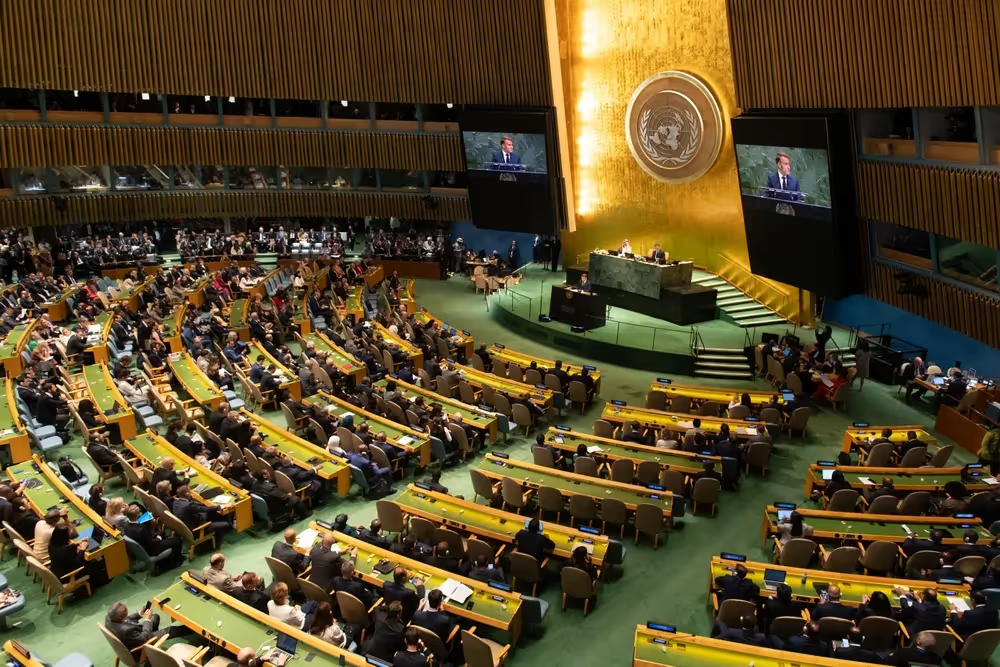
But in the twentieth century, the notion of international law began to change. Rather than two nations negotiating directly, global institutions were established that enabled many nations to participate on equal terms. Moreover, agreements would apply to all members equally. The League of Nations was established in the wake of World War I to promote international peace through collective security. But the United States never joined, and the organization could do nothing to stop World War II. The League of Nations dissolved in 1946. After World War II, the United Nations was formed. Now, the United States and the other major superpowers joined.
Still, the United Nations failed in its mission to stop armed conflicts. To the contrary, President Truman justified the United States’ entrance into the bloody Korean War based on a United Nations resolution. Congress did not even adopt a Declaration of War. And United Nations resolutions are non-binding, and are routinely ignored. In the modern era, the United Nations has been on the sidelines of major international peace agreements. Trump has wisely sought to engage complex agreements in the Middle East, Ukraine, and other hotspots through direct negotiations, rather than through the UN.
This much is well known. But less understood is how the United Nations, and other international bodies, have inverted the normal course of international law. In many contexts, a coalition of smaller nations may seek to shape the foreign policy of larger nations that they could not challenge in other contexts. To be sure, the United States and four other superpowers retain a veto on the United Nations Security Council. But in most other contexts, a majority group of minority nations can set the agenda and shape expectations about international authority. It is far more difficult for any nation, including the United States, to withdraw from the United Nations Charter than to withdraw from a bilateral treaty. As a result, great nations have to suffer complaints from weaker nations, all for the sake of faux equality. It has always been a fiction to treat countries with weak influence as having the same stature as countries with strong influence. The United Nations reminds me of a liberal little league: no one keeps score, the best players are benched so weaker players have the same number of at-bats, and all the teams receive the same participation trophy regardless of their record.
This dynamic is perhaps most egregious with regard to international “courts.” And I quite deliberately use scare quotes around “courts.” The International Criminal Court, for example, has issued arrest warrants for the Israeli Prime Minister (ICC), even though Israel has not joined the ICC, under a dubious legal theory. Worse still, the President of the International Court of Justice (ICJ) was from Lebanon, a country that refuses to recognize the existence of Israel. Progressives abroad rely on these elite international judges in much the same way that progressives in the United States rely on elite American judges. We should look at these international inquisitors as a sort of a globalized Jack Smith junta of roving prosecutors who can punish any governments that elites deem harmful. Fittingly, before Jack Smith prosecuted Donald Trump, he served as a prosecutor at the International Criminal Court in The Hague.
And if I had to predict, Trump is next. He will be prosecuted as a war criminal once he is out of office. Earlier, Trump imposed sanctions on members of the International Criminal Court. I agree with Professor Eugene Kontorovich that Trump should take further action and dismantle the entire construct of the ICC. This institution will never advance any sort of American interest. Indeed, in 2002, Congress passed the American Service-Members' Protection Act, better known as the “Hague Invasion Act.” Should the ICC ever imprison any American, the President can use “all means necessary and appropriate” to obtain their release, including military force.
Worse still, these institutions advance a decidedly liberal perspective of the law. President Trump recently withdrew the United States from scores of international organizations that are “contrary to the interests of the United States.” These entities also act in ways that are contrary to conservative interests. As Secretary of State Marco Rubio observed, “what started as a pragmatic framework of international organizations for peace and cooperation has morphed into a sprawling architecture of global governance, often dominated by progressive ideology and detached from national interests.” These groups support more extensive government controls on economic activity, private wealth, environmental regulation, gun control, and far more. Much like USAID, conservatives simply find no home in these international organizations. They advance only one side of the political spectrum.
Thus, in a recent interview, President Trump was asked if international law constrains him. He replied, “It depends what your definition of international law is.” I agree. Modern international law has been a failed experiment. America should restore the classical law of nations.
Josh Blackman holds the Centennial Chair of Constitutional Law at the South Texas College of Law Houston, is a contributing editor to Civitas Outlook, and is an adjunct fellow at the Manhattan Institute.

.webp)
Can Britain’s Next Prime Minister Escape the Net Zero Trap?
Britain has burned through five Prime Ministers and is paying some of the highest electricity prices in the world.
The Scanner at the Gate: Europe’s China Policy Litmus Test
China’s industrial policy is entering Europe through public procurement—and reshaping sensitive markets from within.

To Family Engineers of All Parties: A Call to Reject State-Sponsored Culture
During the 80 years following WWII, family engineers have repeatedly pulled levers in failed attempts to produce their preferred outcomes.
.jpg)
.avif)



Get the Civitas Outlook daily digest, plus new research and events.
Get the Civitas Outlook daily digest, plus new research and events.