America’s Roundabout Revolution

The roundabout revolution shows Americans can still act rationally.
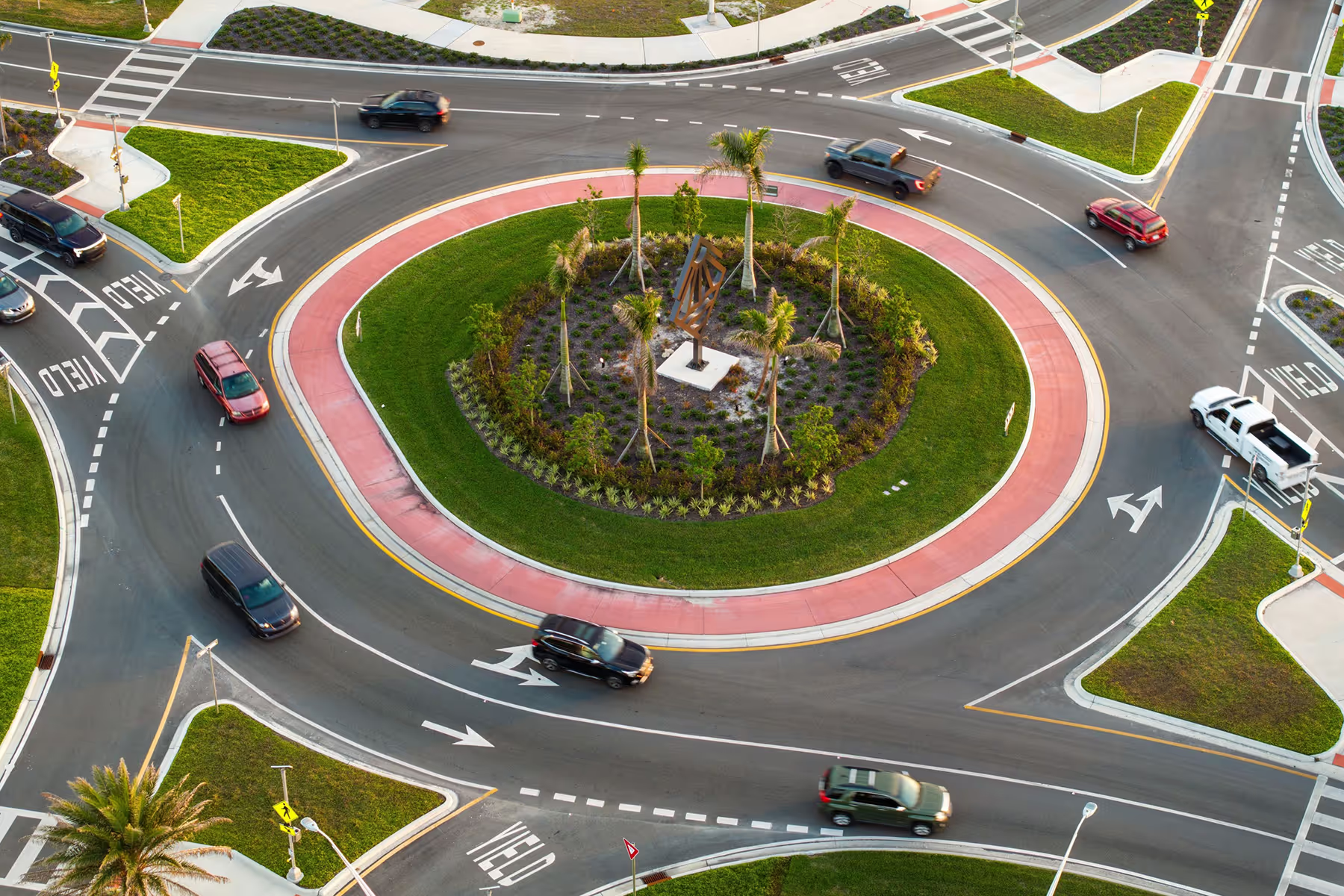
Last summer, Engler Road, a street I drive nearly every day, was under construction. The experience was, shall we say, a pain. Every morning, when I had to drive my kids to the community center, I was forced onto a route that added five to ten minutes to my trip. “What are they building?” I asked my wife, who pays more attention to community projects. The city was installing three new roundabouts, she informed me, two at four-way stops and one at a busy traffic-light intersection near our children’s schools. I grumbled, but by September the work was complete, and the results were amazing. My commute time had been cut in half. The experience caused me to take a closer look at the roundabout revolution quietly underway across America, which carries important lessons on economics and progress.
Roundabouts: A Brief History
The concept of a circular junction for motor vehicles dates to about 1900. Some claim the first roundabout was built in Görlitz, Germany, in 1899, while others contend the distinction belongs to Paris (the Place de l’Étoile in 1907). Whatever the case, the first “modern” roundabouts, with yield-on-entry and tighter curves to slow speeds, didn’t begin appearing until the United Kingdom widely embraced the design in the 1960s.
Perhaps it’s no surprise, then, that for generations Americans associated roundabouts with Europe. Many Americans were introduced to them in the 1985 comedy National Lampoon’s European Vacation. In the film, the Griswolds visit London, and Clark (Chevy Chase) gets trapped in an endless loop outside Parliament. (Homer Simpson would have a similar experience years later.)
The scene was ridiculous, but it captured a truth: Americans were clueless about roundabouts. When European Vacation was shot, there was not a single roundabout in the United States, according to official sources.
“The first modern roundabouts constructed in the United States date to 1990 in Nevada,” says the American Society of Civil Engineers, which analyzed data compiled by the Insurance Institute of Highway Safety.
By the late 1990s, roundabouts — not to be confused with their cousin, the rotary — were still rare, with only about 150 in the entire US.
When I drove a roundabout for the first time in Wisconsin in 2004, there were not quite 300 nationwide. By 2021, however, the count was 7,000. And in the four years since, the figure has reached more than 11,000, according to Kittelson & Associates Inc., a Portland, Oregon firm that tracks roundabout data. They are meeting with the approval of both local elected officials and their constituents, it seems.
‘Roundabouts Save Lives’
Why roundabouts are becoming more popular is not a mystery, at least if you ask Jim Brainard, the former mayor of Carmel, Indiana (pop. 101,001).
Under Brainard, Carmel became “The Roundabout Capital of the World,” and today has more than 155 roundabouts. In a 2021 interview, Brainard explained to John Stossel why he made it his mission to convert all the traffic light intersections to roundabouts.
“Because [they] save lives,” said Jim Brainard.
Brainard is a roundabout evangelist, but the data support his claim. Federal transportation research finds that intersections redesigned as roundabouts see roughly three-quarters fewer injury crashes and about a 90 percent drop in fatal collisions. A separate federal study found that from 2005 to 2013, there were just 46 fatal crashes at roundabouts nationwide.
Stephen J. Dubner, co-author of the popular book Freakonomics, says data show that just 0.1 percent of roundabout crashes result in death (one death per 1,000 crashes), compared to a death rate of 0.4 percent at traditional intersections (four deaths per 1,000).
This doesn’t mean accidents don’t occur at roundabouts. They do — and at slightly higher rates than at traditional intersections. But roundabouts result in fewer fatalities because they virtually eliminate dangerous right-angle and head-on collisions. When accidents do occur, they tend to occur at far lower speeds.
There are other benefits to roundabouts. According to studies cited by the Insurance Institute for Highway Safety, replacing traffic signal intersections or stop signs with roundabouts typically reduces fuel consumption by 23–34 percent.
Additionally, traffic lights waste a lot of time. Journalist Zachary Crockett says the Federal Highway Administration estimates that traffic signals cause 295 million vehicle-hours of delay annually.
Why Doesn’t America Have More Roundabouts?
Though I’d driven on roundabouts for years, the idea that roundabouts could replace busy traffic light intersections hadn’t occurred to me until this past summer. That’s when the city replaced the lights by my children’s school in Carver County, Minnesota, with a roundabout.
I was astounded. Replacing a four-way stop was one thing. Replacing a busy traffic-light intersection (one I despised because it was poorly timed) was something else entirely. Instead of waiting at a red light for several minutes every morning, I now pass right on through, rarely having to yield.
The experience invited a natural question: Why are we still using traffic lights at all?
I spoke to experts, and there are various answers. For one, roundabouts save money long term, but in the short term, they are expensive — a couple million bucks, typically — especially if you’re replacing an existing intersection.
Additionally, roundabouts don’t work everywhere. A roundabout in the wrong place can make traffic worse, says Randal O'Toole, a land‐use and transportation expert who worked at the Cato Institute.
“I've seen 55-mph freeways that had roundabouts that forced vehicles to slow to 30. I've seen cities install roundabouts at places that have no intersection,” O'Toole told me. “I've seen traffic lights replaced by roundabouts that end up causing traffic to back up for miles. Roundabouts were a mistake in all of these places.”
The biggest hurdle roundabouts face may be psychological: they seem alien to Americans. “Let's be honest,” said Dubner on Freakonomics, “one reason the roundabout remains unpopular in the US is that it’s just too European.”
To be fair, when Americans say roundabouts feel foreign, they are not wrong. France and the UK alone have about 75,000 roundabouts — about seven times as many as the US, even though the US has nearly triple the population.
On the other hand, the UK and France also have far lower traffic fatality rates. The US rate is 13.3 per 100,000, compared to 3.9 per 100,000 in France and 2.26 per 100,000 in the UK. Are roundabouts a substantial part of the reason for this difference?
The Past vs. the Future
The first electric traffic light in the United States was installed on August 5, 1914, in Cleveland, Ohio, at the intersection of Euclid Avenue and East 105th Street. It still exists today, one of 330,000 traffic-light intersections across the US, a relic of the command-and-control economy of the time.
Roundabouts can’t replace all these intersections, but they could replace tens of thousands of them. The consequences of this would be enormous, a massive increase in savings for the world’s most important resource: people.
“If roundabout implementation increased, we likely would see a reduction in fatal and severe injury crashes throughout the country,” Lee Rodegerdts, an engineer and traffic expert for Kittelson & Associates, told me. “On balance, fatalities and injuries would decrease substantially.”
It might sound strange, but there’s something exciting about America’s quiet roundabout revolution. The most obvious benefit is the number of lives saved. And there’s also the amount of time and energy Americans will save, year after year. But there’s also something less tangible.
The roundabout revolution shows Americans can still act rationally. In a world that seems increasingly coarse and dysfunctional, communities are still capable of working together to improve things. The revolution stems not from some federal five-year plan, but from community leaders using local knowledge to identify and solve real problems.
For these reasons, as silly as it sounds, I’ve found hope in the humble roundabout.
Jonathan Miltimore is editor-in-chief of The Daily Economy, an online journal published by the American Institute for Economic Research.


Spielberg’s Empty Hope
'Disclosure Day' should have been called 'Hope and Change,' or rather 'Change and Hope.'
.jpeg)
Deliberative Republicanism and the Triumph of the American Founding
Instead of rejecting the moral urgency of the postliberal right and left, it is fitting and proper that we redirect it through the right kind of education—both formal and informal—that can inspire affection for our Constitution.

Can Civic Friendship Save America?
Start with “civic assimilation” on the way to a more peaceful Union.


.avif)


Get the Civitas Outlook daily digest, plus new research and events.
Get the Civitas Outlook daily digest, plus new research and events.