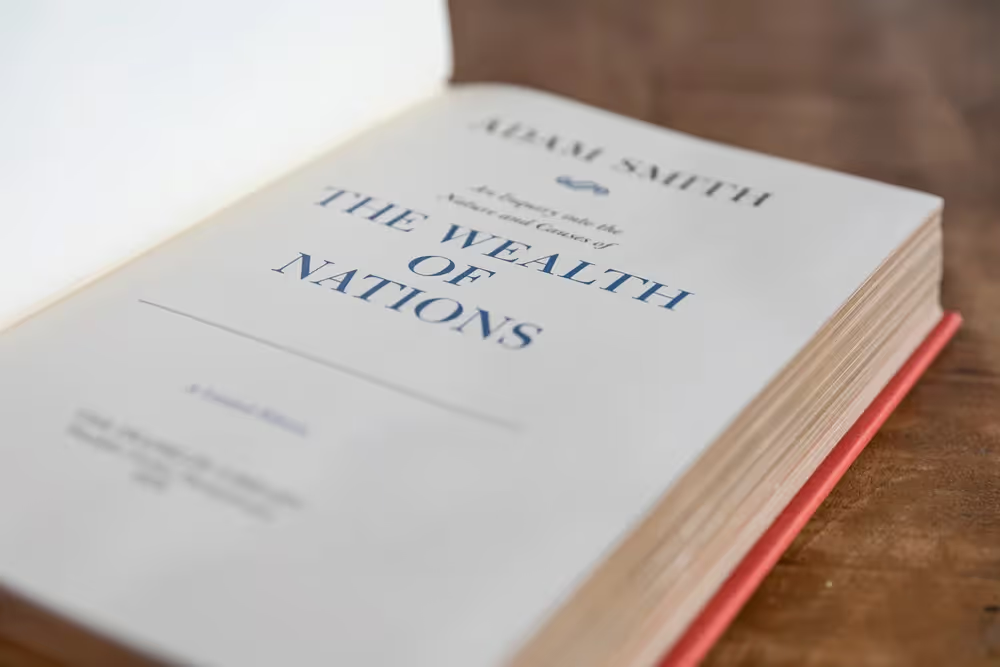
The Wealth of Nations at 250: Adam Smith’s Blueprint for the American Economy

Remembering The Wealth of Nations at 250 is not about reverence for an old book. It is about understanding why a decentralized, specialized, and institutionally grounded economy has served America so well, and why abandoning those principles would be a costly mistake.
In 2026, two anniversaries arrive together with unusual resonance. The United States will mark 250 years since its founding. At the same time, Adam Smith’s The Wealth of Nations, first published in 1776, turns 250 years old. The coincidence is not accidental. Ideas of few books have shaped the economic logic of the American experiment more profoundly, even when Americans have not always realized it as an agent that promotes prosperity and reduces poverty.
The Wealth of Nations was read by many prominent American founders, including Alexander Hamilton, James Madison, and Thomas Jefferson.
In a 1790 letter to Thomas Mann Randolph, Jefferson wrote, “In political economy, I think Smith’s Wealth of Nations the best book extant,” and in 1807 wrote that “Smith’s wealth of nations is the best book to be read, unless Say’s Political Economy can be had, which treats the same subjects on the same principles.”
Hamilton relied on The Wealth of Nations as a major source when discussing the division of labor and economic policy in his Report on Manufactures. Draft manuscripts of the Report on Manufactures show that Hamilton quoted Smith directly, even marking specific page references to Smith’s Wealth of Nations edition (Hamilton generally agreed with Smith’s arguments for specialization though took Smith’s defense exceptions to free markets further arguing for a more active government and the use of "infant industry" tariffs and subsidies at the dawn of America to compete with the British and French).
But what does The Wealth of Nations say? The Wealth of Nations was not written as a manifesto for minimal government (Adam Smith was not some anarcho-libertarian). It was written as an inquiry into why some societies grow rich while others stagnate, and what institutional arrangements allow ordinary people to become more productive over time. Adam Smith wrote The Wealth of Nations primarily to challenge the prevailing mercantilist economic system, arguing that national wealth arises from productive labor and free trade (with exceptions for national defense), rather than from the accumulation of gold that characterized mercantilist societies.
Smith’s answers, centered on specialization, decentralization, and a carefully defined limited role for government, map remarkably well onto the sources of American economic success.
Smith’s most famous insight appears at the very beginning of the book. The division of labor, he argued, is the primary driver of productivity growth. By allowing individuals to specialize in narrow tasks, societies unlock increases in skill, efficiency, and innovation that no centralized authority could ever design. Productivity gains and prosperity do not come from genius central planners but from countless small marginal improvements made by the people closest to the work.
This logic became a defining feature of the American economy. From early agriculture to manufacturing to current-day services and technology, the United States has consistently allowed specialization to deepen across regions, firms, and occupations. Farmers, machinists, engineers, financiers, and entrepreneurs each focused on what they did best, connected through markets that coordinated their efforts without requiring central direction. The result was not just higher output, but sustained growth over generations.
Closely related to specialization is decentralization. Smith emphasized that economic knowledge is dispersed. Prices, profits, and losses convey information about scarcity and demand that no single authority can fully observe. Attempts to direct production from the top down inevitably fail because they override this information rather than harness it.
Also important was the common law legal tradition inherited from Britain, which, as later emphasized by the legal origins literature, allowed decentralized private actors to form and adapt contracts through judge-made law and precedent rather than detailed state planning of civil law systems, supporting market exchange in a way largely independent of centralized government direction.
This legal foundation was reinforced by the United States Constitution, whose deliberate difficulty of amendment committed the country to stable property rights and limits on arbitrary government action, giving investors and entrepreneurs confidence that the rules of the economic game would not shift under short-term political pressures.
American federalism reflected this same insight. Economic decisions were largely left to states, local governments, and private actors. Experimentation flourished as states acted as laboratories of democracy, as coined by U.S. Supreme Court Justice Louis Brandeis. Successful practices spread, unsuccessful ones faded. This decentralized structure proved resilient, adaptable, and innovative, especially compared with more centralized European economies of the eighteenth and nineteenth centuries.
Yet Smith never argued that government should withdraw from economic life altogether. On the contrary, The Wealth of Nations, particularly Book V, lays out a substantial and carefully reasoned role for the state. Smith believed the government had a duty to provide national defense, administer justice, enforce contracts, and supply public works that private markets would underprovide. State-subsidized roads, bridges, ports, and education are prerequisites for a productive commercial society in Smith’s vision.
Notably, Smith also supported taxation to fund these functions, and he did so on principles that remain strikingly relevant to how many economists today think about optimal taxation. He argued that taxes should be proportional to ability to pay, predictable, and minimally distortionary.
America’s early economic development reflected this balance. Markets were largely free to operate in most domains, while the government invested heavily in infrastructure, land surveys, education, and legal institutions. The Erie Canal, the land grant universities, and later the interstate highway system all fit comfortably within Smith’s framework. They were public investments that expanded the scope for private specialization and exchange.
Smith also makes exceptions for tariffs and industrial policies in cases of national defense. In Book IV, Chapter II, Smith discusses how the defense of Great Britain depended on its sailors and shipping, justifying the Navigation Acts (which granted a monopoly on trade to British ships) as a necessary measure for national defense, even if costly to consumers.
Over time, debates about Smith’s legacy hardened into caricatures. Supporters of free markets often portrayed him as categorically hostile to government like a current day libertarian . At the same time, critics treated him as a free market libertarian supportive of “unfettered markets”. Both views miss the core of The Wealth of Nations. Smith’s concern was not the size of government per se, but whether government actions complemented or obstructed the division of labor and decentralized coordination that drives growth and reduces poverty.
When the government attempts to pick winners, suppress competition, or protect entrenched interests, it undermines the very mechanisms that generate prosperity. When it provides public goods, enforces laws, and finances itself transparently and broadly, it strengthens them. The distinction is institutional and legal, not ideological.
As America approaches its 250th anniversary, these lessons remain highly relevant. Economic debates today often oscillate between populist calls for heavy-handed industrial policy and libertarian demands for complete withdrawal of government. Smith offers a more mixed standard. The question is not whether government acts, but whether it acts in ways that protect specialization, decentralization, and the limits of centralized knowledge.
The American economy grew rich not because it rejected government, but because it largely avoided using government to override market signals. It used government to create a strong and predictable regime of property rights, light regulation, and reasonable taxation. It allowed people to specialize, regions to differentiate, and firms to rise and fall. At the same time, it built economic institutions in ways consistent with Smith’s principles.
Two hundred and fifty years after The Wealth of Nations, and two hundred and fifty years into the American experiment, the core insight still holds. Prosperity is not planned into existence. It emerges from systems that let individuals focus on what they do best, coordinate through markets, and operate within a framework of law, property rights, and limited public investment. This, in turn, helps lift many out of poverty.
Smith ultimately offered a blueprint for growth grounded in realism about human knowledge and incentives. America’s most significant economic successes came when it followed that blueprint, even imperfectly. Remembering The Wealth of Nations at 250 is not about reverence for an old book. It is about understanding why a decentralized, specialized, and institutionally grounded economy has served America so well, and why abandoning those principles would be a costly mistake.
Jonathan Hartley is a research fellow at the Civitas Institute, a senior fellow at the Foundation for Research on Equal Opportunity, a senior fellow at the Macdonald-Laurier Institute, and podcast host of Capitalism and Freedom in the 21st Century at the Hoover Institution.


Can Civic Friendship Save America?
Start with “civic assimilation” on the way to a more peaceful Union.

Mansfield’s Insufficient Protest
Harvard’s failings are not episodic but systematic and rooted in a view of the human person that Mansfield himself has consistently tried to resist.

Anger Management
Jonathan Turley’s 'Rage and the Republic' stands out as a worthwhile addition to the growing list of books on the Revolution.
.jpg)
.jpeg)



.jpg)

Get the Civitas Outlook daily digest, plus new research and events.
Get the Civitas Outlook daily digest, plus new research and events.