
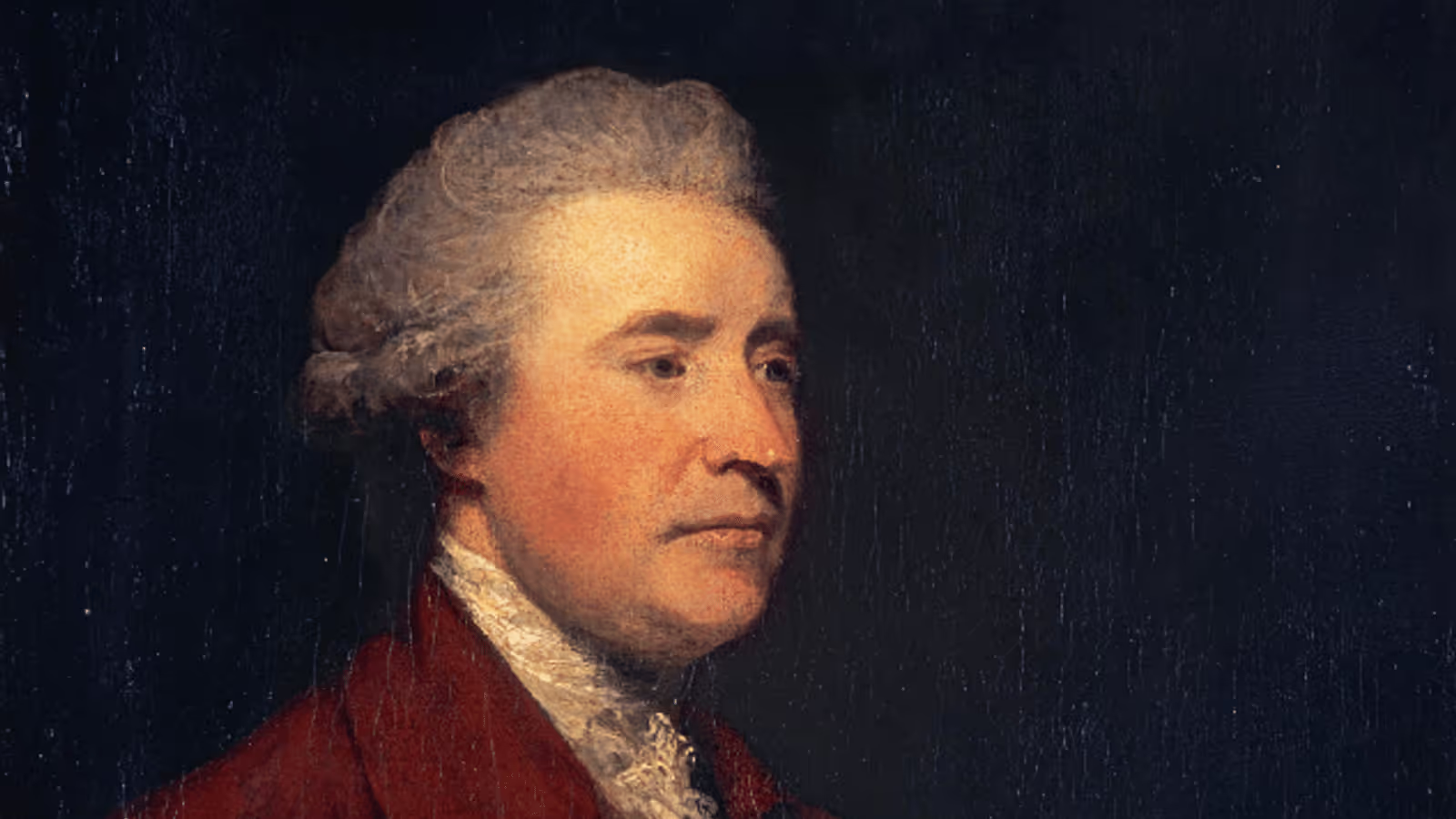
What Did the Godfather of Conservatism Think about the Jewish People?

Groyper exhibitionists craving to tear down social order through vitriol and bigotry may not be friends to the Jewish people, but the father of Anglo-American conservatism was.
Playing footsie with a Groyper is child’s play, but scrutinizing the roots of conservatism’s relationship with Judaism is a test of intellectual valor. Would Tucker dare pass it? The debate over conservatism and anti-Semitism, sparked by the Fuentes-Carlson affair, prompts the question of how Edmund Burke, an Anglican, understood the Jewish people. Although Burke’s most famous work, Reflections on the Revolution in France, is known as the founding text of conservatism, it also subtly pushes anti-Semitic tropes that fed the prejudices of the book’s discerning readers. Yet Burke demonstrated deep sympathy toward the Jews in other contexts, including in one overlooked episode of his life when he established a firm moral argument in defense of the global Jewish community. The conservative godfather’s fondness for the Jewish people, in short, revolts against the irritable mental gestures of Groyper drivel.
Burke’s Defense of the Jews
An underappreciated occurrence in Burke’s life during America’s War of Independence conveyed his evident affection for the Jewish people. In February 1781, nine years before the publication of the Reflections, British naval forces captured the Dutch-controlled island of St Eustatius, which had been serving as a channel for the transport of military supplies to the Americans and the French during the war. Upon capturing the island with the assistance of General John Vaughan, British Admiral Sir George Brydges Rodney, burdened by debt, soon feasted his widening eyes on the bounty that fell into his lap. St Eustatius was a prosperous community of merchants, spanning various nationalities and ethnicities, that held considerable amounts of property. Rodney proceeded to pillage the island and seize its inhabitants' wealth. The Jewish merchants on the island, numbering around one hundred families with established roots in the community, were not spared from Rodney’s promiscuous plunder.
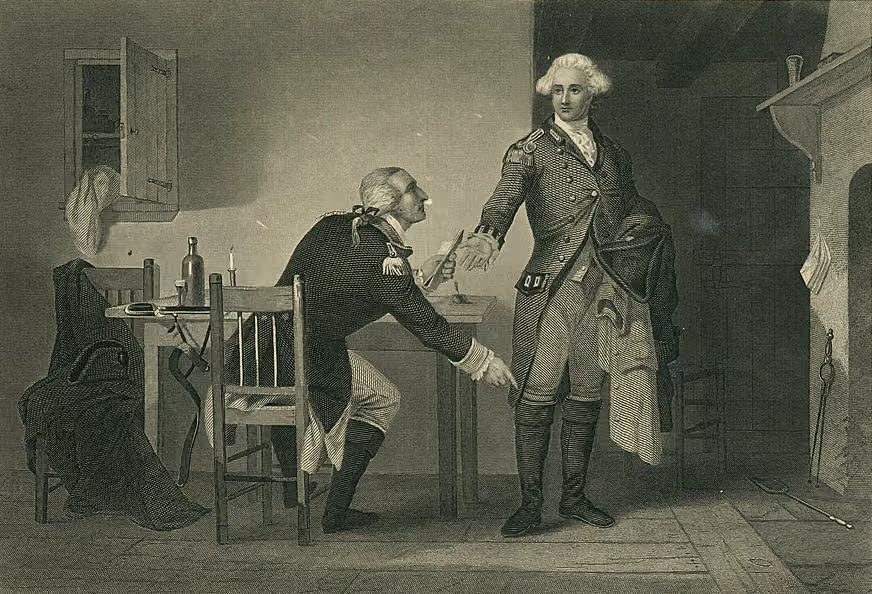
Burke was generally sensitive to threats directed at the propertied interest in West Indian politics. But Rodney’s merciless raids lit a special fuse in Burke’s conscience, provoking the parliamentarian to motion for an inquiry into Rodney’s confiscations, which the House of Commons denied. Yet Burke delivered two parliamentary speeches throughout this ordeal that defended the honor and integrity of the Jewish people and cryptically insinuated that the Jews warranted a nation of their own. The latter speech, given in December 1781, exposed the distinctive savagery the Jews suffered under Rodney. “The poor Jews at St Eustatius were treated in a worse manner, if possible, than all the other inhabitants,” he pronounced. Burke cast a spotlight on Samuel Hoheb, a “venerable old gentleman” who was “treated in the most harsh manner,” his money having been seized from the inside of his coat before he was expelled from the island, where he had lived for twenty-five years, without due process.
During his speech, Burke displayed a piece of linen that was part of this coat, offering physical proof and an affecting metaphor of Rodney’s debasement of Hoheb’s dignity. Hoheb was “ill treated because” — wait for the horror — “he had endeavoured to carry away some of his own money.” Burke later presented a petition calling for compensation for Hoheb's losses, an effort that apparently failed. Hoheb was eventually allowed to return to St Eustatius, only to learn that his inventory had been sold for a third of its price and his warehouses ransacked, which reduced Hoheb to “poverty and absolute Want.”
Burke’s earlier speech on the plundering of St Eustatius, in May 1781, also decries Rodney’s assault on the Jews. In addition to Hoheb’s agony, Burke discusses several instances of other Jews enduring this dreadful tribulation, including Myer Pollock, who was “stripped of all he was worth.” These Jews had remained loyal to the British, yet fidelity to the Crown was no match for the sparkle of plunder. Such persecution, Burke makes sure to mention, was “not confined to the Hebrew nation,” taking note of other St Eustatius inhabitants whose property had been usurped.
Burke could have drawn attention to Rodney’s specific acts of cruelty toward Hoheb, Pollock, and other Jewish merchants, as part of his political campaign criticizing Britain’s war against the American colonies, and left his speech at that. What is intriguing in this earlier speech, however, is Burke’s decision to submit broader comments on the status of the Jews in the global order. He contends that, because the Jewish people held no permanent home, they “ought to be the care and the wish of humane nations to protect” them. The Jews had no “fixed settlement in any part of the world, no kingdom nor country in which they have a government, a community, and a system of laws.” They were therefore “thrown upon the benevolence of nations, and claim protection and civility from their weakness, as well as from their utility.” This utility encompassed the “links of communication” that Jewish merchants forged in the “mercantile chain” worldwide. Whatever “vices” they did contract naturally emerged from their “dispersed, wandering, and proscribed state.” Notice here that, unlike in the Reflections, as we shall learn, Burke portrays Jews’ dexterity in commerce and finance in a positive light.
Accordingly, the Jews’ “abandoned state, and their defenceless situation calls most forcibly for the protection of civilized nations.” If the Dutch and the British were attacked, Burke explains, they could use their nations, governments, and militaries as a sturdy shield against aggressors. “But,” he continues, “the Jews have no such power, and no such friend to depend on. Humanity then must become their protector and ally.” Other peoples and nations carried the moral responsibility to protect them from the specter of rapine and violence. Burke does not go so far as to assert that the Jewish people deserved a nation of their own, but his argument dangles this conclusion in front of his audience.
A listener to his speech might reason: if a nation — such as the Dutch nation and the British nation — provided the resources necessary to defend their people from threats to their livelihood, then a Jewish nation would have the same effect on the Jewish people, lest they continue to rely on the benevolence of others for their protection. Instead of just noting the oppression of Jewish merchants on St Eustatius and petitioning for Hoheb's compensation, Burke tactfully raises the intensity of his appeal. He highlights the torment of Jews worldwide, presents a resolute moral argument affirming their honor and dignity, and indirectly suggests that a Jewish nation could help deliver the Jewish people from persecution.
Judaism by no means was the only non-Christian religion that commanded Burke’s respect throughout his life, for liberty of conscience was a sacred principle engraved in his latitudinarian outlook. Burke supported religious toleration toward dissenting Christian sects, Muslims, Jews, and even Pagans, as long as they did not threaten the supremacy of the Church of England, though he held more reservations about granting this freedom to anti-Trinitarians. He was even more favorable toward Hinduism. Burke furthermore refused to validate the clergy of the Church of Scotland when they were accused of using incendiary anti-Catholic language. Holding that he possessed “that degree of respect for all other religions” in addition to Christianity, Burke insisted that he “could not prevail on myself to bestow on the Synagogue, the Mosque or the Pogoda, the language which your Pulpits lavish upon a great part of the Christian world.” Fury and malice had no place in Burke’s treatment of religious difference.
Reflections on the Revolution and Anti-Semitism
In his philippic against the French Revolution in the Reflections nine years later, however, Burke slips in remarks hinting at prevailing shibboleths surrounding the Jews in eighteenth-century England. As Frans De Bruyn explains, Burke’s portrayal of the French mob forcing the King and Queen of France back to Paris evoked the image of via dolorosa (“way of suffering”), the route Jesus was forced to take by Roman soldiers to the place of his crucifixion. The subtext, in turn, implicates the Jews in Jesus’ death. Burke periodically associates Jews throughout the Reflections with stockjobbers, an activity he suggests did not cultivate the necessary habits of citizenship — a criticism of the mercantile class that spans back to Aristotle’s Politics. Burke sprinkles in similar innuendo connecting Jews to the political radicalism and intolerance of Protestant dissenters and to the legerdemain of the new financial oligarchy in Paris, novel political influences that, in Burke’s view, reeked of insurrectionist tendencies.
But some of the language that appears to deliver jabs at Jews yields, on a second reading, a more tempered conclusion about the presence of anti-Semitism in the Reflections. Burke’s attack on Lord George Gordon, a convert to Judaism, for instigating the anti-Catholic Gordon Riots, derisively called on Gordon to “meditate on his Talmud” in prison. Burke’s point, however, was not to ridicule the Talmud — mocking sacred texts of any religion for him was out of bounds — but to censure Gordon for defaming the Queen of France and for his generally seditious and pestiferous behavior. Burke then goes on to suggest that Gordon’s misconduct was “disgraceful to the ancient religion to which he has become a proselyte,” indicating that his reckless indiscretions were not worthy of Judaism. Even Burke’s criticism of Jewish stockjobbers can be persuasively interpreted not as a rebuke of the Jewish people but as a reflection of his belief, as mentioned, that experience in trade and finance did not, in itself, breed the virtues of responsible statesmanship. These were tenable vocations in Burke’s judgment, so long as they did not shake the foundations of religion and the nobility.
Burke’s allusions to the Jewish people and Judaism throughout the Reflections never reached the level of anti-Semitic vitriol from someone like Voltaire, much less that from many anti-Israel campus protestors and Groypers of today. Such remarks were far from the vicious forms of modern anti-Semitism Hannah Arendt would describe in The Origins of Totalitarianism, although these movements would later seize on some of the anti-Semitic tropes of the eighteenth century with which Burke flirted. It is safe to say Burke would have been appalled at the anti-Semitic campaigns fueled by twentieth-century totalitarian regimes.
Burke and the Contemporary Scene
Speculating on what a historical figure would think about contemporary public affairs is always a treacherous exercise. But let’s go with it: what might Burke’s response be to recent debates surrounding university protestors’ reactions to the Hamas attacks, the Fuentes-Carson affair, and Judaism’s status in the United States? Based on his zealous endorsement of Christianity but also on the grace he extended to non-Christian religions, I suggest he would most likely: condemn the vile anti-Semitism of the protestors, in addition to that of twentieth-century totalitarian regimes; maintain that one could be a critic of Israel and a proponent of isolationism without being an anti-Semite; and denounce Fuentes and Carlson for abetting the diffusion of neo-Nazi doggerel.
Burke would also defend, without a quiver of hesitation, Christianity as the superior among all the world’s religions, Judaism and otherwise; maintain that Jews and other religious minorities had the right to exercise their religion free from persecution; Jews and other cultural and religious minorities practiced distinctive customs, traditions, and belief systems that should be respected, even if one did not fully endorse them; insist nevertheless that Christianity, given its deeply embedded roots in the United States and its timeless ethical code, should be revived in America’s public square; and thus conclude that the rigid doctrine of the separation of church and state perpetrated by a string of U.S. Supreme Court decisions in the twentieth century should be weakened.
Burke’s legacy on this matter is not untainted. What explains the seeming shift in his treatment of the Jews from the St Eustatius episode to the French Revolution? His St Eustatius speeches testified to the special warmth he harbored toward the Jews in the backdrop of Britain’s war against the American colonies. They also reflected his acute sensitivity to the plight of persecuted peoples worldwide, a moral touchstone of his imperial political thought and cosmopolitan disposition.
Yet Burke’s dalliance with gratuitous anti-Semitic shibboleths in the Reflections marked his growing fear in the late eighteenth century of any real or perceived threat — dissenter, Jewish, atheist, or otherwise — to Europe’s Christian civilization. De Bruyn aptly concludes that Burke “helped to unlock an intellectual Pandora’s box from which others were to conjure worse malevolence.” But it is at the same time true that Burke’s commentary on the Jews in response to Rodney’s plunder helped to unlock a treasury from which others could draw to defend the global Jewish community against persecution. Groyper exhibitionists craving to tear down social order through vitriol and bigotry may not be friends to the Jewish people, but the father of Anglo-American conservatism was. Who are the insurrectionists now?
Gregory M. Collins is a lecturer in the Program on Ethics, Politics, and Economics at Yale University and the author of Commerce and Manners in Edmund Burke’s Political Economy. His book manuscript on the idea of civil society in early black political thought, featuring Richard Allen, Absalom Jones, Frederick Douglass, Booker T. Washington, Fannie Barrier Williams, Alexander Crummell, and W.E.B. Du Bois, is forthcoming by Cambridge University Press.


Fentanyl’s Deadly Successor Emerges
Start by admitting both that there is a growing Novel Psychoactive Substances (NPS) problem and that responsibility for its harms lies not only with nations like China and Mexico, but also with our own drug users and society.

What Is Wrong with Americans?
Tocqueville warned us against binding ourselves together under the allures of soft despotisms.




Get the Civitas Outlook daily digest, plus new research and events.
Get the Civitas Outlook daily digest, plus new research and events.