
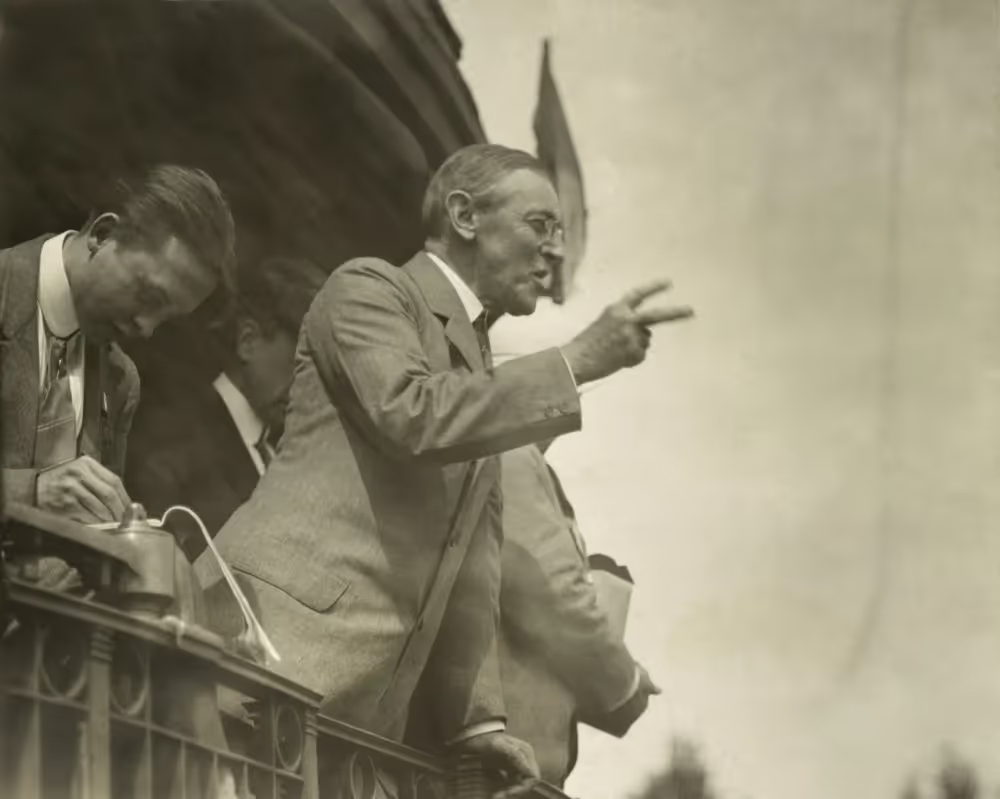
Looking For Solidarity in the Wrong Place

Like many criticisms of liberalism on the right, Reno’s version of liberalism is a strawman.
R. R. Reno, editor of First Things, calls on conservatives to reconsider “The Lessons of Woodrow Wilson” for inspiration in addressing the economic and social problems we confront today. According to Reno, Wilson’s legislative program — creating the Federal Reserve, establishing the Federal Trade Commission, banning child labor, and setting maximum hours for railroad workers — “addressed the economic problems of his day.” (For some reason, Reno omits other elements of Wilson’s program, such as tariff reduction and the federal income tax.)
Ronald Pestritto has ably critiqued Reno’s enlistment of Wilson. I would add one thing to Pestritto’s critique: Reno mischaracterizes the relationship between liberalism and regulation. He believes that liberalism was linked to laissez-faire, which necessitated Wilson’s illiberal policies to correct liberalism’s excesses.
In Reno’s formulation, liberalism requires “statesmen who address[] liberalism’s failures so that the American ideals of liberty could be renewed and reshaped for new circumstances.” His two great illiberal leaders are Woodrow Wilson and Franklin Roosevelt. These illiberal leaders were necessary to correct the excesses and failures of liberalism itself, mixing in a strong dose of the “solidarity” that liberalism needs to be sustainable. As Reno explains, Wilson and FDR offer examples in which “illiberal methods were employed to renew and buttress solidarity.” (Reno does not offer a precise definition of solidarity, but he suggests that it involves expanding “rights accorded only to property-holding white men…to encompass wage-earners, blacks, and women,” so that “those once excluded are included.” He seems specifically inspired by Wilson’s expansion of solidarity to wage-earners, since it can hardly be said that Wilson did much for the other groups he mentions.)
That solidarity was necessary, Reno argues, because the “economic problems of [Wilson’s] day” were the result of liberalism. Wilson’s measures “were denounced as violations of one or another aspect of the liberal principle of freedom of contract, which is the foundation of a free market unhindered by governmental intervention and regulation,” he tells us. Reno cites the Supreme Court’s decision in Lochner v. New York as a case which “upheld this liberal principle.”
This is a common account in histories of the Progressive Era. According to this narrative, the industrial revolution gave rise to a plutocracy of “Robber Barons,” aided by a “laissez-faire constitutionalism” deployed by courts to impede popular attempts to rein in economic power through regulation.
This narrative, however, is inaccurate. The alternative to Progressivism’s illiberal “solidarity” was not laissez-faire individualism, but a reasonable exercise of the state’s regulatory power – power that is not only compatible with liberalism, but is necessary for liberalism to exist in the first place. As a litany of scholarly studies have shown over the past sixty years, America was not a laissez-faire society before or during the early twentieth century. There was no need for Woodrow Wilson to come along and save us from laissez-faire liberalism by introducing his dose of “solidarity,” because laissez-faire liberalism did not exist in the first place. Liberalism, as the American Founders understood and practiced it, is perfectly compatible with regulations that protect the community.
A close reading of Lochner itself is enough to illustrate this alternative. Lochner concerned the legality of a New York law limiting bakers to a maximum of 60 working hours per week and 10 hours per day. The Lochner Court determined that the law “interferes with the right of contract between the employer and employees” and that this right of contract “is part of the liberty of the individual protected by the Fourteenth Amendment of the federal Constitution.”
At the same time, however, the Court acknowledged that “police powers” belong to the states, “the exact description and limitation of which have not been attempted by the courts.” Those police powers, the Court affirmed, “relate to the safety, health, morals, and general welfare of the public. Both property and liberty are held on such reasonable conditions as may be imposed by the governing power of the state in the exercise of those powers,” regardless of the Fourteenth Amendment’s protection of liberty.
In other words, even in Lochner itself, the Court acknowledged a) that the states possess police powers that authorize regulations relating to public health, safety, morals, and general welfare, and b) that when states exercise those powers for those legitimate purposes, the regulations would withstand scrutiny. Justice Peckham, the author of the Lochner opinion, pointed out that the Court had recently upheld a Utah law limiting hours for miners, in smelting and in many other contexts. These legal limits were upheld because they were legitimately related to public health and safety. By contrast, the law in the Lochner case was problematic because it “involve[d] neither the safety, the morals, nor the welfare of the public.” In Lochner, the law was not about safety, but about class legislation.
Justice Holmes’s famous dissent in Lochner essentially agreed with the majority’s characterization of the states’ police powers. Like Peckham, Holmes pointed out the wide range of matters subject to the police powers:
It is settled by various decisions of this Court that state constitutions and state laws may regulate life in many ways….Sunday laws and usury laws are ancient examples. A more modern one is the prohibition of lotteries….The other day, we sustained the Massachusetts vaccination law.
Both sides agreed in Lochner that states had significant regulatory authority and that courts had generally upheld the exercise of that authority when it extended to the police power’s legitimate objects. They disagreed on the more specific question, whether the law limiting bakers’ working hours was related to public health, safety, morals, or the general welfare.
Did Lochner change this long-settled understanding of the states’ police powers, introducing an era of laissez-faire that required presidents Wilson and Roosevelt to correct by introducing “illiberal methods?” Not really. As scholars pointed out then, and today, the Lochner decision was a departure from the norm – the exception that proved the rule. Charles Warren’s “The Progressiveness of the United States Supreme Court,” published in 1913, concluded that the Supreme Court “so far from being reactionary, has been steady and consistent in upholding all State legislation of a progressive type.” Warren exhaustively documented the various laws that came before the Supreme Court and survived, noting that the vast majority (557 of 560) state laws were upheld. From Tennessee to Utah, Massachusetts to North Carolina, Ohio to California, laws regulating wages, antitrust, workmen’s compensation, pure food, liquor and cigarettes, and licensing were sustained by the Court.
These laws, consistently sustained by the Court, were not illiberal admixtures to the laissez-faire, liberal polity. As Eric Claeys and I have both argued, regulation through the police power is not only consistent with liberalism’s conception of natural property rights, but is actually a necessary component of liberalism. The legal history of regulation in early America provides ample evidence for this view.
Like many criticisms of liberalism on the right, Reno’s version of liberalism is a strawman. According to Reno, liberalism is a libertarian political system founded on laissez-faire. This does not match the actual history of American law and regulation, but drawing that caricature allows Reno to assert that we need a figure like Woodrow Wilson to correct liberalism’s excesses.
In fact, no such “remedy” was needed. Liberalism is not opposed to community “solidarity.” It is consistent with regulation in the public interest. But where Woodrow Wilson envisioned national solidarity through a central state, administered by experts and led by a visionary president, the Founders’ liberalism empowered communities to regulate through officials who were accountable to them. For conservatives, the choice between these two options should be easy.
Joseph Postell is Associate Professor of Politics at Hillsdale College.


Fighting Anti-Semitism from the Bench
Judge Roy Altman wrote "Israel on Trial" not as a judge, but as an American who loves this country.
Justice Gorsuch’s Warning
'Slaughter' may have rid us of the headless fourth branch of government, but it might end up leaving us with an all-powerful presidency.
The Common Law and Citizenship in the Constitution: A Response to Linda Denno
The fatal flaw in Professor Denno’s argument is that she would elevate political philosophy above the original understanding of the constitutional text.



Get the Civitas Outlook daily digest, plus new research and events.
Get the Civitas Outlook daily digest, plus new research and events.