
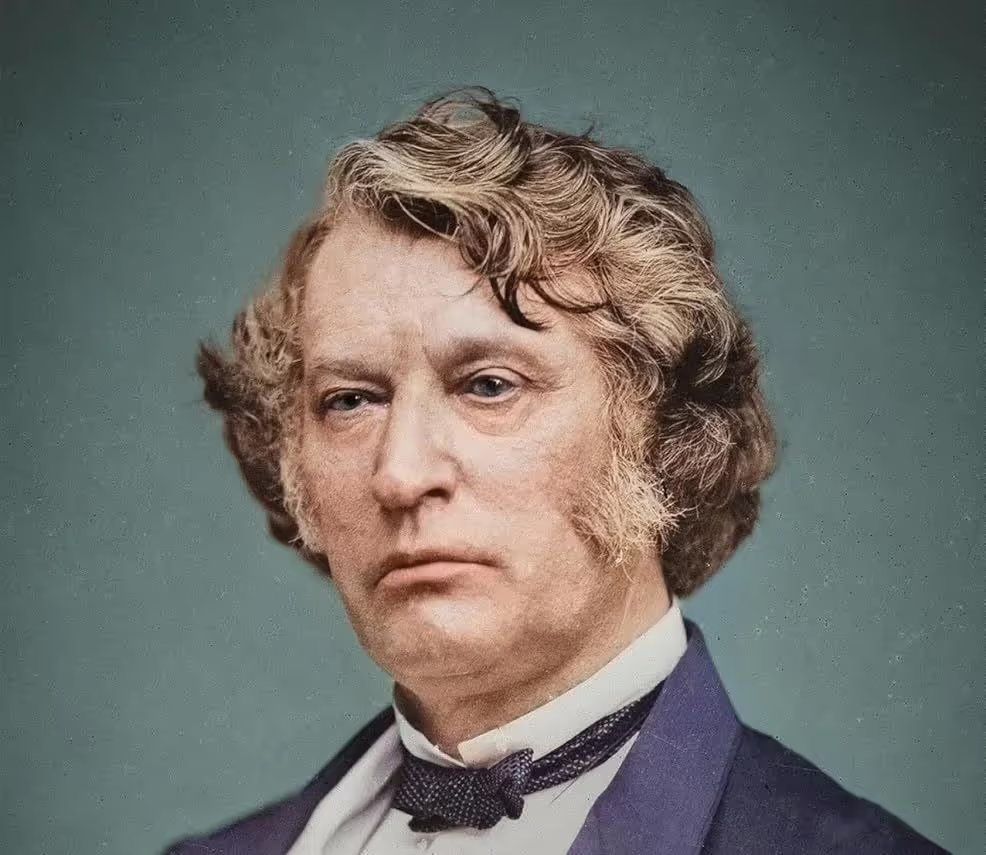
Charles Sumner’s Harmony with the Declaration

Zaakir Tameez narrates the life of a complex man whose boisterous personality transferred grassroots activism into antislavery legislation.
In 1940, Frank Owsley’s presidential address to the Southern Historical Association scorned the “egocentric sectionalism” of northern abolitionists for igniting the Civil War. He cited the usual suspects — Theodore Parker, Wendell Phillips, and William Lloyd Garrison — but he was also sure to mention one antislavery politician, Charles Sumner, among the cast of characters he considered “too indecent to quote.” This opaque blame is what Zaakir Tameez aims to set right in Charles Sumner: Conscience of a Nation, his new biography of the only actual legislator mentioned above. Unlike the moralistic terrorist that David Donald characterized in his two-volume biography a half-century ago, Tameez narrates the life of a complex man whose boisterous personality transferred grassroots activism into antislavery legislation.
But this is also no hagiography. Instead, Tameez treats Sumner “as a living, breathing person, who struggled with moral dilemmas, family crises, romantic longing, poor health, financial hardship, psychological trauma, tough friendships, and hard political conflicts.” Despite these flaws, Sumner’s reverence for the founding era and constitutional democracy led him to become a champion of legal theories aimed at combating slavery, racial inequality, and the suppression of civil rights. Tameez restores Sumner's status as a leading founder (if not the leader) of the Second Founding, returning him to “the place he deserves in the pantheon of American heroes.”
Raised in Boston’s poor, predominantly black neighborhood, Beacon Hill, Sumner was a gifted student with a passion for reading and debate. His interracial upbringing shaped his lifelong commitment toward securing civil rights for unfree and disenfranchised black Americans, even as he moved through elite circles at Harvard’s new Law School. Studying at Harvard brought opportunities and relationships he would not have developed otherwise. Massachusetts’ dignitaries Joseph Story and John Quincy Adams both served as lifelong mentors of Sumner. Following law school, he hated the menial tasks associated with actual legal work. Therefore, Sumner’s analytical talent and oratorical skill quickly propelled him to the Senate, where he was a minority voice who incessantly spoke against the unconstitutionality of slavery and racial inequality.
A true political outlier who bounced from party to party his entire career, Sumner’s eccentric personality and hot-blooded emotions both hindered and helped his efforts. His rigorous study and passion strengthened his most famous antislavery tirades, most notably “The Crime Against Kansas,” where he railed against the unconstitutionality of the Kansas-Nebraska Act and the violence wrought in its wake. In his speech, he used historical allusions to berate proslavery expansionism and the slave interests of southern senators. He compared Kansas under President Franklin Pierce to the leadership of Roman territorial governor Gaius Verres during the first century BC. Verres openly employed forms of torture and killing, such as crucifixion, on Roman citizens, even though Roman law forbade the use of those methods on its citizens. In Sumner’s eyes, Pierce echoed Verres’s actions in allowing proslavery mobs to use force in denying antislavery Kansans the right to speak against slavery. Turning to the architects of the Kansas-Nebraska Act, he compared one of its principal authors, South Carolina senator Andrew Butler, to the deluded ‘Don Quixote,’ the aging fool of Cervantes’s classic novel.
Even though Sumner could dish out these insults, his sensitivity to criticism left him easily bruised, resulting in sporadic states of melancholy and spells of endless crying, either from his failing love life or from public jabs from enemies. The inverse of the adage, “sticks and stones may break my bones, but words will never hurt me,” was perhaps true for Sumner. He seemed more offended by what people said about him compared to the time he was severely beaten with a gutta-percha cane by Preston Brooks in Congress. As the cousin of Andrew Butler, Brooks felt his home state of South Carolina and his family’s honor had been offended in Sumner’s oration against the Kansas-Nebraska Act. But instead of challenging Sumner to a duel, which would have signaled he was worthy of that honor, Brooks preemptively executed a surprise attack on Sumner in the Senate chamber. This form of violence was so dishonoring in the South that it was largely reserved for enslaved people who received it as punishment. Brooks recalled striking Sumner thirty times before others intervened. Sumner went into a coma, and it took months to recover. Although he carried those injuries with him for the rest of his life, he rarely brought up Brooks’s name ever again. “What have I to do with him?” he once said. “It was slavery, not he, that struck the blow.” Despite this stoic response to physical violence, when people critiqued his words, he could not take it, often complaining to his friends how unlovable he was. A friend summarized his reactivity best: “Sumner uses words as boys do stones….to break windows and knock down flower pots, while he all the time plays offended.” But Tameez highlights that his emotive and animated personality also helped him galvanize support for his antislavery goals.
Sumner formed alliances with anyone willing to support his causes. One of the most standout features of Tameez’s characterization of Sumner is his ability to appear both conservative and liberal at the same time. Although he was a bookish lawyer and statesman, his closest friends were romantic reformers, ranging from Samuel Gridley Howe to Henry Wadsworth Longfellow, and even the Garrisonian abolitionist, Wendell Phillips. In fact, if someone were looking for Sumner in Boston, they would not go to his home, but to Garrison’s central office for the American Anti-Slavery Society. Sumner was like most radical abolitionists, celebrating the Declaration of Independence’s self-evident truth that all men are created equal, often referred to by abolitionists as the “Spirit of '76.” But he also disagreed with his closest friends by committing himself to antislavery constitutionalism. He went further than most abolitionists and politicians, demanding that the Declaration serve as the interpretative lens for all readings of the Constitution. While Garrisonians were quick to detach the Declaration of Independence from the Constitution, Sumner read them in tandem. As fellow Massachusetts senator George Hoar stated, “[Sumner’s] political creed, his political Bible, his Ten Commandments, his Golden Rule, were the Declaration of Independence and the Constitution of the United States penetrated, illuminated, interpreted by the Declaration of Independence.”
Given this, Sumner had a deft ability to exist between the poles. As Tameez writes, he had a way of “combining conservative and progressive ideas,” thus recasting his goals in ways that neither abolitionists nor shrewd jurists could deny. Whether it be the end of slavery, national enforcement of equality before the law, or the spread of human rights after the Civil War, he saw all this work supported by the mutual work of the Declaration and Constitution. He read the Constitution as liberal jurists do today, “open-handed, liberal, and just,” always favoring human rights and freedom. But he was also like conservative jurists today in that he demanded the historical context ought to be “animating the ideas in which our institutions were born” in all constitutional interpretation. Proslavery advocates rejected this, insisting that the Constitution intended for slavery to be perpetual despite what the Declaration said about unalienable rights. One proslavery politician even called the Declaration’s opening line a “self-evident lie.” But Sumner disagreed and proclaimed the “conservatism of ’76” implied that slavery and racial inequality had no place in the republic.
Sumner’s twofold commitment to constitutional nationalism and equity jurisprudence reinforced his efforts to abolish slavery and fight for black enfranchisement after the war. While constitutional nationalism maintained that the national government reigned supreme over the states, Sumner did not think this was the same as federalism. Constitutional nationalism, according to Sumner, was the national government’s authority to ensure states did not violate the protection of the Declaration’s unalienable rights: the right to life, liberty, and the pursuit of happiness. These rights also included civil and legal equality for its citizens, a project that, to this day, is known as equity jurisprudence. Sumner argued these two ideas, constitutional nationalism and equity jurisprudence, had been violated by what he called the “Slave Oligarchy.” Both ideas also had to be applied together. Just as he argued the Declaration ought to be read alongside the Constitution, so was equity jurisprudence to be used within a framework of constitutional nationalism.
Two instances illustrate Sumner’s twofold appreciation for constitutional nationalism and equity jurisprudence. First, Sumner is credited with codifying the phrase “equality before the law,” which evolved into the equal protection clause in the Fourteenth Amendment. Sumner first used this line as a lawyer in a civil rights case that mirrored the scope of Brown v. Board of Education. Although Sumner lost his case, Thurgood Marshall cited Sumner in the landmark civil rights win a century later. Even before the war’s end, Sumner demanded that his fellow senators advocate the inclusion of the phrase “equality before the law” while drafting the Thirteenth Amendment, so that it would give “precision to that idea of human rights which is enunciated in our Declaration of Independence.”. Sumner believed equity jurisprudence was visible in the Declaration and thus had to be forcibly engrafted into the Constitution by the Fourteenth Amendment. Second, Sumner’s constitutional nationalism appears in each of the Reconstruction amendments’ “enforcement clause.” Giving Congress the authority to enforce the amendments thus meant the national government overruled what Sumner called “the dogma and delusion of State Rights.” This was all to ensure that a republican form of government, and therefore a multiracial democracy, was the expected governance for all states. As Sumner argued, the Constitution “must be interpreted, in harmony with the Declaration of Independence, so that Human Rights shall always prevail.” Tameez notes that the only thing that sapped Sumner’s effort after the war to expand human rights — civil, educational, and political — was the declining unity in the Republican Party and his failing health.
Despite his success championing antislavery legislation and human rights in the halls of Congress, Sumner’s stubbornness got the best of him. For example, after a Republican colleague, Matthew Carpenter, agreed to Sumner’s civil rights bill with minor alterations, Sumner balked. Refusing to accept the changes, Sumner berated Carpenter in a speech on the Senate floor, killing a friendship and the possibility of the bill’s passing in his lifetime. Not to mention, he always struggled committing to women who showed interest, and his closeness to male companions has influenced Tameez to suggest he was homosexual. Nevertheless, perhaps because he was sick of rumors that spread about the reasons for his bachelorhood, he married a Washington socialite, Alice Hooper, in the last leg of his career. But she detested his devotion to politics over her, only to end in a quick separation.
Despite his personal struggles, Tameez shows that claims of fanaticism ultimately pale in comparison to Sumner’s contributions to American constitutionalism. Tameez’s accessible prose will invigorate readers as he weaves together the life of a man who inspired a century-long pursuit of civil rights, even after his death. A man of conscience, Sumner was, in the words of W.E.B. Du Bois, “a seer of democracy” who indomitably worked to tether the Declaration’s principles to American constitutionalism. In commemorating the 250th anniversary of the most cherished document in Sumner’s catalog, readers will come away from Tameez’s work with a greater appreciation for how Sumner used the Declaration to increase the Constitution’s pursuit of forming a more perfect union.
James Howard is a PhD candidate in the history department at Baylor University and assistant book review editor of the Journal of Church and State.


%2C_Ancient_Rome%2C_1757.jpg)





.png)
.png)
Get the Civitas Outlook daily digest, plus new research and events.
Get the Civitas Outlook daily digest, plus new research and events.