
Obamacare Should No Longer be SCOTUScare

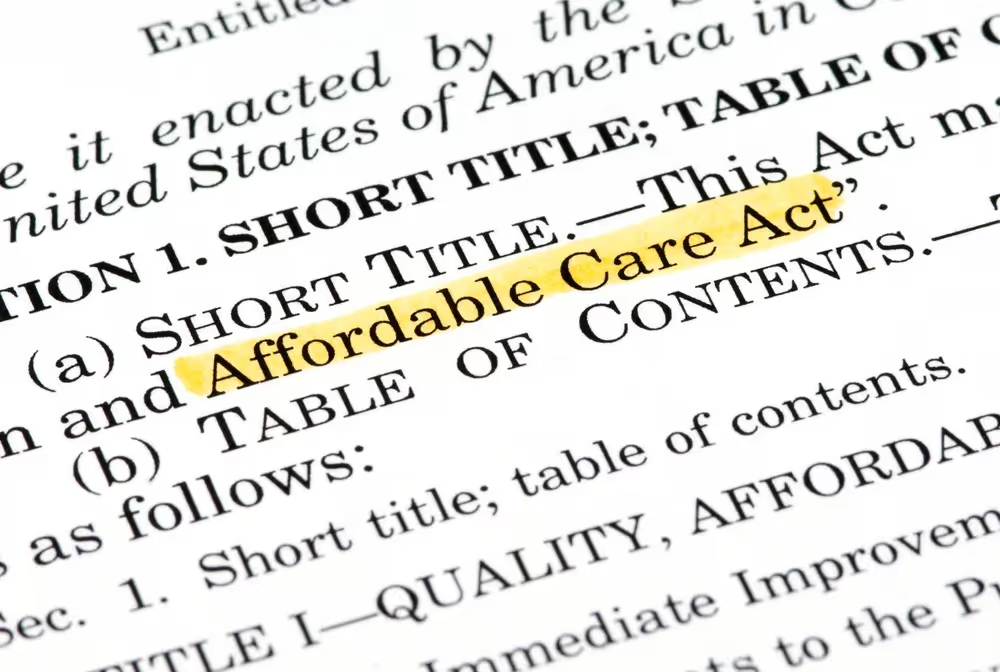
Now that Republicans are considering broader reforms to the ACA tax subsidies, they should use the opportunity to bring Obamacare into compliance with the rule of law and retire “SCOTUScare” for good.
Congressional Republicans are proposing to reform Obamacare by steering tax credits to high-deductible plans with health savings accounts purchased on federal and state exchanges. While they’re at it, they should make the use of tax credits on the federal health-insurance exchange legal in the first place. 70 percent of consumers who have insurance today through an Obamacare marketplace used tax credits to purchase insurance on the federal exchange, HealthCare.gov, even as the text of the law limits these subsidies to policies purchased “through an Exchange established by the State.”
The Supreme Court addressed this issue in King v. Burwell (2015). By a 6-3 vote, the justices stretched the Affordable Care Act (ACA)’s language reserving the use of tax credits to exchanges established “by the State” to permit subsidies on exchanges set up by the states or the federal government. 17 million Americans’ health insurance shouldn’t rest on a dubious ruling.
To quote Justice Scalia’s dissenting opinion: “Words no longer have meaning if an Exchange that is not established by a State is ‘established by the State.’” Defenders of the ACA claimed that the restriction on tax credits was merely a “typographical error.” If that were the case, Congress would have been remarkably targeted in its typos. The ACA refers to exchanges “established by the State” in seven separate places. Rewriting this term to encompass federal exchanges across the ACA, as the dissent pointed out, “makes nonsense” of these other provisions. The majority opinion conceded as much when it clarified that its interpretation of “State” to mean “ State and Federal” applied only to the ACA’s tax credit provision and not to the other parts of the law. Considering this and other “somersaults of statutory interpretation,” Justice Scalia jested that the law should be renamed “SCOTUScare.”
Predictably, mainstream media regaled Chief Justice Roberts, the author of the majority opinion in King, with full Profiles in Courage treatment. “The Supreme Court Saves Obamacare, Again,” the New York Times editorialized. “Federal subsidies survive. A crisis of government has been averted,” sighed New York Magazine. “John Roberts,” opined Harvard Law professor Laurence Tribe, “handed the people . . . a resounding victory.”
Nonsense. The ACA encouraged the formation of state exchanges by providing enrollees on these marketplaces with tax subsidies. People in states without exchanges would have to shop for insurance without subsidies on the federal exchange. The justices in King didn’t save Obamacare. They saved red states from having to choose between establishing state exchanges or turning blue.
Take Florida and Texas, both of which have declined to establish state exchanges. At the time of the King decision, around 1.27 million people in Florida had signed up for subsidized policies through the federal marketplace, almost twice as many as the number of votes who provided then-Senator Marco Rubio’s victory margin in his 2016 re-election and 40 times as many as the roughly 32,000 voters who made up Ron DeSantis’s razor thin gubernatorial victory in 2018.
In the Lone Star State, Beto O’Rourke came within roughly 200,000 votes of unseating Ted Cruz in an unexpectedly tight 2018 Senate race. At the time, over one million Texans were insured through the federal exchange, with 86 percent of these enrollees receiving federal subsidies. Does anyone think that voters wouldn’t have punished Republican candidates in states that continued to hold out?
Even with the Supreme Court’s embrace of textualism with the addition of three Trump appointees, it’s unlikely that the justices will revisit King. The Supreme Court applies a higher bar when overturning past decisions interpreting Acts of Congress, such as the ACA, than when construing constitutional text. Whereas correcting wrongly decided constitutional cases requires a herculean effort in the form of a constitutional amendment, critics of the justices’ statutory interpretations, as Justice Kagan remarked in Kimbel v. Marvel Entertainment (2015), “can take their objections across the street, and Congress can correct any mistake it sees.”
Whatever one makes of the Supreme Court’s “why bother” attitude to its prior statutory rulings, Republican leaders in Congress should accept the invitation to provide a legal fix here. Democratic lawmakers could have authorized subsidies for use on HealthCare.gov when they expanded the Premium Tax Credits to cover upper-income earners in 2021 and extended these extra subsidies in 2022, but they failed to address the statutory gap both times. Now that Republicans are considering broader reforms to the ACA tax subsidies, they should use the opportunity to bring Obamacare into compliance with the rule of law and retire “SCOTUScare” for good.
Michael Toth is the Director of Research at the Civitas Institute at the University of Texas at Austin.

Justice Gorsuch’s Warning
'Slaughter' may have rid us of the headless fourth branch of government, but it might end up leaving us with an all-powerful presidency.

The Common Law and Citizenship in the Constitution: A Response to Linda Denno
The fatal flaw in Professor Denno’s argument is that she would elevate political philosophy above the original understanding of the constitutional text.

The End of Independent Agencies
"We have tolerated adventurous theories long enough. It is time to return, all the way, to the Constitution."





Get the Civitas Outlook daily digest, plus new research and events.
Get the Civitas Outlook daily digest, plus new research and events.