
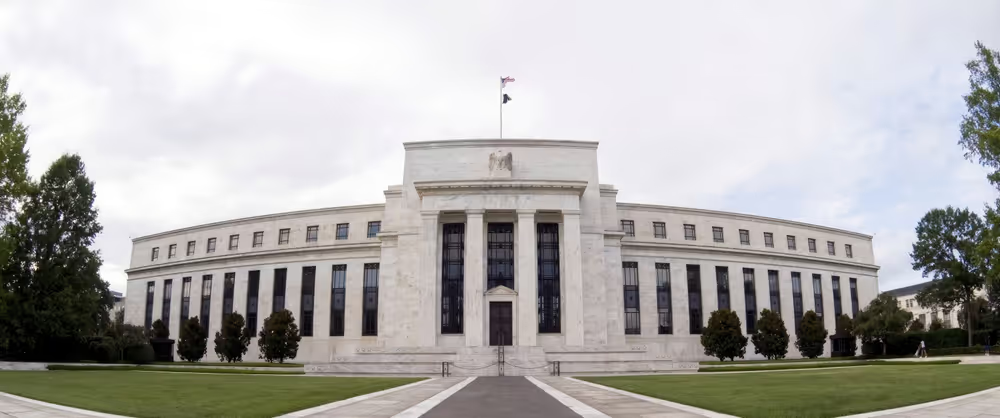
Kevin Warsh’s Challenge to Fed Groupthink

Warsh’s intellectual lineage, disciplined policymaking, and skepticism toward the Fed's fashionable consensus are badly needed today.
Over the past decade, the Federal Reserve has run adrift, indulging in leftist politics, from green monetary and regulatory ambitions to its slow and hesitant response to the inflation of the early 2020s. More than ever, the Fed needs a refocused commitment to its core mission, embodied in the dual mandate of price stability and full employment. It needs independence not just from the executive branch, but from the broader political pressures that expanded the Fed’s remit during the Yellen and Powell years. Kevin Warsh offers an antidote.
Hoover Institution Distinguished Visiting Fellow and Federal Reserve Chair nominee Kevin Warsh was a student and research assistant of Hoover Institution Fellows Milton Friedman and George Shultz during his undergraduate years at Stanford in the late 1980s and early 1990s. From Arthur Burns to Ben Bernanke to Warsh, it is striking how many Federal Reserve chairs Milton Friedman personally crossed paths with and influenced to varying degrees. President Joe Biden claimed in 2020 that “Milton Friedman isn’t running the show anymore.” Perhaps the era of Friedman isn’t over after all.
Warsh’s intellectual lineage matters. Friedman and Shultz represented a tradition that emphasized institutional credibility, disciplined policymaking, and skepticism toward fashionable consensus, which can sometimes fall into error. Those virtues are badly needed today.
Secretary Steve Mnuchin acted to prevent Warsh from becoming Fed chair in 2018, instead pushing his preferred candidate, Jay Powell. With hindsight, one cannot help but wonder how much better a clear-thinking Warsh Fed might have responded to the inflationary surge of the 2020s and how much institutional drift toward woke and green capture from the political left might have been avoided.
It was groupthink across the Federal Reserve, academia, the media, and much of Wall Street that brought us “Team Transitory”, the idea that the post-pandemic era inflation would subside and that interest rate hikes were not warranted. “Team Transitory” dominated elite opinion, and dissent was dismissed rather than debated. The Fed’s response to the 2020s inflation was slow, not because the data were unknowable, but because the prevailing intellectual consensus discouraged timely action.
To be sure, from April 2021 through roughly October 2021, one could plausibly attribute much of the price surge to used-car prices, pandemic supply disruptions, and reopening frictions. But by the fall of 2021, it was clear that inflation was no longer narrow or transitory. The housing component of inflation (measured by owner-equivalent rents and comprising roughly one-third of the CPI basket) was accelerating. Many, including myself, were warning about this at the time. That was a flashing red warning light. Yet the Fed did not raise interest rates until March 2022.
It is unclear how much different inflation would have been had interest rates risen earlier. What is clear is how intellectually complacent the Federal Reserve and the broader policy establishment had become. The failure was not just one of timing, but of mindset.
This is where Kevin Warsh stands apart.
My favorite Warsh speech, “Challenging the Groupthink of the Guild,” which I saw him deliver in Washington in 2016, was prescient in ways that now seem almost uncanny. In it, Warsh argued:
“The economic brain trust at the Fed is a precious public resource. It ought not to be squandered by repeating outputs of broken models. The economic talent assembled should be aimed squarely at the toughest, most consequential economic issues of our time, for example, the vexing productivity shortfall in the U.S.”
That critique applies even more forcefully today. The Federal Reserve does not suffer from a lack of talent. It suffers from excessive intellectual conformity. Challenging that groupthink, rather than institutionalizing it, is precisely what the Fed now needs.
Nowhere is this clearer than on the Federal Reserve’s balance sheet, which sits squarely in Warsh’s crosshairs. After expanding dramatically during the global financial crisis, the Fed’s balance sheet never returned to anything resembling its pre-crisis footprint. What began as an emergency measure quietly became a permanent feature of monetary policy. A bloated balance sheet and a system of “ample reserves” were normalized without sufficient public debate or clear evidence that the benefits outweighed the costs.
Warsh has long warned that this quiet transformation of monetary policy is not benign. A permanently large balance sheet, while lowering long-term interest rates, can distort asset prices and weaken market discipline. While it encourages risk-taking by lowering long-term rates, it entrenches financial dependence on central-bank liquidity, making the financial system heavily reliant on the Fed. At times, the Fed’s attempts to engineer long-run interest rates through its balance sheet have moved in the opposite direction from short-term interest rates.
Confronting the balance sheet head-on has been a central theme in Warsh’s work for years. He understands that credibility is not built through ever-larger interventions, but through restraint, clarity, and a willingness to unwind extraordinary policies once a crisis has passed.
To be sure, tightening the balance sheet is not easy. The entire financial system has adapted to it. When the Federal Reserve tried to run down its balance sheet in 2019, it faced an illiquidity crisis in the repo markets. The Fed immediately reversed course on balance sheet tightening. Communicating a clear, long-run plan for the Fed’s balance sheet is a much needed task that the Warsh Fed can deliver.
Warsh is also willing to confront the empirical challenges with the Phillips Curve, the theoretical inverse relationship between unemployment and inflation that has broken down in recent decades. It was Phillips Curve thinking that led the Fed to raise interest rates prematurely in 2018, when its forecasted inflation did not materialize.
There's also an important open question on how large a staff you need to run a central bank. From the research conducted by Fed researchers, which is largely irrelevant to monetary policy, to the Federal Reserve System's failure to identify risk in uninsured deposits and mismatched interest rate risk at Silicon Valley Bank, there are many questions about how well the Fed is being managed operationally.
Kevin Warsh understands the Fed’s mandate, respects its independence, and is willing to question comfortable assumptions when the evidence demands it. At a time when credibility has been strained and mistakes have proven costly, that combination is not just refreshing. It is essential.
Jonathan Hartley is a research fellow at the Civitas Institute, a senior fellow at the Foundation for Research on Equal Opportunity, a senior fellow at the Macdonald-Laurier Institute, and podcast host of Capitalism and Freedom in the 21st Century at the Hoover Institution.

Diagnosis: Recession
'Recession' reads less like a technical macroeconomics monograph and more like intellectual history conducted with an economist’s data discipline.

From Milton Friedman to Alexander Hamilton: Why J.D. Vance’s Economic Vision Needs James Madison
Loftily stated goals do not remove the risks of concentrated benefits, dispersed costs, and political capture.


.jpg)
.png)