
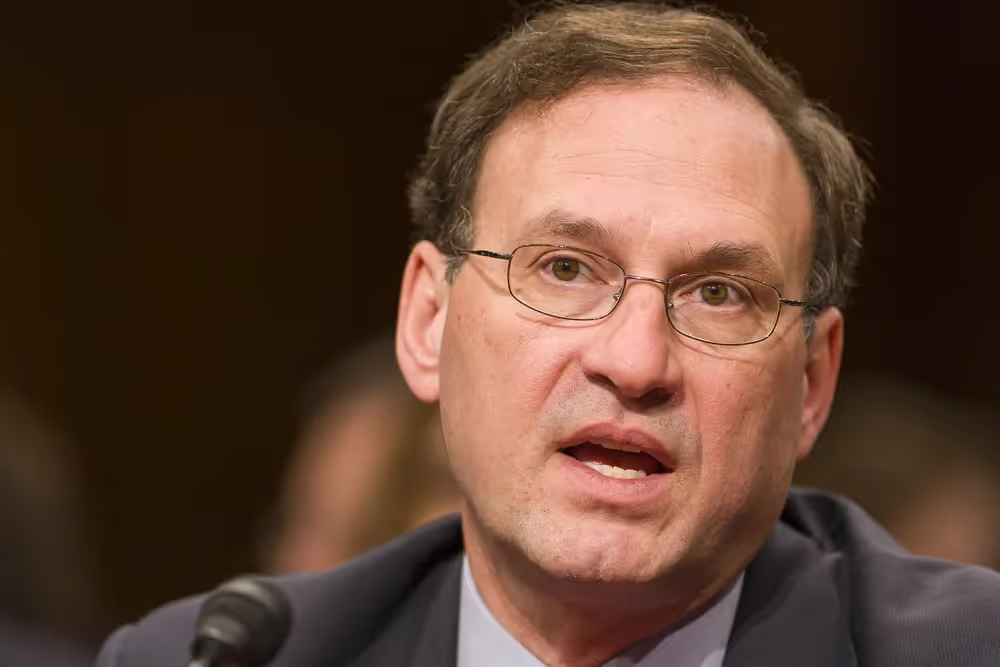
Twenty Years of Justice Alito

Supreme Court Justices must be smart, wise, and steadfast, too, especially when under pressure. Alito checks all of the boxes and more.
Tomorrow, January 31st, will mark two decades since Justice Samuel A. Alito Jr. was confirmed to the U.S. Supreme Court. I was a law student that day and had spent much of December 2005 working early mornings and late nights with other interns at the Department of Justice to assist with his nomination. At that time, his confirmation was one of the highlights of my professional life. Twenty years later, it still is.
I first heard about Justice Alito from one of my professors. The hunt for clerkships is competitive and stressful, and I was looking for guidance on how to navigate the process. My professor’s eyes lit up when he mentioned Alito; evidently, they had worked together, and my professor told me about Alito’s combination of horsepower and good-naturedness. I knew right then that I wanted to clerk for Alito.
That didn't happen at first, which turned out to be for the best. Alito was nominated and confirmed to the Supreme Court before I graduated from law school. Instead, I was able to clerk for two wonderful judges who changed my life: Judge Jerry Smith on the U.S. Court of Appeals for the Fifth Circuit and (now retired) Judge Janice Rogers Brown on the U.S. Court of Appeals for the D.C. Circuit. Had I not clerked for Judge Smith in Houston, I doubt very much that I would have ended up many years later as Texas Solicitor General. Eventually, though, Alito asked me to clerk for him at the Supreme Court. How that happened says many things about him. A clerkship at the Supreme Court is one of the hardest jobs to get in all law. Each Justice has just four slots a year, and they can pick from the most qualified applicants from across the country. To manage the volume of applicants, most Justices develop systems like screening committees of former clerks or hiring networks in which other judges sort out potential clerks. Because of the value of a clerkship, applicants and others are very strategic when working within those systems.
I applied for a Supreme Court clerkship while clerking for Judge Brown. I did not get so much as a screening interview from any of the Justices. Knowing how competitive the process is, that did not surprise me. I'd never expected to be a clerk at the Supreme Court. After I started as a law firm associate, however, some mentors encouraged me to apply again. On the theory of “what’s the worst that could happen?” I did. And again, complete silence from the Justices.
At that point, I gave up on clerking for the Supreme Court. When I learned that Brigham Young University’s law school was seeking a Civil Procedure instructor, I was fortunate to be hired as a professor.
And that’s when it happened: Just days before my family was scheduled to move to Utah, I received a call from Alito’s secretary asking whether I would be interested in interviewing with the Justice. Evidently, he kept my application. The problem? The time proposed for my interview would be literally the same hour that I was scheduled to teach my first class at BYU. The thought came to me that I had committed to be all in for BYU, so I did something many people would say is crazy: I said I could not come because I had just accepted a teaching position. The typical advice for someone seeking a highly competitive job — and certainly a Supreme Court clerkship — is to clear the deck and make any time work. I didn't do that.
Alito did not know that I had just become a professor when he decided to set up an interview, but my answer was the right one. Alito was not offended that I had not put his invitation at the top of my list of priorities. Instead, he liked that I took my commitment to BYU seriously, and so he arranged another time to interview me. I also learned that my interview would be with him alone. There was no screening committee. I came prepared for a very hard interview and was ready to discuss a thousand possible legal issues. But the interview swerved from my expectations. Alito wanted to know me as a person, so we talked about my mission to the Philippines and what happens if a cobra bites someone (not me, thankfully), where I grew up, and why I wanted to teach. It wasn't a test; he wanted to know who I was and whether I would be a good fit for his team. As I recall, he asked me just one question about administrative law — which from his perspective at least — I got wrong. He didn’t hold my wrong answer against me, though, either because he appreciated how I thought through the issue or (more likely) because he didn’t see the interview as a test but rather an opportunity to get to know me.
During the interview, he also told me something about himself. I don’t think it is inappropriate to share what he said, because since then, I’ve heard him tell this story publicly. But it was news to me. He told me about how early in his career, Rex Lee — former Solicitor General for President Reagan and founder of BYU Law — had decided to hire Alito (then a line-level federal prosecutor in New Jersey) into the SG’s office. It was obvious to me that Alito was genuinely grateful and admired Lee immensely. When Alito called later with an offer, he told me that he would move my start date back a year to avoid creating scheduling problems for BYU.
They say that no man is a hero to his valet. I disagree. My year clerking for Alito left me more impressed with him, not less. Clerks swear to keep confidential what happens within the Court, so I cannot discuss specific cases or anything of the sort. But I can say that whatever one's views may be on his jurisprudence, anyone who sees Alito work will appreciate how seriously he takes his job. He reads everything. I joke that he is better at online legal research than I am — but it’s true. I can remember when he found materials that I did not even think about. He also cares about getting the law right and spends countless hours in thought and study. My co-clerks and I used to wonder whether — like the shoemaker in the fairy tale — Alito had another set of clerks at home that he worked with at night. Many times, we came to work in the morning to find massive amounts of work had been done since we left. We used to marvel that he was a nineteenth-century justice; if there were no law clerks at all, he would be fine. Ben Aguiñaga (now Solicitor General of Louisiana, and another former Alito clerk) recounts something similar: “On more than one occasion, email chatter from him would go quiet, and then a flood of perfectly cited draft opinions would come streaming in. He did not need us.”
Despite all he has accomplished, moreover, he's exceptionally kind and humble. I recall when a co-clerk and I were speaking with the clerk for another Justice about something unimportant. Unbeknownst to us, Alito was waiting patiently at the open door to give his clerks an assignment, but he did not want to interrupt our conversation. His clerks also often would find him making his own photocopies. We would protest that at least we could help him with the copy machine, but he would just laugh politely. He is also remarkably funny, in a very dry, understated, and often self-deprecating way.
Being a Justice is not a job where you can expect everyone to sing your praises or even treat you fairly. One thing I pay attention to when I read commentary about Alito is the photo accompanying the article. It's almost impossible to find a good picture, even though he often smiles and laughs. But the public almost never sees that aspect of the man. In my office, I keep a photograph of him having a thoughtful conversation with Santa Claus at the Court’s Christmas party. Anyone on such close terms with Santa can’t be bad.
Of course, being hardworking and humble is not enough to succeed as a Justice. Justices must be smart, wise, and steadfast, too, especially when under pressure. Alito does not enjoy being the center of attention, but oral advocates know that, like a tiger in tall grass, at some point, he will jump in with a line of devastating questions.
Apologies for a long quotation, but the following exchange from the oral argument in Minnesota Voters Alliance v. Mansky shows the power of Alito’s mind. The case concerned the constitutionality of a law that barred political messages on t-shirts at voting stations, with state election judges deciding what counts as too political. Alito was skeptical, and the following exchange occurred:
JUSTICE ALITO: The problem is that so many things have political connotations, and the connotations are in the eye of the beholder. And on Election Day, you're going to have hundreds, maybe thousands of officials in Minnesota, and every one of them probably thinks that he or she is the reasonable observer, and they're making a determination about whether something has political connotations. … [For example, an AFL-CIO shirt, that would be prohibited?]
[ADVOCATE]: So, Your Honor, the—I think the—the answer is that it has two components to it. It has to be understood as relating to electoral choices and it has to be well-known. …
JUSTICE ALITO: Alright how about a shirt with a rainbow flag? Would that be permitted?
[ADVOCATE]: A shirt with a rainbow flag? No, it would—yes, it would be—it would be permitted unless there was—unless there was an issue on the ballot that—that related somehow to—to gay rights.
JUSTICE ALITO: How about a shirt that says "Parkland Strong"?
[ADVOCATE]: No, that would—that would be—that would be allowed. I think—I think, Your Honor—
JUSTICE ALITO: Even though gun control would very likely be an issue? …
[ADVOCATE]: Your Honor, the—the—the line that we're drawing is one that is—is related to electoral choices in a—
JUSTICE ALITO: Well, what's the answer to this question? You're a polling official. You're the reasonable person. Would that be allowed or would it not be allowed? …
[ADVOCATE]: I—I think—I think today that I— that would be—if—if that was in Minnesota, and it was "Parkland Strong," I—I would say that that would be allowed in, that there's not—
JUSTICE ALITO: Okay. How about an NRA shirt?
[ADVOCATE]: An NRA shirt? Today, in Minnesota, no, it would not, Your Honor. I think that that's a clear indication—and I think what you're getting at, Your Honor—
JUSTICE ALITO: How about a shirt with the text of the Second Amendment?
[ADVOCATE]: Your Honor, I— I—I think that that could be viewed as political, that that—that would be— that would be—
JUSTICE ALITO: How about the First Amendment?
No one wants to be on the receiving end of a line of questions like that, not because the questions are unfair, but because they are too fair. The advocate’s own answers were the best proof of the impossible subjectivity that Alito identified at the outset.
Over the last two decades, Alito has also charted his own course when it comes to legal interpretation. Although he has written and joined many significant originalist opinions, he also has labeled himself a “practical originalist.” As Professor Joel Alicea (also an Alito clerk) explains, “Alito has shown a keen awareness of, and ability to respond to, [the] danger emanating from originalism’s increasing theoretical complexity,” namely, that “scholars” — and often Justices — “have introduced distinctions and concepts that ‘threaten to dissolve originalism as a distinctive position by collapsing it into its long-time nemesis, the idea of the ‘living Constitution.’” According to Alicea, Alito cares a great deal about not just the the Constitution’s principles, but also to trying to understand “how the Founders themselves would have applied the principles they placed in the Constitution.”
Alito also is skeptical of taking principles beyond what the Founders could have imagined. For example, in a case about whether States can regulate violent video games, Alito was quite dubious that one could simply extend historical traditions about savage fairytales to first-person shooter games:
Today's most advanced video games create realistic alternative worlds in which millions of players immerse themselves for hours on end. These games feature visual imagery and sounds that are strikingly realistic, and in the near future video-game graphics may be virtually indistinguishable from actual video footage. Many of the games already on the market can produce high definition images, and it is predicted that it will not be long before video-game images will be seen in three dimensions. It is also forecast that video games will soon provide sensory feedback. By wearing a special vest or other device, a player will be able to experience physical sensations supposedly felt by a character on the screen. Some amici … foresee the day when "`virtual-reality shoot-`em-ups'" will allow children to "`actually feel the splatting blood from the blown-off head'" of a victim. … If the technological characteristics of the sophisticated games that are likely to be available in the near future are combined with the characteristics of the most violent games already marketed, the result will be games that allow troubled teens to experience in an extraordinarily personal and vivid way what it would be like to carry out unspeakable acts of violence.
Justice Antonin Scalia was unmoved. After all, “the books we give children to read … contain no shortage of gore. … Cinderella’s evil stepsisters have their eyes pecked out by doves. And Hansel and Gretel (children!) kill their captor by baking her in an oven.” Alito disagreed that a book is the same as a videogame, and lampooned Scalia’s refusal to see the difference: “I think what Justice Scalia wants to know is what James Madison thought about video games. Did he enjoy them?”
Alito has also authored significant decisions. Obviously, his most famous opinion for the Court is Dobbs v. Jackson Women’s Health Organization, which overruled Roe v. Wade. But that is not the only Alito opinion that will be studied well into the future. For example, and again quoting Alicea, Alito’s “majority opinion in Gamble v. United States so compellingly analyzed the text and history of the Double Jeopardy Clause that Justice Thomas — who had previously expressed his skepticism of the dual-sovereignty doctrine at issue in that case — joined Justice Alito’s opinion reaffirming the doctrine.” And although not a constitutional decision, Alito’s opinion for the Court in Holt v. Hobbs — which held that a prison violated federal law by refusing to allow “a devout Muslim … to grow a ½-inch beard in accordance with his religious beliefs” — sets down a marker for religious liberty. These are not the only opinions that could be mentioned, but they illustrate the point: Alito has made a mark on constitutional and statutory law.
In short, Alito takes his duties seriously. He works hard, thinks a lot, does not seek to be the center of attention, and cares about others. The nation is lucky to have him.
Aaron L. Nielson is a senior fellow at the Civitas Institute and holds the Charles I. Francis Professorship in Law at the University of Texas at Austin School of Law.

.jpg)
The Best Escape from the U.S. Attorney Mess
The process for appointing U.S. Attorneys is sputtering, but there is a way out of this mess.
Fighting Anti-Semitism from the Bench
Judge Roy Altman wrote "Israel on Trial" not as a judge, but as an American who loves this country.
Justice Gorsuch’s Warning
'Slaughter' may have rid us of the headless fourth branch of government, but it might end up leaving us with an all-powerful presidency.




Get the Civitas Outlook daily digest, plus new research and events.
Get the Civitas Outlook daily digest, plus new research and events.