
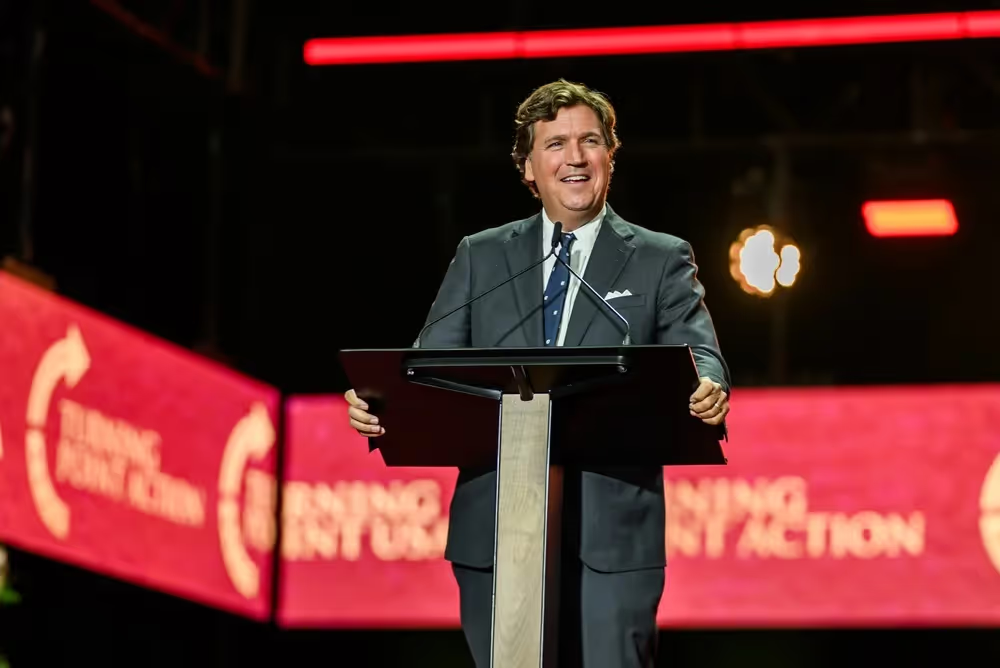
What Happened to Tucker?

Jason Zengerle's book reveals that there is no easy, definitive answer.
“What the hell happened to Tucker Carlson?” That is the question Jason Zengerle poses and attempts to answer in his new biography, Hated by All the Right People: Tucker Carlson and the Unraveling of the Conservative Mind. It is a question asked by Washington journalists and conservative intellectuals across America. As the book title suggests, it is not a question that is asked admiringly.
Unfortunately, as Zengerle shows, there is no easy, definitive answer to the question. Even President Donald Trump seems confused by the trajectory of the former Fox News host. According to recent X posts by Tucker’s former friend and ally, Yoram Hazony, the president asked Tucker to cool it on the antisemitism, which Tucker is promoting by platforming antisemites and then claiming with false naivete, “I’m just asking questions.” Tucker contacted Hazony, who is Jewish, and asked him how to get past the antisemitism problem. Hazony explained that Tucker’s increasing antisemitism is so apparent to Jews on both the left and the right that there is not much he can do. Tucker appeared befuddled by this, as if somehow unaware of what he had been doing.
Tucker’s role in spreading antisemitism is a big part of the current Tucker narrative, but it barely appears in Zengerle’s book. This is in part because, like AI, Tucker’s transmogrification has accelerated over the last two years. Zengerle likely had already handed in his book draft as Tucker’s spiral became undeniable. Still, Zengerle does catalogue Tucker’s descent into the conspiratorial fever swamps that preceded his recent antisemitic binge.
We learn that divorce was a feature of Tucker’s childhood. His dad, a Runyonesque journalist and provocateur, divorced his heiress mom when Tucker was six years old. Tucker’s dad got custody. Tucker’s mom moved to France, and when she died, left Tucker a grand total of $1.00 as an inheritance.
Carlson’s father remarried to an even wealthier heiress. Young Tucker went to prep schools, first in Switzerland and then in New England, where he met his wife, Susie. After prep school, he went to Trinity College, where he met his best friend, Neil Patel. They got drunk together at their first meeting, and then, as Zengerle describes, “After they sobered up, they realized they also shared an interest in conservative politics; before long, they were debating the finer points of the latest column by George Will (Trinity class of 62) and swapping copies of the American Spectator and National Review.” Patel later worked for Dick Cheney during the George W. Bush administration and then co-founded The Daily Caller with Tucker.
Academia was not Tucker’s strong suit, but he did spend some time at Trinity writing letters to the editor, which Zengerle dismisses as “the lazy man’s version of political journalism.” It is noteworthy that the letters to the editor that Zengerle cites just happened to be attacking Jewish targets, a “Ms. Levin” and a “Professor Greenberg.” Whether this reveals early prejudices by Carlson or selective bias by Zengerle in his highlighting of specific letters is unclear.
Tucker never graduated from Trinity – Zengerle reports his GPA was 1.9 – but he was drawn to conservative journalism. He got a job at a journal published by the Heritage Foundation, but his big break came when he landed at the Weekly Standard, a new magazine started by Bill Kristol, John Podhoretz, and Fred Barnes. According to Zengerle, Tucker bombed the interview and initially was not going to get the job. Fate intervened when Mark Gerson, a friend of Tucker’s who was writing a book on Kristol’s father Irving, pleaded with Kristol, saying, “You really shouldn’t reject him on the basis of one interview. He’s the best. Give him a second interview.” In addition, Zengerle reports that Susie was teaching Barnes’ children and “Barnes’s kids were upset that ‘Mrs. Carlson’s husband might not get a job at their dad’s new magazine.”
Carlson capitalized on his big break, acing the second interview and becoming a key member of a talented Standard team that also included Andrew Ferguson, Matt Labash, David Brooks, and David Frum. Podhoretz, who now publicly laments the role he played in elevating Tucker, said upon reading the draft of one of Carlson’s articles, “this kid was born knowing how to write a magazine article.”
Carlson did well at the magazine but soon set his sights on something bigger. He decided that TV would afford him the most opportunities and began looking for ways to get on screen. Kristol apparently thought Tucker’s interest in TV was a bit sweaty, as the kids say today. While Kristol valued the opportunity to appear on a prestigious show like ABC’s This Week, he looked down on Tucker’s willingness to interrupt his day for a short hit on a midday cable program.
Although Tucker was a conservative journalist at the time, he was by no means a spokesperson for the GOP. He wrote a critical profile of George W. Bush for Tina Brown’s Talk magazine in 1999 that angered the Bush campaign. Bush communications director Karen Hughes questioned some of the quotes Tucker included in the article, saying, “I don’t remember those words being used.” Years later, Frum was also skeptical about the Bush quotes, saying after he had worked in the Bush White House, “I think it would be an interesting thing to go back and find out, was that story fact checked? And did the fact checkers hear a tape?”
Tucker was more of a John McCain guy in this period. He even traveled to Vietnam with McCain and some other journalists in the spring of 2000. When the rest of the party left the country, Tucker was left behind, detained at the airport by Vietnamese officials over a passport issue. (Perhaps this inspired Tucker’s recent false claim that he was detained by Israeli security officials?) Zengerle reports that David Brooks wrote a brutal Weekly Standard parody mocking Tucker for missing his beloved TV hits while in detainment, for which Brooks later apologized.
Tucker’s TV career experienced ups and downs. He got a gig hosting “Crossfire,” elevated his profile, but he was also savaged on the show by Jon Stewart in 2004. He worked at MSNBC but then lost that position as well. His TV career was resurrected in 2009 by Fox News’ Roger Ailes, who liked humiliating Tucker, telling him that “The only thing you have going for you is that I like hiring talented people who have screwed things up because once I do, you’re going to work your ass off for me.” According to one Fox executive, “Roger took no small amount of pleasure in being able to tell Tucker Swanson McNear Carlson, ‘you’re a loser.’”
Tucker did indeed work his tail off at Fox, which entailed doing demeaning hits, such as serving as a fill-in weekend co-anchor on Fox & Friends. His efforts helped him get his own show, which debuted shortly after the 2016 election. From his new perch, Tucker was shocked to find out that the president of the United States not only watched his show but sometimes acted on what he heard. Zengerle twice quotes Trump son-in-law and aide Jared Kushner saying, “you can’t work in this White House and not watch Tucker Carlson.” According to a Fox producer, “The show was effectively a senior advisor to the president and could change government policy.”
Tucker’s show became the top-rated primetime cable news show during Trump’s first term. He then lost his show in 2023, following the Dominion lawsuit against Fox. Zengerle admits he doesn’t know why Tucker was fired, but speculates that he might have been a sacrificial lamb thrown in along with the lawsuit settlement. Since then, Tucker has had his own podcast in which he has gone to increasingly dark and conspiratorial places. It’s not clear what exactly has sent Tucker in his current antisemitic direction, but there is no shortage of suspected reasons – Qatari money, jealousy, resentment, or a thousand other things that have made antisemites in the past. Regardless of the reason, there is little doubt that he has changed since his Weekly Standard days. As Zengerle writes in the book’s concluding sentence, “He had descended into madness, but he was speaking to millions.”
Without the Fox platform, Carlson may no longer be essential viewing in the White House, but he remains disturbingly influential, with over 1 million listeners to his podcast. Whereas he once was surprised and even a little worried that the president would watch his show, he now has to make a special effort to ensure that the president hears what he is saying. As Zengerle writes,
where Carlson once tried to reach Trump through his Fox show, he now recognized that Trump did not have the wherewithal to watch (or listen, after Carlson began releasing his online show as a podcast) a two-hour-plus program. He began to communicate with Trump more directly – by text message, on the phone, and in person.
Direct communication with the president is concerning but could also be helpful. After all, if Trump is telling him to tone down his antisemitism, he might be one of the few people in the world that Carlson still listens to.
Mr. Troy is a senior fellow at the Ronald Reagan Institute, a senior scholar at Yeshiva University’s Straus Center, and a former senior White House aide. He is the author of five books on the presidency, including, most recently, The Power and the Money: The Epic Clashes Between Commanders in Chief and Titans of Industry.


Fentanyl’s Deadly Successor Emerges
Start by admitting both that there is a growing Novel Psychoactive Substances (NPS) problem and that responsibility for its harms lies not only with nations like China and Mexico, but also with our own drug users and society.

What Is Wrong with Americans?
Tocqueville warned us against binding ourselves together under the allures of soft despotisms.




Get the Civitas Outlook daily digest, plus new research and events.
Get the Civitas Outlook daily digest, plus new research and events.