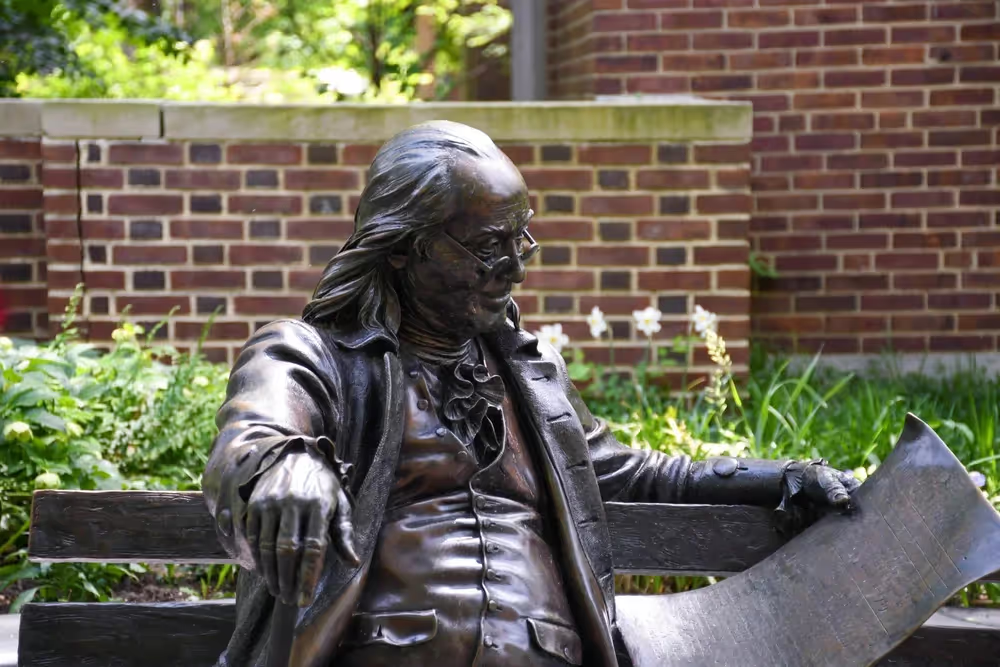
The Quintessential American: Ben Franklin, Man of All Ages

Where are you when we need you so much, Ben? This is the question that Chapman University economist Mark Skousen asks and aptly answers in his new book on our famous Founder.
Exceptional humans tend to emerge in unexpected places. Though few in pedigree-conscious sixteenth century Europe would have believed that humble birth was no barrier to genius, Florence gave the world Leonardo. A century later, the New World too followed suit, when the youngest of several sons born to an impecunious candlemaker, the autodidact Benjamin Franklin, was to become an “Enlightenment superman.” These two colossal historic figures were strikingly similar: endlessly curious inventors, polymaths, humanists mesmerized by the star-filled universe, both were convinced of heavenly perfection. Just as the former personified the best of his age, so too did the latter, who at once defined and defied his own. The eponymous Renaissance man more than met his equal in our famous Founder.
But there was a difference. While the great painter could capture the ambiguity of a smile with breathtaking perfection and still sketch the outlines of a flying machine, the Bostonian diplomat-scientist harnessed the thunder of Jehovah and launched a working democracy by invoking His divine paternity of all humans. Poor Italy had to wait another two centuries after Leonardo’s death to be unified. And not until 1947, after being ravaged by fascismo, would it finally adopt a modern constitution, whose prototype had been fashioned as early as 1789 by none other than Franklin, alongside an extraordinary band of fellow Americans.
That hallowed document had been based on the idea that all humans are endowed by their Creator with unalienable rights, which Franklin called a self-evident principle. He thus replaced Thomas Jefferson’s original epithet of “sacred,” perhaps to prevent its misuse. Franklin may have feared it might restrict confessional disparities in a manner contrary to the nation’s nonsectarian vision. The Declaration of Independence, as America’s covenantal creed, was rooted in centuries of biblical tradition, common sense, and experience. Harboring no doubt of its righteousness, in 1776, Franklin joined 55 other patriots in signing the parchment unhesitatingly, despite being fully aware of committing treason against the British king.
Perhaps he felt that providence was smiling at America, and he probably winked back. Although he had just turned 70, he felt ready to take on the challenge of transforming the dream into reality. Would he have imagined that America would be toasting its 250th anniversary? But of course he would; of all the Founders, none would have been less surprised. As he wrote in his Autobiography, “America will, with God’s blessing, become a great and happy country.” Knowing that “[t]here are two sorts of people in the world, who with equal degrees of health and wealth, become the one happy, the other unhappy,” he avoided the latter who “think and speak only of the contraries” — precursors to present-day dialectical haters.
Where are you when we need you so much, Ben? That was exactly the question that Chapman University economist Mark Skousen asked and aptly answered by reintroducing Ben’s wisdom to a new generation. After his successful 1996 booklet “The Wit and Wisdom of Benjamin Franklin,” Skousen followed with a series of short columns for the Franklin Prosperity Report from 2009 to 2016. Together, these form the basis for his recently published encomium, The Greatest American: Benjamin Franklin, the World’s Most Versatile Genius.
The claim of versatility is no marketing hyperbole. The book begins by listing no fewer than twenty-two careers in roughly chronological order: printer, postmaster, diplomat, author/essayist, humorist, inventor and entrepreneur, scientist, financial guru, fundraiser, military leader, delegate/legislator/founding father, clerk, economist, land speculator, colonial agent, club president, musician, city planner, justice of the peace, banker, and university founder.
Skousen readily admits to having a particularly personal reason for calling him “Grampa Ben”: he is an eighth-generation grandson of the great man. But his book is no hagiography — in fact, the list of careers leaves out some of Franklin’s most momentous achievements, notably his generous contributions to various houses of worship, including the Mikveh Israel synagogue in Philadelphia, helping them escape debt in 1788, and Christ Church in Philadelphia, where he and his wife were members. It was not Skousen but the distinguished historian Henry Steele Commager who called Franklin “the greatest American,” and the celebrated biographer Walter Isaacson who proclaimed our colorful Founder “the most accomplished American of his age and the most influential in inventing the type of society America would become.”
Considering the adulation and attention that Franklin enjoyed throughout his life and beyond, it might seem that one more book among thousands, ranging from academic biographies and specialized studies to edited collections of his own writings, cannot add much. Yet Skousen’s engaging style and particular perspective as an economist is especially important given widespread ignorance of how markets work. In a section titled “On Being an Optimist,” he notes the contemporary relevance:
Regarding the “disagreeable” economic and political situation facing American today, I suspect that Ben Franklin would be more in sympathy with these words of counsel from his contemporary friend, the economist Adam Smith, in The Wealth of Nations (1776): “The uniform, constant, and uninterrupted effort of every man to better his condition is frequently powerful enough to maintain the natural progress of things toward improvement, in spite both of the extravagance of government, and of the greatest errors of administration.” The message is clear: Don’t underestimate the future of America, despite our current problems.
As befits the author of the runaway bestseller Poor Richard’s Almanack, which pioneered modern self-help literature, Franklin preached public as well as private austerity: “There is much revenue in economy.” Smith, too, would write: “What is prudence in the conduct of every private family can scarce be folly in that of a great kingdom.” How much more does this apply to a republic? Advised Franklin: “A virtuous and laborious [i.e., industrious] people may be cheaply governed.” He condemned government regulation as ineffective or worse, hypocritical and contrary to the general welfare: “Most of the statues, acts, edicts, and placards of Parliaments, princes, and states, for regulating, directly, and restraining of trade have been either political blunders or jobs obtained by artful men for private advantage under the pretense of public good.”
Not that Franklin’s principal passions were either material or political. Rather, writes Skousen, his first love was “all things ‘philosophical,’” meaning science and technology, primarily the “applied” rather than merely “theoretical.” His inventions are breathtaking in scope and significance. In 1742, he designed a stove that saved fuel while simultaneously warming better. In 1784, he invented one of the most widely used innovations of all time: bifocals. Their most useful benefit to the savvy diplomat was quite unexpected: being able to wear them at banquets and see both his victuals and the features of speakers “so that I understood French better by the help of my spectacles.”
It seems that he simply could never stop inventing. Obligated to cross the Atlantic no fewer than eight times, for example, he was the first to discover and map the Gulf Stream, which lengthened the passage of ships. By avoiding it, they could save several days — a benefit both comforting and strategic. Also, in the interest of efficiency, while inspecting post offices in America, he invented a crude odometer to streamline mail delivery. Not that he shunned theoretical science, having proposed that electricity was a single fluid with “positive” and “negative” charges that were conserved, which the celebrated historian of science I. Bernard Cohen considered “of the same fundamental importance to physical science as Newton’s conservation of momentum.” Practically, Franklin distinguished between insulators and conductors, thereby developing the concepts of capacitors and batteries. Of course, his immense international reputation was due above all to the lightning rod he had invented in 1752. But what gave him the greatest pleasure was not fame but finding, upon his return home from France in 1786, that his own home had been saved by the rod. Whereupon he quipped: “Thus the invention was of some use to the inventor.”
Yet notwithstanding his recommended triumvirate of desiderata — being “healthy, wealthy, and wise” — Franklin never registered or patented any of his discoveries. When the governor of Pennsylvania offered him a lucrative patent for the immensely popular Franklin stove, he flat out “declined it.” His reasons, as explained in the Autobiography, were philanthropic: “As we enjoy great advantages from the invention of others, we should be glad of an opportunity to serve others by any invention of ours, and this we should do freely and generously.” Skousen observes that a similar impulse seems to be motivating Elon Musk, who in 2022 told Jay Leno: “They don’t actually help advance things; they just stop others from following you.”
Whether Franklin and Musk share anything else, one thing — besides genius — that they have in common is no shortage of enemies. Skousen acknowledges the fact but prefers to accentuate the positive, as history has amply justified; in his bestselling biography, H.W. Brands has called Franklin “the most celebrated American of any age.” If Skousen’s book does have a flaw, possibly the unavoidable result of its compilation, it is redundancy. Which is, however, compensated by the author’s engaging clarity and the optimism he shares with his erstwhile Grampa.
That attitude is undoubtedly what led to the sunny peace that Franklin found at the very end of his long and good life. A month before his death, which he knew to be imminent, Franklin wrote to his longtime friend, Yale University president Ezra Stiles, who had expressed a desire to know “something” about his religion:
I believe in one God, Creator of the Universe. That he governs it by his providence. That he ought to be worshipped. That the most acceptable Service we render to him is doing good to his other Children. That the soul of Man is immortal, and will be treated with Justice in another Life respecting its Conduct in this. These I take to be the fundamental Principles of all sound Religion, and I regard them as you do in whatever Sect I meet with them.
But in a postscript to that letter, ever the realist, Franklin asked that this correspondence be kept confidential, lest it expose him to “Criticism and censure” from those who manage to find something objectionable when none was intended. Wise advice, particularly relevant in these times of ideologically fueled polarization, as language is increasingly distorted and ruthlessly weaponized.
Franklin’s prudence is as welcome as his legendary serenity. Happy 320th birthday, Ben — it’s a good age for a patriarch. May America raise a toast to its own landmark birthday alongside yours for decades, if not centuries, to come.
Juliana Geran Pilon is a senior fellow at the Alexander Hamilton Institute for the Study of Western Civilization. She is the author of several books, including The Utopian Conceit and the War on Freedom (2019) and her newest book, An Idea Betrayed: Jews, Liberalism, and the American Left (2023).

Adam Smith, Economist of the American Revolution
Clear-eyed economic thinking remains one of humanity’s most powerful instruments for understanding our problems and advancing our possibilities for improvement.
Made in the Image of Nothing
We need a sequel to Carl R. Trueman's 'The Desecration of Man: How the Rejection of God Degrades Our Humanity.'
Spielberg’s Empty Hope
'Disclosure Day' should have been called 'Hope and Change,' or rather 'Change and Hope.'
.jpeg)

.png)


Get the Civitas Outlook daily digest, plus new research and events.
Get the Civitas Outlook daily digest, plus new research and events.