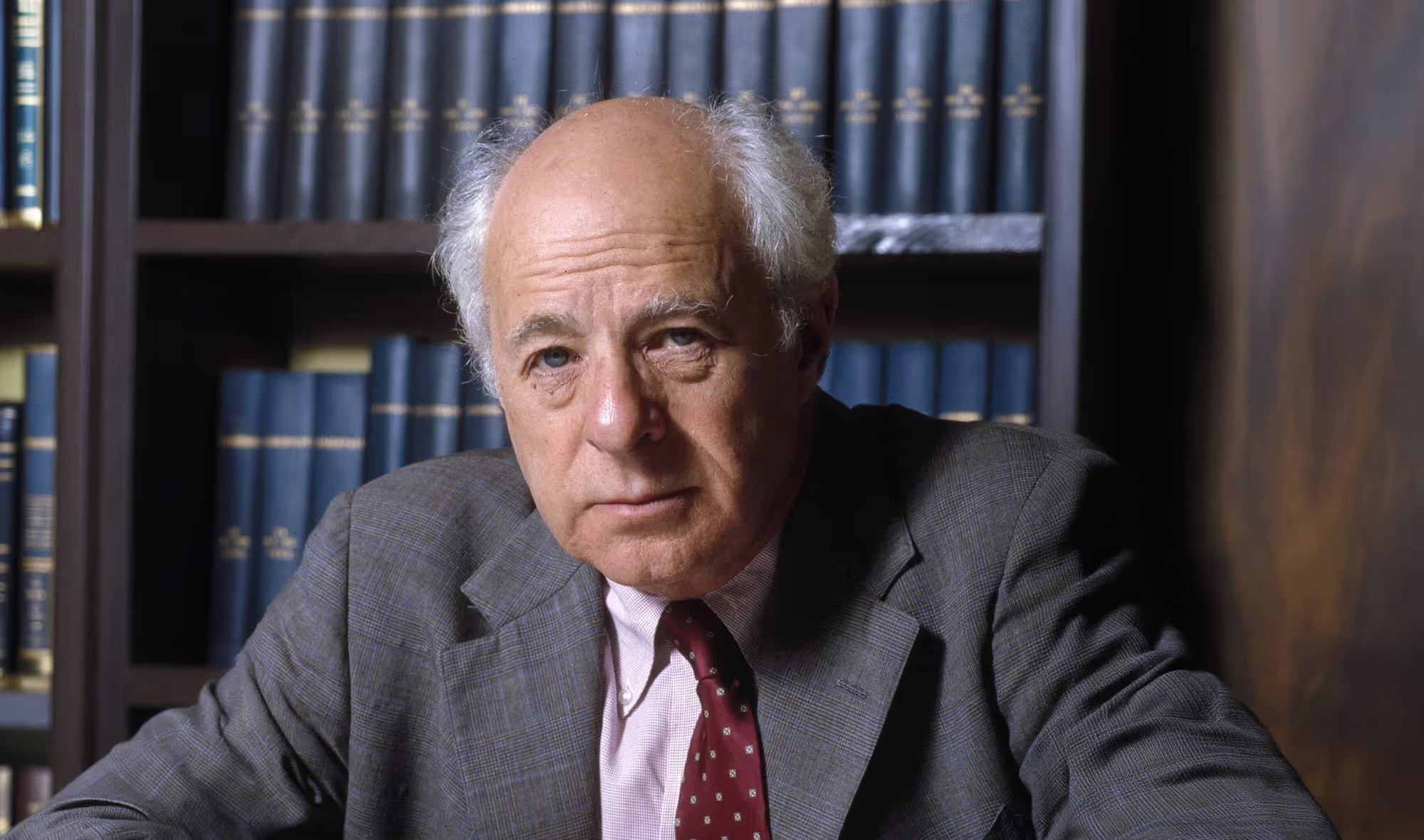
Norman Podhoretz: American Patriot, Faithful Jew, and Indomitable Defender of Civilization

To his dying breath, Podhoretz remained an anti-totalitarian par excellence and an intransigent foe of the counterculture in all its forms.
If anti-Communism was the ruling passion of the neoconservatives in foreign affairs, opposition to the counterculture of the 1960s was their ruling passion at home. Indeed, I suspect that revulsion against the counterculture accounted for more converts to neoconservatism than any other single factor.—Norman Podhoretz (1996)
Norman Podhoretz’s recent death, as he approached his ninety-sixth birthday, seems like the passing of an age. This gifted and pugnacious writer, editor, and man of letters was not one to suffer fools gladly, much less ideologues. Even as a man of the moderate Left in the 1960s who opened up the pages of Commentary to assorted thinkers of the New Left, he never turned on the promise of America or succumbed to the cheap and preening nihilism of the counterculture. After ‘de-radicalizing’ in the late 1960s and early 1970s (to appropriate Nathan Glazer’s suggestive term), he turned Commentary, then published by the American Jewish Committee, into the most indispensable journal of its time.
Under his tutelage, this monthly ran lengthy, well-written, and well-edited essays on literature, culture, Judaism, and American and international politics, essays that shaped the thinking and sensibility of a generation or two of thinkers and actors on the center-right. Whether it was Edward Luttwak’s bold reflections on grand strategy and the Cold War, Walter Laqueur’s incisive warnings about Findlandization and ‘Hollanditis,’ Robert Alter’s luminous meditations on the poetry of the Hebrew Bible, or Podhoretz’s own hard-hitting ruminations on the threats that anti-Americanism and the “adversarial culture” posed to everything he cherished, Commentary gave high-minded voice to those who refused to sign on to the fashionable assault on Western and American culture and civilization. In so doing, he showed what a magazine devoted to the high and important things in life could be. Under Podhoretz’s editorship, the writing found in Commentary formed the reader’s taste, as well as mind and judgment. The late Terry Teachout, who came to New York from Missouri, became something of America’s critic in the pages of Commentary.
Present at the Creation
Like many others of my generation, I admired and found inspiration in Podhoretz’s thoughtful and spirited defense of America, Israel, and Western civilization. More generally, I delighted in its most famous articles, such as Daniel Patrick Moynihan’s “The United States in Opposition” (March 1975) and Jeane J. Kirpatrick’s “Dictatorship and Double Standards” (November 1979), as they fearlessly spoke the truth about democracy, totalitarianism, and the realities of a world on fire. They stood out at a time when the intellectual class had collectively lost faith in America and the West and had committed itself to an antinomian project of repudiation and negation whose bitter fruits we see all around us. Reading old issues of Commentary, one comes to see that our present discontents are by no means of recent origins. Far from it. The warning signs were already there, and the rot had set in. However, far too many decent people were slow to wake up to the cultural revolution unfolding around them. They often became complicit in it without realizing their complicity. This, despite the best efforts of Commentary and Norman Podhoretz.
As he himself put it, Podhoretz was “present at the creation” of both the New Left and the most impressive and sustained resistance to it by old Cold War liberals and those so-called “neo-conservatives” who had the good fortune of being “mugged by reality.” In two arresting memoirs, Breaking Ranks (1982) and Ex-Friends (2000), he told the story of his break with a liberalism that had lost its soul and had come to aid and abet the enemies of civilization. As the titles indicate, this came at great personal cost. Along the way, though, he and his wife, Midge Decter (herself a fearless thinker and gifted writer), made new friends and allies, including William F. Buckley, Jr., and Richard John Neuhaus.
Some have criticized Podhoretz for being unduly self-referential and self-aggrandizing in his writings, and I must confess that his 1967 book, Making It, an unapologetic defense of a young man’s unvarnished ambition, has never been my cup of tea. But Podhoretz was always a fundamentally decent man, and his pugnacity never gave way to hate or disfiguring passion. He never lost friends for light or trivial reasons. He was what came to be known in connection with Ronald Reagan as a “happy warrior”.
The son of Jewish immigrants who grew up speaking Yiddish in an ethnically and racially mixed neighborhood in Brooklyn, Podhoretz confessed to a lifelong “love affair” with America. (See especially his 2001 book with the eponymous title My Love Affair with America.) His America was decent and free, providing hope and opportunities to new Americans like himself and, more broadly, to the Jewish people. He was never attracted to Communism or to the various ideologies or ersatz religions that placed their hopes in chimerical revolutionary paradises rather than in the living promise of America. As a result, he was appalled by the Left’s ideological anti-Americanism, which has only grown since the 1970s and is more or less hegemonic today in the Democratic Party, the universities, and among the hyper- and demi-educated. Conversely, he no doubt would be appalled today by those on the disaffected Right who have given up on patriotism, flirt with anti-Semitism, and who seem to have concluded that America’s noble experiment in republican self-government does not deserve our best efforts.
While wholehearted, Podhoretz’s abiding faith in America was by no means naïve. He fully appreciated that the “adversarial culture” as Lionel Trilling first called it, or the “culture of repudiation” as Roger Scruton more recently called it, had spread far beyond the “New Class” of old. Step by step, it had eaten away at the moral foundations of our democracy. America was better than the nihilistic counterculture that had undermined it and even usurped the name of liberalism. But Podhoretz freely admitted that “empirical” America was less morally estimable than it used to be, sullied by ideas and sentiments that warred with her fundamental decency. A fighter at heart, he refused to despair. An untold number of Americans remained faithful to the “better angels” of this country’s “nature.” In any case, decent men and women were obliged to fight in defense of our noble patrimony. Becoming a conservative in our age, or a “paleo-neo-conservative,” as Podhoretz sometimes amusingly called himself, meant joining a “resistance” of sorts and cultivating the fighting spirit. It meant being part of a minority in the intellectual community, and perhaps at times in the country at large. None of that deterred Podhoretz, who remained a vigorous defender of America and our Western inheritance well into his tenth decade.
He was also an indefatigable defender of the Jewish people and of the legitimacy and nobility of Zionism and the State of Israel. He was not an observant Jew in the traditional sense of the term, but he carefully studied and engaged with the Jewish tradition and attended the Jewish Theological Seminary while also studying English literature with the famed critic Lionel Trilling at Columbia University. He had a profoundly Jewish sensibility and exuded deep gratitude toward his Jewish forbears.
Under his tutelage, Commentary broadened its concerns and became less exclusively Jewish, while remaining an unabashedly Jewish magazine. In its pages, one could read Leo Strauss, Gershom Scholem, Werner J. Dannhauser, Cynthia Ozick, and later Leon Kass, Hillel Halkin, Joseph Epstein, and Ruth Weiss. The first-class fiction that Commentary published over the years also had a decided Jewish cast, as one would expect. Being a Gentile reader of Commentary for a good fifty years, I was grateful for the opportunity to engage the highest quality Jewish thought, whether more secular or more religious in orientation.
Seth Mandel points out in the February 2026 issue of the magazine, which is devoted to his thought and work, that Podhoretz was among the first to understand that “the addition of anti-Semitism to the nihilism and antinomianism of the age was creating nightmarish politics” for Jews and all Americans. Here, too, Podhoretz was ahead of the curve. Zhoran Mamdani is the fanatical and self-parodic heir to this perverse current of thought, adding militant post-colonialism and a shameless indulgence to radical Islam to an already incendiary mix. Would that Podhoretz were alive to take him and it on!
For thirty years or more, one could count on Norman Podhoretz to respond factually (and forcefully) to the growing number of those whose criticism of Israel immediately turns into pathological hostility and a remarkably tendentious rendering of empirical reality. Under the editorship of his son John, Commentary continues to expose a Left gone mad, even as it pursues a middle path between uncritical support for Donald Trump and unhinged Never Trumpism.
Podhoretz and Arendt
Before I conclude, let me say a word on the relationship between Podhoretz and Hannah Arendt. They had once been friends, and Podhoretz remained an admirer of her seminal 1951 book, The Origins of Totalitarianism, the first work by a political philosopher to attempt to come to terms with the totalitarian negation of man. But Arendt flirted with the fashionable Left in the late sixties, confused Nixon with an aspiring tyrant, and opposed the Vietnam War in a way that seemed to forget what she once knew about totalitarianism. Podhoretz, in contrast, would challenge the view that American intervention in Vietnam was “Immoral” in his 1981 book Why We Were in Vietnam (even if he considered American intervention in Vietnam imprudent). But he had already soured on Arendt after she published the essays in the New Yorker that became her most controversial book, Eichmann in Jerusalem. In Podhoretz’s estimation, and I do not think he is unduly harsh, Arendt had the pernicious “habit of judging the Jews by one standard and everyone else by another.”
In Podhoretz’s judgment, Arendt also had made too much of the desperate and misplaced cooperation of the members of the Jewish councils in Nazi-controlled ghettos with their oppressors. This tragic and unsavory episode hardly contributed to the fact or severity of the Shoah. Nor was he impressed by Arendt’s overwrought emphasis on Eichmann’s “banality.” It did nothing to qualify the fact that this dutiful Nazi bureaucrat was an ideological fanatic who embodied in his thoughts and deeds what Arendt had earlier, and more accurately called, “radical evil.” For all her brilliance, Arendt’s tortured paradoxes about Eichmann failed to convince.
A Man of Letters
I agree with John Podhoretz that his father was at his very best as a man of letters. His prose was lucid through and through, marked by equal touches of grace and pugnacity. It was utterly free of the jargon that corrupts and deforms so much academic prose. Simply put, Norman Podhoretz was and remains a joy to read. This student of Trilling and the famous English literary critic F.R. Leavis authoritatively commented on the great writers and thinkers from his 1953 piece on Saul Bellow’s Auggie Marsh in the early 1950s to memorable essays on Orwell and Solzhenitsyn in the 1980s. (The latter two essays can be found in the Bloody Crossroads, published in 1986, and the excellent 2004 The Norman Podhoretz Reader, edited by Marquette English professor Thomas L. Jeffers (a book that is thankfully still in print). The Orwell essay (“If Orwell Were Alive Today”) speculates that if Orwell had not died of tuberculosis in January 1950 but had lived another several decades, he might have given up on socialism and all the other “smelly little orthodoxies” beloved by contemporary intellectuals. He would have done so, Podhoretz surmises, precisely because of his preternatural “power of facing unpleasant facts.” This speculative essay sparked a raging debate, no doubt as Podhoretz had intended.
A Defender of Solzhenitsyn
As a long-time student of Solzhenitsyn’s thought and writing, I have always appreciated Podhoretz’s brave 1985 essay (originally published in Commentary) entitled “The Terrible Question of Aleksandr Solzhenitsyn.” The terrible question is not that of the person of Solzhenitsyn himself, but rather the pressing question he posed to East and West alike: Do we have the courage and nerve to resist the totalitarian Lie and to stand up forcefully for decency, liberty, and human dignity? Podhoretz admired the man and saw through the multiple calumnies against Solzhenitsyn put forward by lesser men (including the undeserved charge of anti-Semitism). He also admired and was deeply moved by Solzhenitsyn’s nonfiction work, The Oak and the Calf, his literary memoir about his battle with the “Soviet Dragon,” and particularly The Gulag Archipelago, the great anti-totalitarian work written “with such verve, such gusto, such animation, such high-spirited irony and sarcasm,” that nothing can be compared to it.
Podhoretz, however, was rather too quick to dismiss such artful and philosophically significant novels as Cancer Ward and In the First Circle, which was certainly his prerogative as a critic. But his dismissal of Solzhenitsyn’s The Red Wheel without having access to any of its volumes in a good translation was precipitous and unfortunate. In my experience, many people on the Right still cite Podhoretz’s review as the final word on the subject. Still, his 1985 article ably came to Solzhenitsyn’s defense when his cultured despisers were circling around the great man like a pack of sharks.
True Neoconservatism
Let me end with a final word about Podhoretz and neo-conservatism. He supported the Iraq War and never expressed the slightest regret for that support, and, more generally, saw the struggle with radical Islam as nothing less than World War IV (the Cold War having been World War III). He developed these views in a provocative 2007 book entitled World War IV: The Long Struggle Against Islamofascism. These are, of course, highly debatable points. However, Podhoretz did not define neoconservatism by muscular Wilsonianism or by the aggressive promotion of democracy abroad, especially democracy as transformed by antinomianism and progressive ideology.
As two superb interviews with Charles Kesler in the pages of the Claremont Review of Books in 2019 and 2022, respectively, make clear, he came to appreciate Donald Trump’s fight against woke despotism. Moreover, he was appalled by the revulsion against Trump that turned once sane men (the Bill Kristols of the world) into leftists par default, fulminating at the mouth. Podhoretz saw Trump as nothing less than “an unworthy vessel chosen by God to save us from the evil on the Left.” “With all his vices,” the president had “the necessary virtues and strength to fight the fight that needs to be fought.”
Others are free to disagree, of course. But this self-proclaimed “paleo-neo-conservative” is hardly the caricatured “neo-conservative” imagined by the demi-educated on the disaffected Right, who fling clichés around and are incapable of making any of the requisite distinctions necessary to judge political phenomena today. To his dying breath, Podhoretz remained an anti-totalitarian par excellence and an intransigent foe of the counterculture in all its forms. May his memory be a blessing.
Daniel J. Mahoney is a Senior Fellow at the Claremont Institute, a Senior Visiting Fellow at Hillsdale College, and Professor Emeritus at Assumption University. His most recent book is The Persistence of the Ideological Lie: The Totalitarian Impulse Then and Now (Encounter Books, 2025).

Spielberg’s Empty Hope
'Disclosure Day' should have been called 'Hope and Change,' or rather 'Change and Hope.'
.jpeg)
Deliberative Republicanism and the Triumph of the American Founding
Instead of rejecting the moral urgency of the postliberal right and left, it is fitting and proper that we redirect it through the right kind of education—both formal and informal—that can inspire affection for our Constitution.
Can Civic Friendship Save America?
Start with “civic assimilation” on the way to a more peaceful Union.

.avif)


Get the Civitas Outlook daily digest, plus new research and events.
Get the Civitas Outlook daily digest, plus new research and events.