
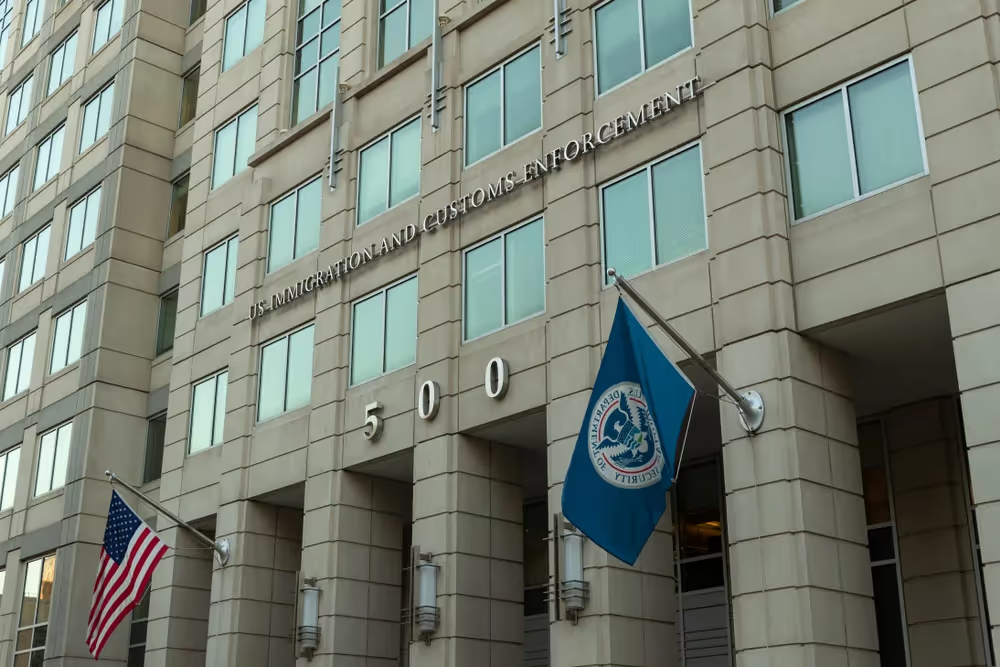
ICE and the Fourth Amendment
.png)
With a midterm election beckoning, Trump, with his sagging poll numbers, has to continue to back down in Minnesota, lest his hard-line rhetoric, practices, and rulings result in a major Democratic sweep.
ICE—the chilling acronym for Immigration and Customs Enforcement is fast becoming one of our most intensely disliked federal agencies. Its strong-arm tactics by masked agents have increasingly alienated ever larger portions of the American public across the political spectrum. So much so that a recent Economist and YouGov poll found that 46% of Americans favor abolishing the agency entirely. Housed in the Department of Homeland Security, it was founded in 2003 and wields extensive power over government through two related operations: Homeland Security Investigations, followed, when appropriate, by Enforcement and Removal Operations. In principle, no one objects to federal government officials dealing with these operations. But today, ICE’s operations have become a flashpoint whenever its heavily armed officers are caught on camera using excessive force on unarmed individuals. The incidents include the highly controversial killing of Renee Good, which many –– including an FBI agent who resigned in protest –– view as the panicked efforts of a mother of three to escape a jam she foolishly engaged in, despite Vice President Vance’s strained efforts to characterize it as a terrorist act. Then on Saturday evening, Alex Pretti, an intensive care unit nurse, was gunned down by ICE enforcers while assisting a woman who had been knocked down and pepper-sprayed by ICE agents. Best evidence— once strongly contested by Trump officials, only for Trump to have backed off for them moment have now backed off for the moment— suggests that his supposed gun was a cell phone, even though Pretti had a licensed gun in his pocket, which may have gone off while he was trying to aid a woman (not a suspect) who had been thrown to the ground. The allegations against ICE extend much further, including an administrative arrest, including a visually documented claim by ChongLy Thao, an American citizen who was dragged from his Minnesota house in his underwear in sub-freezing conditions.
There is, therefore, a pressing question of what kind of oversight ICE needs before unleashing its heavily armed officers on civilians. If we could be sure that the only persons nabbed in these ICE raids were the criminal goons from South America, at least some portion of Americans might unhappily look the other way. But since Trump took office in January 2025, ICE works on a quota system for arrests that necessarily favors quantity over quality and strongly incentivizes ICE agents to expand the rate of arrests, and thus drive up the error rate of false and deadly apprehensions. That solid perception leads American citizens and permanent legal aliens to avoid going willy-nilly onto public streets and into schools, shops, hospitals, work sites, and state and federal offices. Yet ICE seems to pursue illegal aliens who have arrived in this country decades ago and established families and businesses that are a vital part of the life of large and small communities. Why target them? Trump rightly received high public marks for quickly stemming the massive illegal immigration that was both tolerated and aided by the Biden administration.
But instead of tamping down, the Trump administration only adds fuel by freezing out Minnesota officials from this investigation. In the long run, worse still is that ICE has apparently made a secret determination that ICE may substitute administrative arrest warrants, obtained from internal ICE officials, to authorize heavily armed officers to break into civilian homes at any time of day or night. The Trump administration has committed an unforgivable sin by refusing to give the public advance notice of its decision, let alone conduct any kind of hearing, which would subject its program to congressional and public scrutiny. Instead, it relies on the so-called I-205 warrant, whose key provision allows for an “immigration judge in an exclusion, deportation, or removal proceedings” to substitute his or her arrest warrant for one issued by a District Court or Magistrate Judge, who operate as part of an independent judiciary.
ICE is a partisan agency through and through, so we can be confident that regular federal judges will not be used when they are needed most. Such a radical and unprecedented departure from standard practice needs, at the very least, a full public debate, which has never happened. Indeed, the government has never released its full memorandum, which has only been made public by WhistlerBlower Aid, which observes that “By memorandum dated May 12, 2025 (“the May 12 Memo”), Acting ICE Director Todd Lyons authorizes ICE agents to forcibly enter into certain people’s homes without a judicial warrant, consent, or an emergency.” The bold is in his memo, and the import of these words is that none of the traditional justifications for government officials' unilateral action is needed in these immigration cases. The two major grounds for avoiding the warrant are consent or an emergency, neither of which was available in Mr. Thao's case. And the memo makes clear its preferences: “ICE immigration officers should consider all available enforcement mechanisms, including the use of the Form I-205 to arrest an alien in their place of residence, to achieve the requirements of E.O. 14159,” issued on January 20, 2025, which put the program to remove illegal aliens in high gear.
As a simple matter of public optics, ICE should have taken the exact opposite approach. Given the rising cascade of protests against the current ICE practices, it might calm down a restive and indignant public to announce that all individuals, regardless of their citizenship status, now enjoy the interposition of an independent source of review by experts or officials who operate outside of agency power as a check on its power.
This is hardly a novel request. That search for independence lies behind the early effort to protect the members of the Federal Trade Commission from the arbitrary removal of any president, Donald Trump included. That independence was the substantive reason why, back in 1935, in Humphrey’s Executor v. United States, Justice George Sutherland called the actions of the FTC both “quasi-legislative” and “quasi-judicial,” which are jarring terms that formed no part of the originalist vocabulary of 1787. But the substantive reason behind the point was to ensure that the commission would “act with entire impartiality.” But ICE so far has maintained its inflexible position, leaving the courts no choice but to litigate against ICE warrants. And here the text of the Fourth Amendment contains major structural protections that administrative warrants wholly ignore.
“The right of the people to be secure in their persons, houses, papers, and effects, against unreasonable searches and seizures, shall not be violated, and no Warrants shall issue, but upon probable cause, supported by Oath or affirmation, and particularly describing the place to be searched, and the persons or things to be seized.”
Many ICE searches are so far from reasonable that it is proper to ask whether anything short of a blanket injunction can do. The memorandum above, along with ICE’s existing procedures, make a joke of the probable cause requirement when these administrative officials are used in place of District and Magistrate Judges. It was just these major difficulties that led the Supreme Court in Camara v. San Francisco (1967) to strike down the use of these administrative warrants to obtain entry into a private home by a municipal health care professional who sought to determine whether there was the occupation of a ground floor residence in violation of the owner’s occupancy permit. There was no allegation of suspect motive and no hint that the problem extended beyond this case. Nonetheless, Justice Byron White brushed aside some conflicting cases to announce “one governing principle, justified by history and by current experience, has consistently been followed: except in certain carefully defined classes of cases, a search of private property without proper consent is ‘unreasonable’ unless it has been authorized by a valid search warrant.”
It is hard to imagine any case that speaks so loudly to the current issue. Indeed, even if Camara had gone the other way, it should not control cases against ICE. The stakes here are far higher, and the historical track record of ICE abuses is evident. The willingness to shove aside state law enforcement officials in patrolling the streets or investigating cases of abuse reveal an agency that is incapable of self-correction. One does not have to take the silly position that illegal immigration and criminal activity does not matter to realize that these problems were handled under the Obama, Biden, and even first Trump administration without this justified public outrage. Senator Chuck Schumer has already stated that Democrats will block all federal spending if it includes funding for Homeland Security, which would throw out the baby with the bathwater. And pressure in Washington, chiefly from Democrats, is growing for Trump to fire Kristi Noem before she faces impeachment proceedings. And with a midterm election beckoning, Trump, with his sagging poll numbers, has to continue to back down in Minnesota, lest his hard-line rhetoric, practices, and rulings result in a major Democratic sweep.
Richard A. Epstein is a senior research fellow at the Civitas Institute.

Fighting Anti-Semitism from the Bench
Judge Roy Altman wrote "Israel on Trial" not as a judge, but as an American who loves this country.
Justice Gorsuch’s Warning
'Slaughter' may have rid us of the headless fourth branch of government, but it might end up leaving us with an all-powerful presidency.
The Common Law and Citizenship in the Constitution: A Response to Linda Denno
The fatal flaw in Professor Denno’s argument is that she would elevate political philosophy above the original understanding of the constitutional text.



.jpg)
Get the Civitas Outlook daily digest, plus new research and events.
Get the Civitas Outlook daily digest, plus new research and events.