
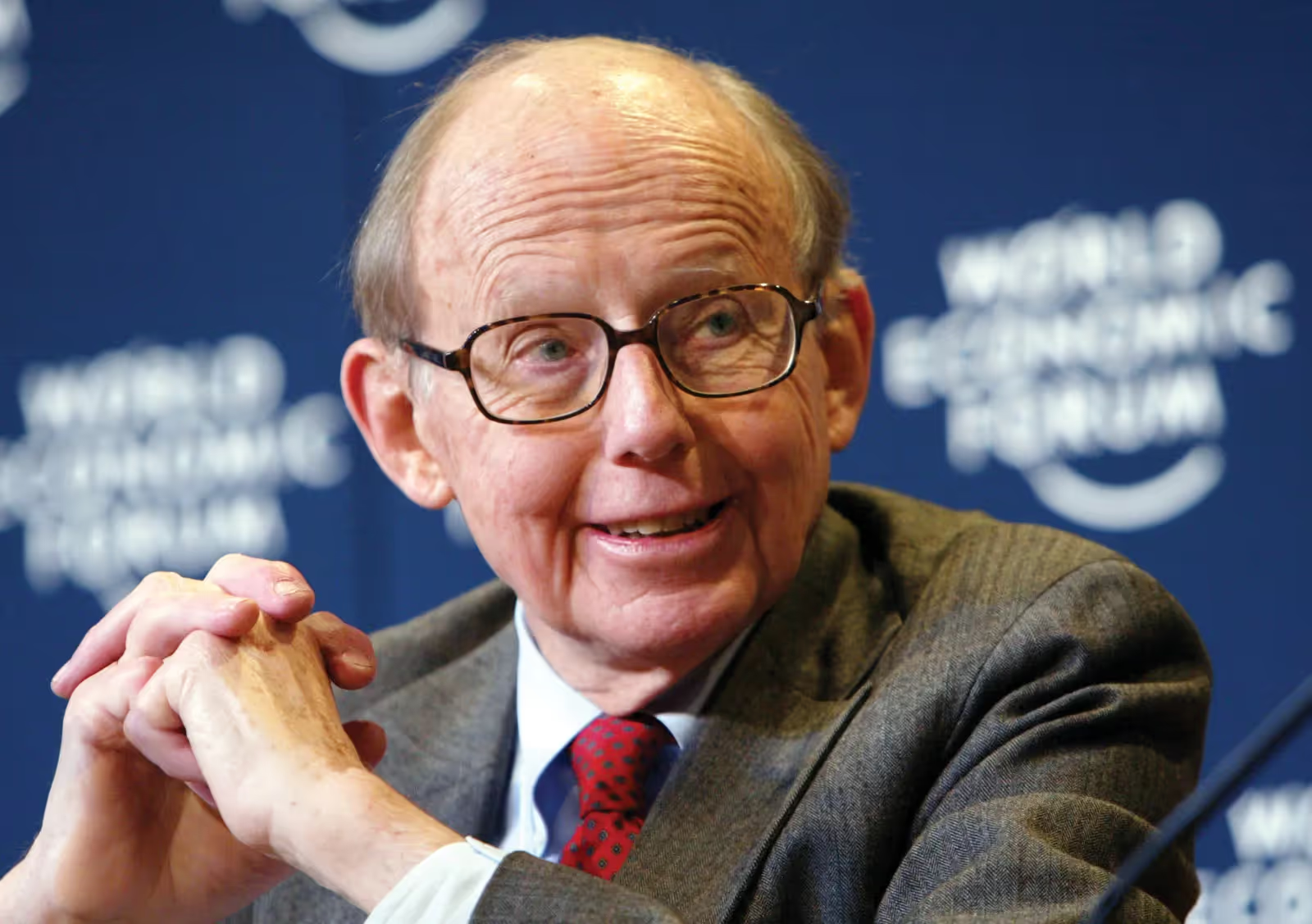
The Clash of Civilizations at 30

Huntington was right to highlight the West's civilizational achievement.
About Samuel Huntington’s “seminal book,” Zbigniew Brzezinski says, “the sheer size of [the] book’s global readership testifies that it satisfied the widespread craving for a comprehensive understanding of our currently turbulent historical reality.” Published after the ideological wars of the twentieth century, Huntington’s 1996 The Clash of Civilizations and the Remaking of World Order argued that moving forward, the central and most dangerous phenomenon in global affairs would be “conflict between groups from differing civilizations.” Despite the best-seller numbers, commentators from the left and the right reacted negatively. In The Nation, Edward Said rebuked “this belligerent kind of thought.” John Gray pointed out that history shows war happens more within civilizations than between them, citing the catastrophes of WW1, WW2, and the Cold War as examples.
Huntington is well able to blunt Said’s point, for his conflict claim had a corollary, that “an international order based on civilizations is the surest safeguard against world war.” In fairness, Huntington, who died in 2008, was more interested in order than in war. Gray contends that the great twentieth century conflicts were resource wars, not disputes between value orders. Yet hierarchies of worth promoted by civilizations must shape how peoples value land. Huntington identified Sinic, Japanese, Orthodox, Christian West, Hindu, Islamic, Buddhist, African, and Latin civilizations. The list is obviously unstable, with all manner of overlaps, yet some such classification of order rings true, and this is why “big picture” philosophies of history work along these lines.
Western civilization is a special focus of the book, but not exceptionalism: “The development of the West to date has not deviated significantly from the evolutionary patterns common to civilizations throughout history.” Huntington saw clearly the rise of multipolarity and the fading of Western power, but he paid little heed to the signs of the West’s internal confusion. Reacting to on-going social failures that have dogged the West for decades, many are revisiting socialism and post-liberalism is surging . Huntington identified the West with constitutionalism and individualism, but our governments routinely invoke emergency powers to rule and the tribalism that Adam Smith said attends all poor economic thinking is now common throughout the West . Rather than being marginalized, the West is eroding.
Order
The Clash of Civilizations appeared in the heady days of Fukuyama’s End of History thesis, which proposed that history shows the only right model of governance is Western. Huntington cites President Clinton in 1994 saying, “freedom’s boundaries now should be defined by new behavior, not by old history. I say to all… democracy everywhere, market economies everywhere, countries cooperating for mutual security everywhere. We must guard against lesser outcome.” He notes that the Clinton presidency gave up these lofty goals as the “old history” of geopolitics reasserted itself. What Fukuyama had missed, argued Huntington, was that “democracy is inherently a parochializing not a cosmopolitanizing process.” In a fine summation of where we are today, Huntington observes, “a Western democrat could carry on an intellectual debate with a Soviet Marxist. It would be impossible for him to do that with a Russian Orthodox nationalist.” He bluntly disposed of Fukuyama’s thesis, observing that “in the five years after the Berlin wall came down, the word `genocide’ was heard far more often than in any five years of the Cold War.” Necessary, argued Huntington, is a theory of order that does not romanticize history.
Huntington served on the national security team of the Carter administration, held a named Chair at Harvard, and founded one of America’s preeminent foreign relations journals. Nonetheless, he cautioned that his book was not a work of social science but rather “an interpretation of the evolution of global politics after the Cold War.” The interpretation rests on Huntington’s belief that peoples first wonder, who are we? “We know who we are only when we know who we are not and often only when we know whom we are against.” In consequence, when “coping with identity crisis, what counts for people are blood and belief, faith and family.” Thus, “the potentially most dangerous enmities occur across the fault lines between the world’s major civilizations.”
Now widely accepted is Huntington’s observation: “Modernization, instead, strengthens those cultures and reduces the relative power of the West. In fundamental ways, the world is becoming more modern and less Western.” Sophisticated but significantly different civilizations span the globe. For an order of civilizations, he contended, there must be some strong nation-states particularly imbuing the civilization, the core states: “the most important countries in the world come overwhelmingly from different civilizations.” Said rebuked Huntington for his belligerent thinking, but the Harvard man’s contention is that core states add stability to a civilization. Said reacted to Huntington’s claim that Islamic civilization is especially fractious, yet this point was not malicious but formal. There is no core state in Islamic civilization: Iran cannot be that state because it is Shiite; Saudi Arabia is too small; and Indonesia, the most likely candidate for the anchor role on account of its population, is geographically on the outer fringe.
Disorder
Huntington also observed that in very many locales, nation-states do not cement order – rivals for that role include mafias, corporations, collectives, religious councils, city-states, and the like. Compounding the problem are cleft countries – countries abreast civilizational faultlines. At the time of the Second Iraq War, The Clash of Civilizations was slotted into the West v Islam book genre, yet an important test case for Huntington was the Western Christianity v Orthodoxy faultline, specifically Ukraine.
The Russo-Ukraine War has scrambled many international relations conceits, but Huntington’s thesis emerges well from that crucible. Ukraine is a cleft state split along a Christian West/Orthodox line running north to south. Presciently, Huntington argued, “NATO expansion limited to Western states would also underline Russia’s role as the core state of a separate, Orthodox civilization, and hence a country which should be responsible for order within and along the boundaries of Orthodoxy.” Smart policy, he thinks, is for NATO to concede that role to Russia. Assuming no meddling, he did not foresee war. Though a cleft country, the two Slavic peoples have muddled along for centuries, and intermarriage is widespread. “If civilization is what counts, however, violence between Ukrainians and Russians is unlikely.” This might now seem a howler, but it is critical to recall that the Biden administration made the war a clash of civilizations, pitting Orthodox Russia against the Christian West’s military alliance. We know that at the 2022 peace negotiations in Istanbul, it was the West that told the Ukrainians to keep fighting, and it was NATO that planned and supplied the disastrous 2023 Ukrainian counterattack. Huntington fares well because that war fully displays the resilience and agency of civilizations.
Western Crisis
The `20s have not been kind to the West, and the wounds are largely self-inflicted. Ignoring Huntington’s advice, European members of NATO have issued tremendous verbal support of Ukraine but haven’t backed those words with necessary means to prevail against Russia, exposing the continent’s powers as hollow. That perception has cratered Western credibility. The West is no longer perceived as admirable or prudent. Our world matches Huntington’s statement: “The dangerous clashes of the future are likely to arise from the interaction of Western arrogance, Islamic intolerance, and Sinic assertiveness.”
He observes that the US is alone in having the capacity to bomb any country in the world and he darkly noted that in the fading light it would start to do so. What he did not see – but no one could have seen – is the impact of drones and cheap missile technology. This development inhibited the US Navy from defeating the Houthis attacks on shipping in the Red Sea. At the time of writing, the Red Sea is still closed after two years on account of Houthi anger over Gaza. Drones have also made mechanized war practically impossible, and the West is ill-equipped to deploy large amounts of infantry. Much of the West’s military edge has been taken off the board. As Huntington observed, soft power follows hard power, and the West’s reaction to diminished hard power looks petulant and craven.
Equally acute is the loss of trust inside Western polities. Alternative and social media have caught Western politicians lying so frequently that “conspiracy” thinking is now a default. Tall tales and cover-ups are so pervasive that real social and economic costs are mounting. As Huntington pointed out: “Businessmen make deals with people they can understand and trust; states surrender sovereignty to international associations composed of like-minded states they understand and trust.” Adam Smith warned that without constitutionalism and individualism, societies revert to tribalism. It was a signature accomplishment of the West’s long tradition of humanism to make durable a civic framework of liberty that generated trust in leadership and moderation in technology. Huntington was right to highlight that civilizational achievement. He was also right to caution that when arrogance replaces virtue, then the world will be far more dangerous.
Graham McAleer is lay member of the Judicial Ethics Committee of the State of Maryland and author, most recently, of Tolkien, Philosopher of War (CUA Press, 2024).


The Uses and Abuses of the Pardon Power
The recent flood of pardon controversies shows no signs of abating.
.jpeg)
The Fall of Fauci
The greater the scope of authority granted to a single individual, by circumstance or deliberate action, the more important scrutiny and accountability become.


.png)
.png)
Get the Civitas Outlook daily digest, plus new research and events.
Get the Civitas Outlook daily digest, plus new research and events.