
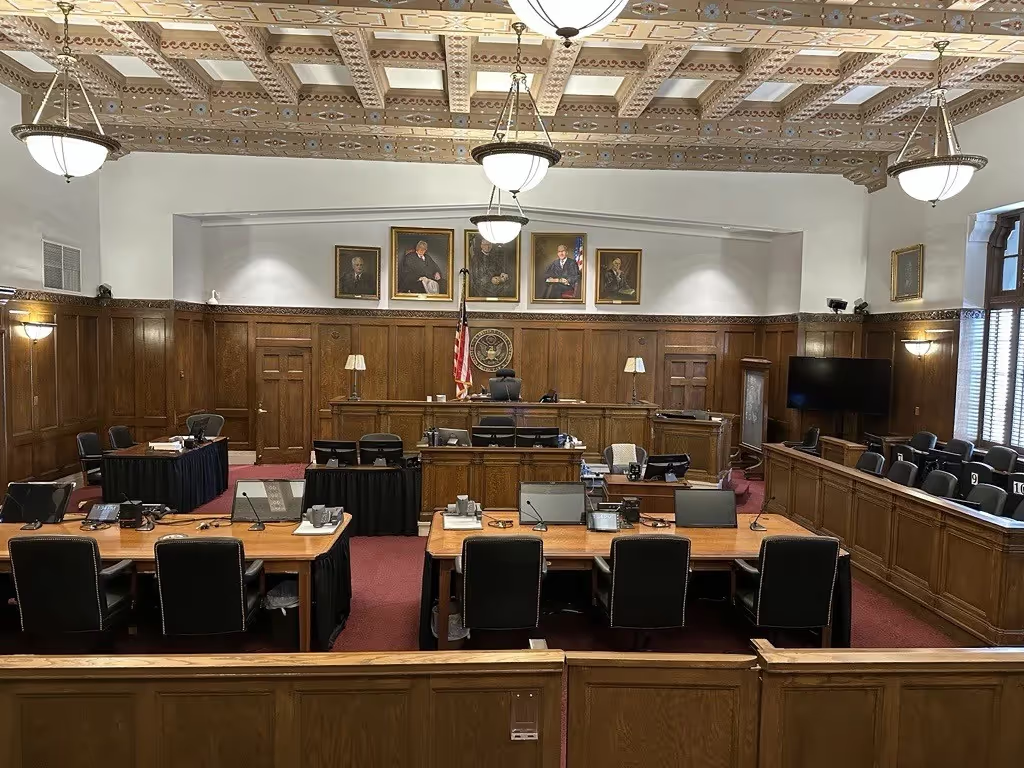
“Brazenly Partisan” Judges Scrutinize Trump’s Mind, But Refuse To Explain Themselves
Given their failure to acknowledge reality, the only remaining remedy for political judges is the political process. If those steps are inadequate, further remedies should be on the table.
Thanks to Article III of the Constitution, federal judges can basically serve for life. Congress, however, created an incentive for judges to step down. Judges who reach the age of sixty-five and have enough years of service can take “senior status.” In this form of semi-retirement, the judges can keep a full docket of cases or wind down to zero cases. While in senior status, the judge will continue to receive full compensation. As a practical matter, judges strategically time when they take senior status. Judges appointed by Republican presidents are more likely to take senior status when there is a Republican president, and those appointed by Democratic presidents are more likely to do so when there is a Democratic president. There is no mystery here. Moreover, some judges even request, directly or indirectly, a preferred replacement as a condition for taking senior status. One judge even withdrew his announcement of senior status when the President did not nominate the judge’s preferred candidate. Federal judges seem to view their positions as sinecures, over which they have complete control — a problem Congress should address.
This practice, however, took a turn for the worse after the 2024 presidential election. During President Biden’s administration, many Democratic-appointed judges predictably announced that they would take senior status on the confirmation of their successors. Even though the Democrats controlled the Senate for Biden’s entire term, several of those seats remained unfilled in December 2024. Shortly before President Trump was inaugurated, three judges announced that they would no longer take senior status: Judges James Wynn Jr. of the U.S. Court of Appeals for the Fourth Circuit, Max Cogburn of the U.S. District Court for the Western District of North Carolina, and Algenon Marbley of the U.S. District Court for the Southern District of Ohio. All three judges, in case you couldn’t guess, were appointed by Democratic presidents.
The judges offered no actual explanation for their decision. Judge Wynn, for example, wrote to President Biden that “after careful consideration, I have decided to continue in regular active service.” Upon “careful consideration,” is code for “further election.” Senator Tom Tillis of North Carolina said that Wynn made this “brazenly partisan” decision because he “clearly takes issue with the fact that Donald Trump was just elected President.” The Article III Project filed a judicial misconduct complaint against these three judges. The complaint charged that “Judge Wynn’s decision to rescind his announcement was likely made because of the outcome of the 2024 presidential election.” The group states that Wynn “had a change of heart solely because” Trump won.
Judge Wynn responded to the complaint. He didn’t offer any actual explanation for rescinding his senior status. Wynn insisted that federal law does not prevent him from changing his mind. Rather, he said, “[c]hoices about retirement and senior status are deeply personal and often influenced by multiple factors.” One would think that Wynn could offer some reason to defend his action. But he offered none. Instead, he insisted that he was under no obligation to explain his motivation. Wynn maintained that “no court has ever found it proper to inquire into an Article III judge’s reasons for taking, or not taking, senior status.” Wynn added, “Accusations of partisanship should not be entertained absent specific evidence of misconduct.” If the judge made this decision for some legitimate reason, it would have been straightforward to state it. But he didn’t; instead, he hid behind a legal process.
In October 2025, the misconduct complaints against Judge Wynn, and the other two judges were dismissed. Chief Judge Debra Livingston wrote the opinion in each case. Livingston found “there is no genuine issue of fact.” She added that whether “the Judge considered the outcome of the election as one factor influencing his decision to withdraw the January 5 letter” was “a factual issue I need not resolve.” Had Chief Judge Livingston simply asked Judge Wynn why he rescinded his senior status, the judge could have defended himself with some legitimate reason. But he didn’t offer such a reason, because there is no plausible, legitimate reason. Regrettably, there is a brazen double standard for brazenly partisan judges. The federal courts routinely scrutinized President Trump’s motivations for improper purposes. But when it comes to rooting out judicial misconduct, judges hide behind a veil of ignorance.
Judge Wynn, in particular, has opened himself up to special criticism. During the first Trump Administration, the Fourth Circuit Court of Appeals heard challenges to President Trump’s travel bans. A constant theme in this litigation was an attempt to psychoanalyze President Trump. The travel ban policy, on its face, was neutral and based on specific findings that aliens from certain countries posed a risk to national security. But judges looked beyond the written policy to figure out what Trump really intended: What was in his heart and mind? A favorite pastime was reading Trump’s tweets, which judges used to impute an impermissible animus to Trump’s policy. Judge Wynn took precisely this approach.
In December 2017, I attended the Fourth Circuit’s en banc oral argument for the travel ban case. Judge Wynn asked the lawyer for the Department of Justice about the relevance of the president’s tweets. “What do we do with that?” he asked, referring to the tweets. “Do we just ignore reality and look at the legality to determine how to handle this case?” Wynn, unsurprisingly, joined an opinion that probed President Trump’s heart and mind. In other words, Judge Wynn would not get bogged down with legalities, as that would force him to ignore what he saw as reality. At the time, I wrote an essay distilling Wynn’s approach: “What should a judge do if the law cuts one way, but reality cuts the other?”
Judge Wynn was all too happy to subject the leader of a coordinate branch of government to this super-strict scrutiny, but refused to engage in even the slightest bit of self-introspection. He declined to offer any explanation for his action. Chief Judge Livingston should have posed the same questions to Judge Wynn that Judge Wynn posed to President Trump: “Do we just ignore reality and look at the legality to determine how to handle this case?” Maybe Judge Wynn would have had an actual response to the complaint filed against him, but I am skeptical. Judge Wynn was all too eager to inquire into the President’s subjective motivations, yet implores us to ignore his own.
In the Emoluments Clauses litigation, Wynn joined the majority opinion that ruled against Trump. Judge Wynn was appalled that a dissenting colleague alleged that the majority had “partisan motives,” insinuating that there was “something other than law [is] afoot” here. As my colleague Professor Seth Barrett Tillman asked, should the public not see “partisan motives” behind Wynn’s decision? To paraphrase the Wizard of Oz, pay no attention to the man under the robe.
There is a never-ending stream of faux-outrage about judicial ethics, but these self-professed experts ignore actual problems where judges engage in partisanship. Let’s not forget Justice Ruth Bader Ginsburg. Before the 2016 election, Ginsburg called Trump a “faker” and said she would move to New Zealand if he prevailed. And the day after the election, Justice Ginsburg wore her “dissent” jabot to Court. Ginsburg was clearly protesting Trump’s election. Yet Ginsburg didn’t leave the country, as her retirement would have given Trump the power to appoint her replacement. Ginsburg likely had the same thoughts as Judge Wynn. Fast-forward four years. On Ginsburg’s deathbed, her last words were, “My most fervent wish is that I will not be replaced until a new president is installed.” Ginsburg said what Wynn clearly thought. Should we just look at Ginsburg’s action behind the veil of ignorance? She was a brazenly partisan critic of Trump, yet she decided a host of cases against Trump while in office. Is there much of a practical difference between what Ginsburg did and what Wynn did?
In recent years, there were routine calls for impeachment when Justice Alito’s wife flew a flag, and Justice Thomas’s wife engaged in politics. Yet when we see progressive judges personally crossing the lines into the political realm, there are only crickets. Here, the judiciary took no action to police political judges — not even a reprimand. Given this failure to acknowledge reality, the only remaining remedy for political judges is the political process. And if those steps are inadequate, further remedies should be on the table.
Josh Blackman holds the Centennial Chair of Constitutional Law at the South Texas College of Law Houston and is a contributing editor to Civitas Outlook.


Fentanyl’s Deadly Successor Emerges
Start by admitting both that there is a growing Novel Psychoactive Substances (NPS) problem and that responsibility for its harms lies not only with nations like China and Mexico, but also with our own drug users and society.

What Is Wrong with Americans?
Tocqueville warned us against binding ourselves together under the allures of soft despotisms.




Get the Civitas Outlook daily digest, plus new research and events.
Get the Civitas Outlook daily digest, plus new research and events.