
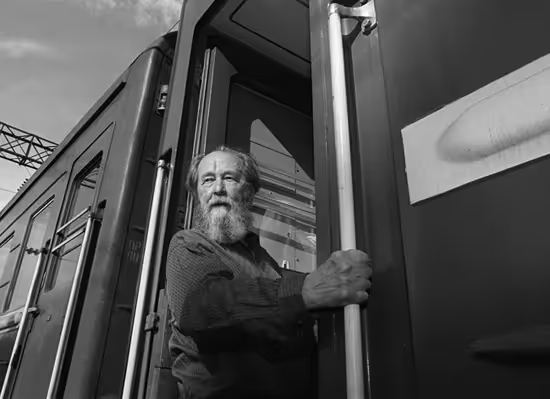
Retracing a Catastrophe: Lessons from Solzhenitsyn’s The Red Wheel

Solzhenitsyn’s witness and wisdom provide what is so needed today: intellectual insight, moral courage, and spiritual fortitude and hope.
Indispensable during the Cold War, Aleksandr Solzhenitsyn’s writings remain essential for our times and troubles. This, for a number of reasons. First, he is one of the handful of essential analysts of Ideology with a capital “I”. In his historical and literary writings, he vividly brings to light the modern Manichean form of thinking that divides humanity into good and evil camps and groups, thereby falsifying history, morality, and politics. As Ideology has continued to exist in transmogrified forms after its Marxist-Leninist version, he remains a sure guide into its dark labyrinths.
Second, in analyzing the great twentieth century test case of leftist Ideology coming to power in his beloved Russia, he shows us how to detect its methods of coming to power and to foresee what it will do as it consolidates its power. The active, scheming Ideologue and revolutionary is a type refracted in a thousand figures, and Solzhenitsyn’s historico-literary art captures both.
Moreover, he focuses not only on the agents of Ideology, but also on the few who became aware of what was happening around them and resisted, and on the many more who were blind to the real nature of the threat, or believed they did not have to come forcefully to terms with the truly committed ideologist. Sentimental “liberals” and feckless Christians (including the Tsar) were two of the several categories of heedless fools deceived, then run over, by ruthless ideologues bent on creating Utopia. Their Manicheanism knew only fully committed revolutionaries and “enemies of the People,” and any alliances were only tactical. These harsh truths, the subdued learned too late.
Solzhenitsyn shows clearly and dramatically what is at stake in the battle with Ideology and ideologists: the fate of a country and its people; human freedom versus unprecedented tyranny; living according to the ideological Lie versus what one can see with one’s own eyes. At bottom, what is at stake is the integrity of the human soul itself. Ideology would sever a people from its living roots and collective memory, seeing the people — at once idealized and instrumentalized — as a tabula rasa upon which social engineering could work its transformative power. Once in power, the ideological promise of Freedom — total human emancipation — turns into its opposite, and warrants the harshest, most thoroughgoing, tyranny and servitude. Not merely a tyranny of the body, Ideology seeks to capture the human mind. It necessarily creates a system of official mendacity and imposes a surreality of lies. It adds to the normal travails and tragedies of human life artificial circles of ideological Hell, culminating in psychiatric wards and gulags.
The human soul in such circumstances is horribly exposed and faces an existential decision: capitulate, in order to live a life of mere survival it knows is debased and unworthy of man, or resist and run the real, indeed nigh predictable, risk of prison, camp, and death. That is how the regime poses the matter, but the soul — or at least some privileged souls —view matters in another light, the light of the soul’s moral and spiritual integrity, and with hopeful confidence in the ultimate goodness of life and the world.
Solzhenitsyn himself faced this choice and made it in the camps – and, with it, discovered true freedom of soul, a freedom predicated on the truth of the human soul. Eventually, this one great soul, bringing to light the Ideological Lie and the terrible truth of the regime of force and lies based on it, helped topple what Ronald Reagan rightly called an “Evil Empire.” The life and works of Solzhenitsyn, a modern-day St. George, are a permanent testament to the human spirit and estimable resources for those of us somewhat similarly situated, that is, faced with Ideology’s more recent iterations. We do well “to take up and read.”
A Short Period But a Long Account
The title and subtitle of the book under consideration, The Red Wheel: April 1917, Node IV, Book 1, are significant. The title points to the main subject: the enabling circumstances, the roots and beginnings, and the eventual, inexorable movement of the Bolshevik Revolution, while the complex subtitle points to a particular month in the revolutionary capture and indicates its place as a later “node” in a wider account. That this short period is significant, nigh decisive, is indicated by the fact that the length of the current volume is almost 600 pp., while being only Book 1 of a two-volume discussion of April 1917. At its end, Lenin is poised to seize power.
Solzhenitsyn’s “Vision”
My friend Daniel J. Mahoney, the foremost Solzhenitsyn scholar in America, has written on The Red Wheel in his very fine book on The Idol of Our Age, in a chapter entitled “Solzhenitsyn’s Red Wheel: A Tough-Minded and Humane Christian Vision”. In it, he provides a magisterial overview, up to April 1917, of “a massive, sweeping work, 6, 000 pages divided into four “nodes” — “Narratives in Discrete Periods of Time” — incorporating actual historical events that changed the course of Russian history, and of human civilization, too. It commences as a historical novel, but in sections it turns into dramatic history with no fictional characters at all.” Like Tolstoy’s War and Peace, “both epics delve into the deepest moral and religious concerns.”
However, as the title of Mahoney’s chapter suggests, Solzhenitsyn’s “Christian vision” —“tough-minded and humane” — is at antipodes to Tolstoy’s “pacifist, rationalist understanding of Christ’s teaching.” “Tolstoy forgets that every human being and citizen has moral and political responsibilities, and that to ignore them, especially in the face of evil, is not a commitment to a higher summons. It is a betrayal of man and God.” A tough-minded vision, indeed.
The contrast with Tolstoy is not Mahoney’s invention; it opens August 1914, the first node of The Red Wheel, and continues through the early chapters of the second node, October 1916. Thus, Tolstoy’s pacifism and “passivism” (a term coined by Vladislav Krasnov in a 1986 essay in Slavic Review) set the stage for the drama that follows and provide a key for reading the blend of history and novelistic addition created by Solzhenitsyn. Worldviews and fundamental attitudes are embodied in its characters and judged in a three-fold way: How do they conceive and fulfill (or fail to fulfill) their “moral and political responsibilities”? More capaciously, how truthful are they to the reality of life and the world? What is their spiritual orientation and disposition? And, finally, how did they contribute to the catastrophe of the ideological takeover of a great and vast empire?
At the other pole from passivism is, of course, the cunning and frenzied activity of the ideologists, Lenin in chief. In between, one finds a full range of human types considered in their moral-political bearing, spiritual depth or shallowness, and their perceptions and responses (or lack thereof) to the unfolding crisis. An eminent negative example is the Tsar himself: “As revolution unfolds, a weak and equivocating Nicholas II has no sense of what is really happening in St. Petersburg, the capital of the Russian empire,” where the Revolution is brewing. Likewise, the majority of his ministers are “nullities.” By and large, with precious few exceptions (more below), the powers-that-be are myopic and irresolute, incapable of fulfilling their responsibilities, much less meeting the challenges of the times.
Their (and Russia’s) archenemy, Lenin, knew and exploited this, making a deal with Russia’s enemy, Germany, to return from exile to pursue the Revolution in the homeland. Indeed, with a practiced eye, he saw weakness and folly wherever it showed itself. Speaking later about fellow revolutionaries, the soft-headed and soft-hearted Kadets (Constitutional Democrats) and Socialists in the post-tsarist government, he characterized them as “incorrigible windbags,” not men of action, much less of ruthless ideologically-dictated action, and rightly inferred that “as long as we firmly deny their accusations, they’re easily persuaded to look the other way.” Thus, across the political spectrum, there was a collective myopia in recognizing ideological falsehood and impending evil for what they are. Along with an unwillingness to exercise force, this sentimental blindness proved catastrophic not only for themselves but also for those under their responsibility and for wider humanity.
Those Who Saw and Acted
There were exceptions. In his reading, Mahoney highlights a number of Solzhenitsyn’s positive “characters,” two of whom have emblematic status and merit comment. One, Colonel Georgi Vorotyntsev, “a fictional protagonist” (and “the direct bearer of Solzhenitsyn’s distress,” as one critic put it), is a far-seeing military officer, who knew that Russia must modernize its army and build up its forces, including its technological capacities (think Colonel De Gaulle trying to get the General Staff to adapt to modern warfare). The other figure, Pyotr Stolypin, “the great political and nonfictional protagonist of The Red Wheel,” was an even more far-seeing statesman, Prime Minister from 1906-1911, who took significant steps to modernize the Duma, to forcefully put down revolutionary violence and machinations, and to improve the lot of the peasantry. Both men had to deal with rotten establishments and elites, while also combating radical ideologues. They knew that serious reform in Russia was necessary, even imperative, if collapse and Revolution were to be avoided. Alas, Stolypin, Russia’s last great hope, was assassinated in 1911 by a double agent of both the reactionary establishment and the radical left.
Collectivism, Pious and Secular
One Stolypin reform in particular attracts Solzhenitsyn’s attention: the reform of the mir, or traditional peasant commune. It contains what one might call a critique avant la lêttre of Zohran Mandami’s collectivist plans for New York City. Despite “mystical” justifications offered by Slavophiles, in Stolypin’s judgment, “the reparational commune reduced the fertility of the land, took from nature what it did not return, and denied the peasant both freedom and prosperity.”
In this domain (as others), “Stolypin was always a realist” informed by Christian wisdom: “No one can ask the people to behave like angels. We have to live with property, as we live with all the temptations of this life.” His realism also recognized that “in any case, the commune created a good deal of discord among the peasants” (and, Mahoney adds, “the novel shows it”).
These were lessons taught long ago, even before Christ, by Aristotle in the Politics, starting with his critique of communism in the Republic. To them, Stolypin added something distinct, a sort of “preferential option”: he “bet on the strong and determined rather than on the idle and the drunk.” Why should the “industrious and rational” (as Locke characterized the cohort) be subject to faux-ideals and hamstrung by their moral and human inferiors? Unlike the collectivist promises of socialism, this was a realizable form of human liberation, “liberating the hardest-working peasants from the tyranny of the commune.”
Solzhenitsyn discusses Stolypin’s communal reform to highlight his practical wisdom in the service of human enterprise and self-respect, and to lay a predicate for contrasting it with Lenin’s later ideological liquidation of the kulaks, peasants who had prospered due to the land reform. While the particular historical contrast is compelling and instructive, its lessons are not limited to Russia or the twentieth century. In the guise of a beautiful ideal, collectivism wars on human nature and punishes the better sorts of human beings, those who contribute the most to society. Necessarily threatened by both, it turns to tyranny against them. Caveant lectores.
Power Structures, Impotent Idealists, and Ruthless Revolutionaries
Recently, the doyen of the study of Russian Literature in America, Gary Saul Morson, published a review of April 1917, Book 1, entitled “Why Lenin Won.” The title indicates his specific focus. While he indeed discusses some estimable heroes of the resistance, chief among them “the hero of The Red Wheel, Colonel Georgi Vorotyntsev, and the heroine, historian Olda Andozerskaya,” the main focus of his reading is the intra-revolutionaries battles, with the aim to lay out why it was that “Lenin, with a handful of followers, triumphed over their rivals.”
Morson sets the stage by focusing on the arrangement of power, both official and real.
As the novel opens, Tsar Nicholas II has abdicated, and a Provisional Government appointed by the Duma has assumed nominal power. Everything it does[, however,] must be approved by the Executive Committee (EC) of the Petrograd Soviet (or Council), a group of self-appointed intellectual representatives of the lower classes who can summon intimidating mobs.
Since personnel is policy, one must look more closely at the players. “Solzhenitsyn portrays the Provisional Government ministers as hopelessly impractical poseurs, who rely on stirring words and dramatic gestures.” Anticipating contemporary progressive initiatives, “the Provisional Government, believe it or not, abolished the police! It also released criminals on condition that they promise to behave, and so initiated a wave of murders and robberies.” Dramatic gestures, indeed! The official governors had a soft spot for society's refuse and trusted implicitly in the goodness of “the People.” Unshackling men from unjust social structures was the one thing necessary for their better angels to appear. Even Rousseau knew better. Those in the Petrograd Soviet also knew better and enlisted these hardened men in mobs that could, in turn, be used to intimidate the official government. “What goes ’round, comes around,” one is tempted to observe.
The feckless blindness of the Provisional Government’s ministers toward the violent and the criminal was extended even further to its most dangerous proponents:
When it becomes apparent that Lenin’s followers, who have already shot unarmed soldiers, plan to seize power by force, the kindly Prime Minister, Prince Georgi Lvov explains in ‘dulcet tones’ to Minister of Defense Aleksandr Guchkov: ‘Where Lenin was concerned, the government should not precipitate events, for that might give rise to conflict.’
Conflict avoidance, however, is only conflict-delaying and battle disarming.
Two Kinds of Revolutionaries
“The Soviet Executive Committee, as Solzhenitsyn portrays it, is little better.”
First, “eager to hamstring the Provisional Government, its leaders refuse to assume power themselves because Marxist theory, in their view, holds that socialism can succeed only after an epoch of bourgeois liberal governance.” Here was the dead hand of Marx holding them back from necessary revolutionary action.
As for their fellow revolutionaries, “even though the Bolsheviks plan to use force against them as well as against the government, they will not resist, in part because they regard Leninists as fellow revolutionaries,” – pas d’enemis à gauche – “but mostly because they differ from the government ministers only in the violence of their rhetoric.” Violent rhetoric, yes, but not violence itself. “They, too, reject force against Lenin as ‘completely inadmissible. He must not be crushed or arrested. … We can combat ideas without using force, just argumentation.’” Talk, talk, talk, and more talk.
In stark contrast, “Lenin knows intimidation works. Attack, always attack: ‘Not a moment on the defensive! … Deny and stigmatize one hundred per cent. Scare them by labelling them. Sully them so they can never clean off the filth.’”
More strategically,
When it comes to seizing power, ‘a minority, if it is close-knit, can slash a majority and march right through it.’ What matters is ‘organization, organization, and again organization. … And our top priority [is the armed] Red Guard!’ With concentrated force in the right hands, ‘the limits of the possible expand a thousandfold … the essence of a leader is to see where the enemy is weakest and level a blow not tomorrow but now.'
In order “to do so, the leader must get others to follow him blindly: ‘like a hypnotist, you are passing the current of your will into the one who is to act — at that tense moment there is no opposition, no disagreement, no doubt is permissible in the person receiving that current.’”
Having laid out this litany of blindness and folly in the face of Revolutionary adamancy, Morson asks, “Is it any wonder that Lenin and his tiny band of followers succeeded?”
Mahoney on April 1917
As we saw above, Mahoney’s initial treatment of The Red Wheel ended before April 1917. However, in the January 2026 edition of the New Criterion, he continued his analysis of the great work, now turning to Book 1 of April 1917. The context was one of widespread chaos and disorder, aided and abetted by an anti-hierarchical “Democratic” Zeitgeist. The “Rule of the People” (the epigram to the volume) meant the rule of no one, the rule of mobs acting in its name. This was true throughout a disintegrating society and, with few exceptions, in government and the armed forces. Even the exceptions, however, were hamstrung by the anarchic circumstances around them. Still, they acted in exemplary ways.
As does Morson, Mahoney pays particular attention to two of Solzhenitsyn’s heroes of resistance, the fictional Colonel Vorotyntsev and the likewise fictional historian Olda Andozerskaya, “said to be the most intelligent woman in Petrograd.” He highlights others as well, including the “remarkably capable and energetic Admiral Aleksandr Vasilievich Kolchak.” In him, natural leadership is fully on display, even in the most untoward circumstances. In one way or another, all these heroes came to two realizations: 1) that a free post-tsarist Russia needed genuine authority and stable order – true liberty is “ordered liberty” and, hence, a renewal of respect for natural and social hierarchy and for the moral law; and 2) they came to see the truth in Dostoevsky’s premonitory depictions of the revolutionary mind and character in Demons. Alas, events outran the dawning insight.
A final element that Mahoney highlights is, therefore, the nihilistic character of Marxist-Leninist ideology. A French friend of mine once characterized the George Pompidou Centre in Paris as “the anti-cathedral of the anti-civilization of modernism.” Similar but even stronger words could be said about Lenin’s quintessential modern ideological thinking. Nothing good, true, or beautiful was to be preserved from the past, and the only lesson to be drawn from it was “no half-measures!” More comprehensively, denying ontological structure and moral limits in reality and man, all was deemed material for the total remaking of man and society.
Furthermore, given its atheistic premise, one could venture that the denial of reality and the murder of men go hand-in-hand with the denial of God, and, conversely, that the defense of man requires the defense of his Creator. Solzhenitsyn certainly thought so. When asked to summarize the cause of the Russian Revolution, he replied with an old Russian proverb: “Men have forgotten God.”
Mahoney observes that “Solzhenitsyn always considered The Red Wheel to be his most significant book.” Coming from the author of The Gulag Archipelago, this judgment is arresting. It suggests that its author did not think that it was simply a historical accounting, that its lessons were restricted to a discrete period of time, or to one people alone. What had happened to his beloved Russia could happen elsewhere in the modern world. In modern times, Ideology is a perpetual temptation. We, alas, have lived to see the truth of this claim.
In our day, the hydra of Ideology has produced any number of post-Marxist-Leninist heads - transnational progressivism, “cultural Marxism” or identity politics, settler colonialism - all forms of invidious binary thinking characterized by moral inversion, historical fabrication, and political insanity. As we gird for our own battles with Ideology, Solzhenitsyn’s witness and wisdom provide what is so needed today: intellectual insight, moral courage, and spiritual fortitude and hope.
Paul Seaton, an independent scholar, is the translator of The Religion of Humanity (St. Augustine Press) and the author of Public Philosophy and Patriotism: Essays on the Declaration and Us (St. Augustine Press).



The Uses and Abuses of the Pardon Power
The recent flood of pardon controversies shows no signs of abating.
.jpeg)
The Fall of Fauci
The greater the scope of authority granted to a single individual, by circumstance or deliberate action, the more important scrutiny and accountability become.


.png)



Get the Civitas Outlook daily digest, plus new research and events.
Get the Civitas Outlook daily digest, plus new research and events.