
Donald Trump's New Hemispheric Policy

The new U.S. hemispheric policy under Trump is characterized by a return to hard-power practices.
Editor's Note: This essay is part of our Venezuela Symposium.
The American states share a common history deeply shaped by colonial processes and subsequent struggles for independence. From the late eighteenth to the nineteenth century, European expansion led to the establishment of colonies across the Americas, whose societies and institutions were influenced by Spanish, Portuguese, and British rule. This shared historical experience of colonial subjugation, followed by the assertion of state autonomy, endowed the countries of the Americas not only with common cultural traits but also with an interconnected geographic and political destiny within hemispheric dynamics.
Despite significant differences among colonial models — such as British institutional rigidity and puritanism, the Spanish system in Central and South America, and the Portuguese model in Brazil, each of which shaped state development in distinct ways — all American countries share the same continental space. Territorial proximity has consistently compelled political leaders to think strategically not only about domestic policies but also about relations with neighboring states, whether through cooperation or competition.
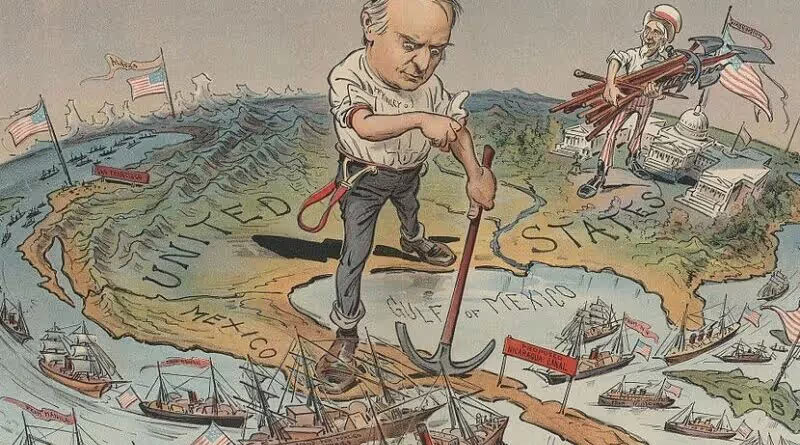
In legal and international relations terms, the pursuit of sovereignty and regional coordination in foreign policy and collective defense has deep roots. One of the most emblematic milestones is the Monroe Doctrine, articulated in 1823 by President James Monroe, which declared that any European interference in the affairs of American states would be regarded as a threat to the security and interests of the Western Hemisphere. At the same time, the Doctrine asserted a form of hemispheric commitment to collective sovereignty and defensive solidarity, although it has long been interpreted as a justification for U.S. hegemony in the region.
Another relevant historical initiative was the Treaty of Union, League, and Perpetual Confederation, proposed by Simón Bolívar in 1826, which proclaimed defensive solidarity among the newly independent American states. At the conference to which all American countries were invited, Bolívar envisioned a system of regional cooperation capable of consolidating the autonomy of the new states vis-à-vis European powers and, more broadly, external interests.
The convergence of these two political movements laid the foundation for hemispheric integration, as states forged a strategic alliance against the resurgence of colonial threats. The expansion of foreign policy reshaped interests and strategies, particularly amid U.S. hegemonic expansion, thereby fostering the institutionalization of Pan-Americanism throughout the nineteenth and twentieth centuries. This process led to the creation of inter-American cooperation institutions, culminating in the formation of the inter-American system, with the Organization of American States (OAS), founded in 1948, as one of its central pillars. Especially during the Cold War, the OAS served as a key forum for political coordination and diplomatic engagement in the hemisphere under strong U.S. leadership.
Following the Soviet Union's collapse and the intensification of economic globalization in the 1990s and 2000s, U.S. foreign policy shifted toward a multilateral orientation that emphasized trade and economic expansion. Over time, this approach led to a gradual decline in U.S. hemispheric engagement, particularly in economic and commercial terms. Latin American countries increasingly diversified their commodity export partners, facilitating the rise of China and other emerging actors as central players in regional trade. In many cases, these actors surpassed the United States' traditional role as the primary economic partner of countries such as Mexico, Argentina, Chile, Colombia, and Brazil.
In this context, the new hemispheric policy of the Republican administration led by Donald Trump must be understood. The administration observed the growing influence of competing powers in areas traditionally dominated by the United States. By adopting a more assertive foreign policy, the administration sought to reposition the United States at the center of the regional order. This strategy was formalized in a new National Security Strategy (NSS), which reaffirmed the Monroe Doctrine as the foundation of U.S. action in the Western Hemisphere. Using more direct and less diplomatic language, the document also introduced a “Trump Corollary” to the Doctrine, intended to contain the influence of external powers — such as China, Russia, and Iran — in Latin America and to protect U.S. strategic, military, and economic interests in the region.
Since taking office in January 2025, the Republican administration has implemented measures that, in practice, reflect the new model of hemispheric hegemony proposed by the “Trump Corollary” and reveal key elements of regional relations. These measures include reclassifying the Panama Canal as a strategic asset sensitive to U.S. national security, accompanied by diplomatic pressure on the Panamanian government to limit Chinese influence in areas deemed critical; a shift in posture within the OAS, marked by pressure on votes for strategic positions to favor allies and agendas aligned with U.S. foreign policy; and intensified pressure against Cuban programs in the region. The most emblematic episode of this new policy was the direct military intervention in Venezuela on January 3, 2026, when U.S. forces captured President Nicolás Maduro in Caracas in a controversial operation widely condemned by governments and international analysts. Official justifications combined allegations of drug trafficking, threats to hemispheric security, and the protection of strategic interests, particularly in Venezuela’s oil sector, which holds some of the world’s largest hydrocarbon reserves.
These developments indicate that the new U.S. hemispheric policy under Trump is characterized by a return to hard-power practices, through which the United States seeks to impose its position in accordance with its interests, with limited regard for multilateral mechanisms and traditional norms of international law. The use of economic and military power — in Venezuela, the Panama Canal, and other strategic arenas — has served as an instrument to reassert control and influence over the region and to weaken the presence of states recognized as threats to U.S. interests.
A critical counterpoint to the Trump administration’s hemispheric policy is the lack of a long-term strategy for regional development. U.S. action has largely been reactive, addressing immediate geopolitical and security challenges while neglecting fundamental dimensions such as trade cooperation, technology transfer, infrastructure development, and sustainable social progress that foster durable ties. A more consistent policy would require mechanisms and partnerships oriented toward equitable growth, the strengthening of democratic institutions, and the reduction of socioeconomic inequalities that continue to characterize many Latin American countries. Such an approach could mitigate external influence and prevent long-term resentment.
For lasting stability and prosperity in the Western Hemisphere, Latin American countries must consolidate forms of cooperation that transcend dependence on external powers. This includes fair trade agreements, technological partnerships, joint infrastructure projects, and social development initiatives that strengthen regional economies, promote integration, and respect sovereignty and the collective interests of the peoples of the Americas. Without a cooperative, long-term vision for regional development, hemispheric policy risks deepening tensions and failing to address the region’s structural needs, underscoring the urgency of an approach that combines security, fair trade, and solidarity-based cooperation rather than episodic displays of hegemony lacking a coherent, substantive strategy.
Wagner Menezes is a Professor at the University of São Paulo – USP. Member of BeLatin. He was visiting professor at University of California at Berkeley in 2019 and 2024.



Isolation Is Not an Option
The lesson the Trump administration ought to have learned by now is that Eastern Europe and the Middle East are two theaters of the same war, not separate conflicts.

A Deadly New York Parable
The public mood in New York City sharply changed when the Mamdani administration took one large and foolish step.


.jpg)
.png)