The Administrative State’s Sludge

In combating the nation’s accumulation problem, more federalism and less delegation are good places to start.
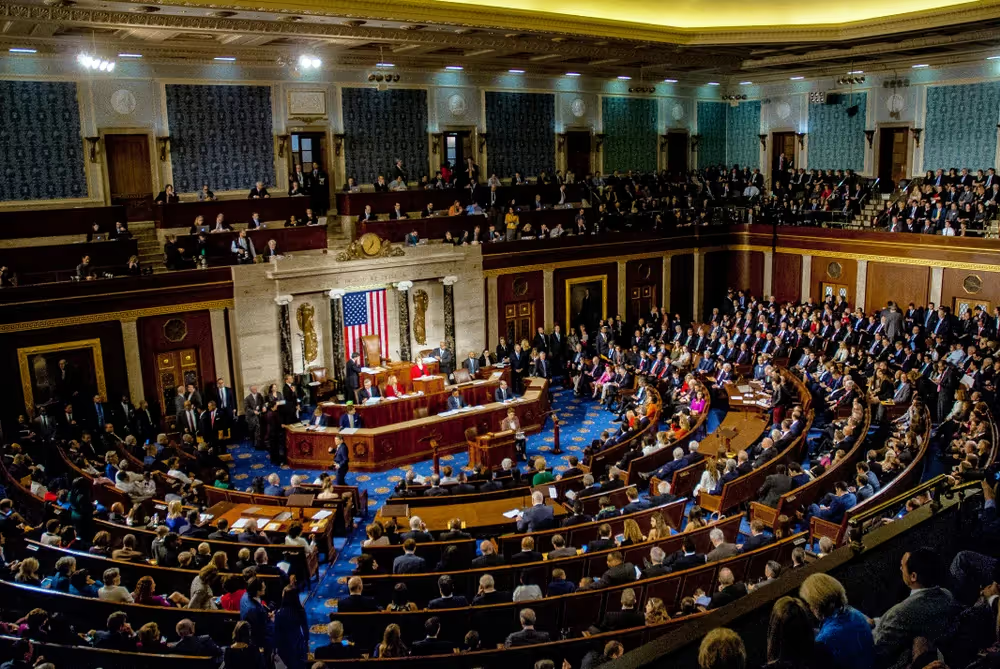
Why do presidential elections matter so much? Because Presidents have a lot of power. Well, why do Presidents have so much power? Because Presidents control the Executive Branch—“all of it”—and Congress has delegated vast policymaking authority to federal agencies within that branch. When that delegated statutory authority is combined with the President’s own constitutional authority, the result is the expansive administrative state that can affect essentially every major policy dispute. No wonder powerful players in society have strong incentives to do all that they can to see their candidates win.
This dynamic has long characterized American politics, but does it have to be this way? Our Constitution reaffirms that the most important entity for wide swaths of policy should not be the federal government at all, but the States. After all, “[t]he powers delegated by the [federal] Constitution to the federal government are few and defined,” while “[t]hose which are to remain in the State governments are numerous and indefinite.” Even within the federal government, Congress should be the preeminent policymaking body. Indeed, “Article I is the longest part of the Constitution … because the Founding generation thought that Congress would be the most powerful—and most dangerous—branch of government.”
Over time, however, the federal government has taken an increasingly prominent role, particularly federal agencies.
None of this is new; students of the federal administrative state have long observed both shifts. As I’ve explained previously, however, the Supreme Court largely no longer attempts to police that first issue. Congress thus often has effectively plenary power to enact legislation, subject only to the “rights” provisions of the Constitution.
The Court, however, has been more active with respect to the second issue — the shift of policymaking power from Congress to agencies. For example, in recent years, the Court in Loper Bright Enterprises v. Raimondo tossed aside “Chevron deference,” which held that when an agency is administering a statute, the court should defer to the agency’s reasonable interpretations of ambiguous provisions. Now, judges should give statutes their “best reading.” The Court has also embraced the major questions doctrine, which holds that for some particularly important policies — like forgiving half a trillion dollars’ worth of student loan debt — Congress must speak clearly. The major questions doctrine is controversial, but the motivating idea is that Congress (and thus the People) should decide the most important policy questions.
Although important, such decisions by the Supreme Court are not gamechangers. There are simply too many statutes administered by too many agencies for such doctrinal tweaks to change how modern government works.
The reality is that our nation has an accumulation problem. Congress has delegated so much power across so many statutes that it’s hard to find a question of any public importance to which some agency cannot point to at least some policymaking authority.
Often, these authorizations from Congress are quite old and were enacted with policies in mind that are quite different from how the delegated authority is used today. Yet, as a rule, a federal statute remains in effect until it is repealed. Over 200 years of legislation has led to a great deal of power accumulating in federal agencies.
This accumulation is a problem. Our Constitution makes it difficult for Congress to pass laws. A statute must pass both Houses of Congress and either be signed by the President or overcome a veto. Congress, however, has limited time, so even unobjectionable laws are often not important enough to warrant Congress’s time. The effect is akin to a “supermajority” requirement. Because it is so difficult to go through each step of the lawmaking process, the laws that survive the gauntlet generally have broad national support. This prevents policy from changing too quickly, for example, when the median voter’s position flips. The upshot is greater stability. If the sometimes inconsistent, often fleeting views of median voters always controlled policy, we would have an even more topsy-turvy government.
But that de facto supermajority requirement has a perverse effect over time. If a coalition can be assembled at one point to delegate broad power to an agency, that delegation generally remains on the books even after the coalition no longer exists and can be used to address policy concerns very different from those that motivated the coalition. For example, if Congress delegated authority to an agency to act “in the public interest” because it believed the agency would use that discretion to address issue X, decades later, the agency may be able to use that same delegation to address issue Y.
But there is no guarantee that a supermajority agrees on how to address issue Y. In fact, a majority may disagree with the agency’s policy; agency leadership, for example, may do what a majority of its political party wants, rather than a majority of all voters. But if Congress tries to prevent the agency from using delegated authority to address issue Y, the President’s veto stands in the way. Bicameralism and the present requirement make it hard for Congress to delegate power, but once power is delegated, it’s often all but impossible for Congress to take the power back because one of the features that makes lawmaking difficult — presentment to the President — hobbles the effort.
The result? Agencies have tremendous power as policymaking increasingly drifts away from Congress. What’s more, after an administration turns over, the next one may go around undoing what the prior administration just did. Justice Gorsuch addressed this problem in the context of Chevron deference with an analysis that applies equally well to many delegations of authority:
Take just one example. [In 2005] … the Court upheld an agency rule adopted by the administration of President George W. Bush because it was premised on a “reasonable” interpretation of the statute. Later, the Obama administration rescinded the rule and replaced it with another. Later still, during President Donald J. Trump's administration, officials replaced that rule with a different one, all before President Joseph R. Biden, Jr.’s administration declared its intention to reverse course for yet a fourth time. Each time, the government claimed its new rule was just as “reasonable” as the last. Rather than promoting reliance by fixing the meaning of the law, [delegation] engenders constant uncertainty and convulsive change even when the statute at issue itself remains unchanged.
Nor is that the only dynamic of accumulation. Because agencies have had broad policymaking power for so long, they have generated many requirements that may no longer make sense. Cass Sunstein, hardly a foe of regulation, groups such outdated requirements in the category of “sludge.” Agencies can do a retrospective review of what is on the books and eliminate outdated requirements, but they often don’t. Instead, they create new ones.
What can be done to address accumulation? The first step should be to stop the bleeding. As Jonathan Adler and Chris Walker explained in their article “Delegation and Time,” adding sunset provisions should prevent accumulation from getting worse.
Congress should also try to reclaim some of the power that has been delegated. As explained above, this is difficult. Often, a minority coalition in Congress will oppose the effort, and even if legislation withdrawing past delegations passes, the White House may oppose efforts to limit executive power. But a legislative solution is worth trying. It should be increasingly obvious to everyone, regardless of political preferences, that zigzagging policy is bad policy. President Trump, moreover, is keenly aware of the problem; one hallmark of his approach to regulation has been to clear away old rules. True, like any president, he may be wary of losing delegated authority, all else equal. That’s understandable. Importantly, though, he has explicitly ordered federal agencies to lean into Loper Bright by finding old rules that cannot be justified without Chevron deference and eliminating them. That order is important. Systemically, cutting back on delegated authority should create greater stability.
But we should be honest about where we are as a country. The accumulation of delegated authority is a problem two centuries in the making and will not be solved overnight. It is important to recognize what is happening and why, and to think through solutions. There are no easy answers, especially when moving from general principles to applications. But in combating the nation’s accumulation problem, more federalism and less delegation are good places to start.
Aaron L. Nielson is a senior fellow at the Civitas Institute and holds the Charles I. Francis Professorship in Law at the University of Texas at Austin School of Law.

.jpg)
The Declaration Symposium
Civitas Symposium featuring Gregory Collins, Aaron Nielson, Joseph Postell, and John Yoo
The Birthright Citizenship Decision Will Not End the Birthright Citizenship Debate
It is unlikely that Trump v. Barbara ended the debate over birthright citizenship. It may have truly started it.

The Declaration and Tradition
As we approach America’s 250th anniversary, we should reflect upon and appreciate the Declaration’s opening paragraphs—but we should not forget to remember the rest of the document or the context in which it was created.

.JPG)
.avif)



Get the Civitas Outlook daily digest, plus new research and events.
Get the Civitas Outlook daily digest, plus new research and events.