
Diversity, Real and Imposed

Having a high regard for difference—meaning variety—is fundamental to conservatism.
The Trump Administration’s campaign to suppress DEI initiatives in universities and firms, along with conservatives’ long-standing concerns over race-based affirmative action, have created the impression that conservatism is opposed on principle to diversity.
This assumption is wrong. Diversity—better understood as variety—has long been a guiding precept of conservatism. The second tenet of conservative intellectual Russell Kirk’s “six canons of conservative thought,” in fact, was “[a]ffection for the proliferating variety and mystery of human existence.”
This conservative perspective recognizes many benefits to variety. Variety reflects the beautiful complexities of social life. It conveys a healthy respect for the infinite and varied distinctions among cultures from around the world. It captures the myriad ways different peoples have used customs, rituals, and institutions to adapt to their specific circumstances and satisfy their particular needs. It affirms the creative faculties of man. It preserves social bonds. It constructs a sturdy safeguard against the concentration of power. It resists rulers’ desires to use human beings as shiny instruments for utopian ends. It is this conception of diversity, understood as variety, that should be recovered today.
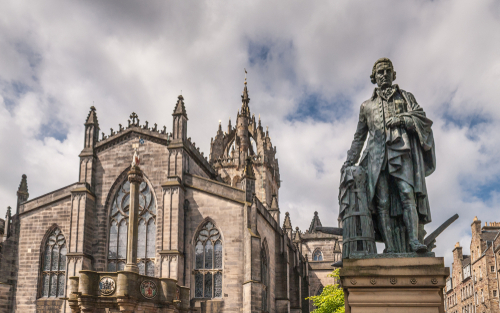
Rooted in the Tower of Babel story in the Book of Genesis and the Roman Empire, the idea of variety in modernity has been welcomed by empirically-minded liberals such as Adam Smith and Montesquieu. But it is perhaps even more fundamental to the origins of conservative thought. Arguing against narrow Puritan interpretations of Scripture in the sixteenth century, Richard Hooker, an Anglican theologian and a forebear of Edmund Burke, argued that the hand of justice “cannot fit all sorts with one measure, the wills, counsels, qualities and states of men being divers.” Knowledge and wisdom steadily flowed from the diffusion of rituals, laws, and institutions.
This insight informed the rise of conservatism in the eighteenth century, which emerged largely as a response to the attempt by early modern liberals in the social contract tradition to flatten the intricate and impenetrable dimensions of social life into a stiff monolith. Philosophers such as Thomas Hobbes, John Locke, and Jean-Jacques Rousseau, and eighteenth-century advocates of the French Revolution, envisioned civil society as an aggregate of largely undifferentiated individuals living under the weight of an impersonal sovereign. These thinkers aspired to bend circumstance to universally applicable laws discoverable through human reason.
What they struggled to appreciate, however, is that the colorful variations among individuals and social groups escaped abstract notions of equality, freedom, sovereignty, contracts, choice, and autonomy. Edmund Burke, generally considered to be the godfather of conservatism and a disciple of Hooker, made this argument in his attack on the French Revolution. Society, he held, was not a heap of discrete individuals connected only by written laws, political coercion, and speculative principles.
Society instead consisted of human beings with varying backgrounds, interests, and experiences threaded into a weave of inherited kinship networks, institutions, and traditions. One chief target of Burke’s criticism of the French Revolution was the Revolution’s radical experiment to thrust the diverse customs and local attachments of various French provinces into regimented conformity. Describing revolutionaries’ attempt to create new administrative districts based on geometrical proportion, he observed, “No man ever was attached by a sense of pride, partiality, or real affection, to a description of square measurement.” On a global scale, Burke emphasized how India was “infinitely diversified by manners, by religion, by hereditary employment, through all their possible combinations.” Joseph de Maistre, a Savoyard counterrevolutionary, explained that he had met “Frenchmen, Italians, Russians, etc.” but never “man” in the abstract, highlighting the sundry strands of national and ethnic identity spanning the earth.
This outlook has guided the evolution of conservative thought throughout the twentieth century. Michael Oakeshott, an English conservative, denounced rationalism for breeding the “politics of uniformity,” which left no place for “variety.” Robert Nisbet, an American communitarian conservative, attacked philosophers for revolting against the “manifest pluralism of the universe and the diversity of society.”
In essence, a high regard for difference—variety, in other words—is elemental to conservatism. Why, then, does conservatism continue to be associated with opposition to diversity initiatives?
Because conservatives—and many moderate liberals uncomfortable with DEI programs—have questioned the effort to manufacture diversity as an end in itself, driven by bureaucratic coercion and based on quantitative procedures and measurements, such as quotas, timetables, and point systems. (This is in addition to their suspicions over the actual efficacy of such programs.) By contrast, the original understanding of variety was grounded in a recognition of the organic nature of differences across the globe that rested on a common human ground, imperfect yet vibrant gardens growing from the shared soil of the earth.
Beer-making, for instance, has long been dominated by people of German ancestry across the globe, exemplifying what Thomas Sowell has called the “developed capabilities” of particular peoples. Just in my neighborhood, there are contractors, landscapers, teachers, and engineers possessing distinctive skill sets and representing a pastiche of races, ethnicities, and religions. My immediate and extended family boasts lawyers, machinists, and educators flaunting real New York, Rhode Island, and Worcester (Massachusetts) accents. Everyone can point to similar examples in his or her personal life. Rather than being imposed by the muscular arm of rulers and administrators, diversity in these contexts sprouted from the scattered religious, social, economic, and geographical circumstances of different peoples spanning back generations. The contemporary notion of diversity as an immediate and manufactured outcome remains in sharp conflict with this organic understanding of variety, draining it of real meaning.
When stretched too far, the idea of variety, much like the conventional view of diversity today, can descend into moral relativism and contrive a romantic rationale for untenable customs. Different preferences regarding vocation and dialect are one thing. Different preferences regarding moral evils, such as killing innocents, are another. Similarly, an embrace of variety must not threaten unifying conventions, norms, and ideals that enable a particular nation-state to flourish, such as veneration of the U.S. Constitution. It is also true that the organic development of variety throughout human history has blended with acts of political repression, which makes it even more difficult to calculate and rectify wrongs that have occurred centuries prior.
But these realities should not pressure us to debauch the concept. While fixed moral truths govern human behavior, many complexities in social life call for judgment, compromise, and tradeoffs, such as eating Italian food one weekend and Chinese food the next. These expressions of prudence are brought to life by the splash of customs and institutions practiced by cultures from around the world in response to their varying circumstances and needs.
In sum, a proper conception of diversity should be variety. It should reject social engineering schemes, enforced by jerks of administrative authority, to fabricate diverse outcomes determined by mechanistic procedures and quantitative metrics. (This also goes for preventing diverse outcomes that naturally emerge over time.)
But it should treasure the beautiful complexities, the splendid variations, the organic unities, of social life shaped by diffuse habits, languages, and circumstances. This understanding of diversity accommodates—indeed encourages—unforced attempts to expand the range of opportunities for individuals and social groups inspired by the spirit of fellowship, not the pretensions of technocracy. Otherwise, diversity initiatives will succumb to the danger that conservatives, spanning back to Burke, have feared: The surrender of human spontaneity, of the shades and gradations of man’s mysterious existence, to heartless uniformity, bearing no pulses, imaginations, or souls.
Gregory M. Collins is a lecturer in the Program on Ethics, Politics, and Economics at Yale University and the author of Commerce and Manners in Edmund Burke’s Political Economy. His book manuscript on the idea of civil society in early black political thought, featuring Richard Allen, Absalom Jones, Frederick Douglass, Booker T. Washington, Fannie Barrier Williams, Alexander Crummell, and W.E.B. Du Bois, is under review.


Nolan’s Odyssey and the Search for Wisdom
Nolan’s 'Odyssey' will be a tremendous success, but it is also a work of decadence.
Adam Smith, Economist of the American Revolution
Clear-eyed economic thinking remains one of humanity’s most powerful instruments for understanding our problems and advancing our possibilities for improvement.
Made in the Image of Nothing
We need a sequel to Carl R. Trueman's 'The Desecration of Man: How the Rejection of God Degrades Our Humanity.'
.jpeg)


Get the Civitas Outlook daily digest, plus new research and events.
Get the Civitas Outlook daily digest, plus new research and events.