

The Declaration and the American Inheritance
America is not an exceptional nation because it is an experiment. It is an exceptional nation because it has historically balanced its restless energies with customary practices and institutions that resist experimentation.
Swipe that baking soda from the cabinet and mix it with a little Heinz ketchup, a cup of Tostito’s Scoop! Tortilla Chips, a handful of Reese’s Cups, and a scoop of kitty chow. Now stir!
Experimentation may be the cat’s meow for a seven-year-old conducting a science project, but it can be perilous in the realm of politics. If there is a self-evident truth among public intellectuals straddling the ideological spectrum, it is that they are endowed by their Creator with the unalienable right to assert that America is an “experiment.” America’s Semiquincentennial has intensified this trend, melting the clever idiom into a shibboleth.
Joseph Ellis, in his recent book The Great Contradiction, references the American colonies’ “bold experiment in republican government.” Jeffrey Goldberg, editor of The Atlantic, says we are “250 years into this experiment.” Bradley J. Birzer’s new book is called The Declaration of Independence: A Radical Experiment in Liberty. The title of Harvard Law School’s programming on the Semiquincentennial is “The American Experiment at 250.” The George Washington Presidential Library at Mount Vernon explains that Gordon Wood “studied and defended the American experiment.” Jill Lepore, in These Truths: A History of the United States (2018), writes, “THE AMERICAN EXPERIMENT rests on three political ideas…political equality, natural rights, and the sovereignty of the people.” A popular AP US history textbook (2002) is titled The American Experiment: A History of the United States. Even Netflix has joined in on the fun, producing a new documentary titled “The American Experiment.” And the list goes on.
It is high time to pause using this phrase and call it out as a misleading characterization of the American Founding and the American system of republican self-government. Two general connotations emerge from the idiom. The first is the most pernicious: the suggestion that the Founding Fathers, clad in sleek lab coats and armed with microscopes and test tubes, mixed and matched speculative theories to contrive a political system based on previously undiscovered knowledge and principles never before attempted in world history. The second, more charitable, interpretation implies the belief that the establishment of any new republic is fraught with uncertainty, due both to its novel character and to the blunt reality that it places great responsibility on free citizens to rule themselves with discipline and restraint.
In both cases, however, the image of America as an experiment crowds out recognition of the manifold ways the founding of the United States was the antithesis of experimentation, grounding its political and moral principles instead in time-tested customs, rituals, and institutions embedded in the constitutional heritage of England and the ethical texture of Christian civilization. America, properly understood, is not a product of experimentation but a product of inheritance.
British American colonists had practiced self-government for a century and a half before 1776. The common law system they adopted dates back to prior to the Magna Carta under the reign of Henry II (1133-1189). Clauses 39 and 40 of the Magna Carta (1215), the godfather of the U.S. Constitution, protect due process rights of the accused. Clause 12 reads: “no scutage or aid is to be levied in our kingdom, save by the common counsel of our kingdom”—in other words, no taxation without representation. The very first clause of the charter preserves the corporate autonomy of the English church.
The common law, property rights, due process, trial by jury, no taxation without representation, the rule of law, legislative supremacy, restraints on royal power, separation of powers, checks and balances, civilian control of the military, limits on administrative intrusion into legislative affairs, and local self-rule: These English political and legal traditions, which colonists inherited, were sturdy checks against novelty. All but four of the twenty-seven grievances enumerated in the Declaration of Independence were drawn from the state constitutions of New Hampshire, South Carolina, and Virginia. This is not to mention the ancient ethical and social codes the colonists absorbed, including Christianity, family structure, chivalry, and sexual morality, that are even more vital to sustaining self-government. Such customs were not microorganisms placed in petri dishes but the sanction of historical wisdom distilled through classical, biblical, and British sources and institutions that guarded against experimentation.
The influence of this inheritance on the American Founding has been well documented, including by some of the very same scholars above who call America an experiment. The point, then, is not to rehash the “rights of Englishmen” versus “natural rights” or “creed versus cultures” debates, but to show how this deluge of overtures to the American “experiment” distorts Americans’ political psychology. This effect stirs the impulse to see America as a laboratory—a site of experimentation—for the boundless expansion of rights, liberties, and privileges animated by modern conceptions of democracy, equality, autonomy, and freedom. It understates the many restraints and checks the Founding Fathers lodged in the U.S. Constitution and state constitutions to shield Americans from novelty. And it shifts our attention away from appreciating this bountiful inheritance, a sentiment of the heart that is the seed of gratitude.
Goldberg, for instance, says:
“We are 250 years into this experiment. There’s not a straight shot toward near perfection in American history or any other history. But we have seen the expansion of the American idea to include women, to include black people, to include all kinds of other people…into the promise that was made by the founders, the genius founders of the United States.”
This logic is a hallmark of the experiment hypothesis. The “expansion of the American idea” to include blacks and women, however, has often meant applying to these groups inherited customs, like those outlined above, that predated July 4, 1776, such as due process, trial by jury, and the security of property rights. To take but one example, A Narrative of the Proceedings of the Black People, During the Late Awful Calamity in Philadelphia, in the Year 1793, authored by Richard Allen and Absalom Jones, two early founders of black civil society in the United States, was the first black publication to receive federal copyright protection in U.S. history—copyright protection whose guiding principles trace back to Britain’s Statute of Anne in 1710.
The Founding Fathers themselves did use the word “experiment,” a term that climbed in popularity in the English-speaking world in the latter half of the eighteenth century. James Madison tied the notion of an “extended republic” to experimentation, asking rhetorically in Federalist Paper 14, “…[W]hy is the experiment of an extended republic to be rejected merely because it may comprise what is new?” But he does not stop there. Madison then asks whether Americans should not allow “a blind veneration for antiquity, for custom, or for names, to overrule the suggestions of their own good sense, the knowledge of their own situation, and the lessons of their own experience?” Even when Madison rightly counsels Americans to avoid a blind veneration for antiquity, he still appeals to “good sense,” “knowledge of their own situation,” and “lessons of their own experience.” All these qualities do not scream experimentation but rather wisdom, judgment, and prudence drawn from, among various sources, Americans’ long experiences cultivating habits of colonial self-government and designing state constitutions.
If any party was guilty of experimentation, it was King George III, his ministers, and Parliament. Their promiscuous interference in colonial governance regarding legislative proceedings, executive councils, due process, jury trials, judicial independence, migration and naturalization, commerce and trade, taxation, and the quartering of troops all marked sharp deviations from custom and the common law that had governed the colonies’ relationship with the British government for generations. The Stamp Act, the Townshend Acts, the Sugar Act, the Boston Port Act, the Massachusetts Government Act, the Administration of Justice Act, among others, yanked authority away from self-governing colonists and revolted against the constitution of the British Empire, transforming the British-American partnership from a soft mercantilist relationship into an increasingly muscular and imperial one.
While the Americans received inspiration from the British constitution (distinct from the constitution of the British Empire) as a model for their new system of government, they, of course, experimented in some ways, if we may use the term, in the early republic and throughout the first decades of the nineteenth century to puncture the puffed-up traditions of European constitutional monarchies and high European aristocratic society. A range of observers, spanning from Alexis de Tocqueville and Frances Milton Trollope to the late Gordon Wood, have rigorously documented the egalitarian mores of American culture that dissolved such traditions.
But even these American shifts in politics and culture were braced by institutional and moral safeguards whose roots predated the American experiment, such as the prescriptions previously mentioned: institutional safeguards like due process and checks and balances; and moral safeguards like Christianity and the family.
Contemporary proponents of the “American experiment” thesis would stand on firmer ground if they confined their conception of experiment to its eighteenth-century meaning. Samuel Johnson’s 1773 dictionary defined the word as: “Trial of any thing; something done in order to discover an uncertain or unknown effect.” Relatedly, the first, second, and third definitions of “Trial” were “Test; examination”; “Experiment; act of examining by experience”; and “Experience; experimental knowledge.”
There is no guarantee that the founding of any political system will succeed. In this sense, the new constitutional order of the United States had an “unknown effect,” a notion that resembles the more charitable conception of the “American experiment” as a test to demonstrate whether a people can govern themselves. Insofar as Americans during the Founding era used “experiment” to denote these definitions of trial, with their accent on experience, such an understanding would be an appropriate usage of the word as well, since colonists sought recourse in their experiences practicing self-government to fend off British encroachment on their liberties.
This is where eighteenth-century notions of experiment and trial, paradoxically, intersect to lay bare the limits of the “American experiment” hypothesis. The dangers of the unknown effects of self-government, arising from human infirmities, can be mitigated by relying on the weight of time-honored customs that comprise our inheritance. Yet the frequent portrayal of America as an “experiment” rather than an “inheritance” minimizes the debt we owe to our colonial and British patrimony. In turn, this pattern smothers the humility we should otherwise show toward this heirloom of ordered liberty stretching back centuries.
America, therefore, is not an exceptional nation because it is an experiment. It is an exceptional nation because it has historically balanced its restless energies, certainly conducive to experimentation, with customary practices and institutions that resist experimentation.
A modest proposal, then: In the spirit of America’s Semiquincentennial, let us temper our zealous tributes to “experiment” and amplify our appeals to “inheritance” when describing the political character of the United States. The nation’s founding principles and constitutional architecture of republican self-government, best understood, is not a potion of baking soda and Tostito’s chips, Reese’s Cups and kitty chow, generating unknown effects and undiscovered knowledge and infinite tastes, but a careful blend of rosemary and thyme, oregano and sage, whose combined aroma has stood the test of time.
Gregory M. Collins is a lecturer in the Program on Ethics, Politics, and Economics at Yale University and the author of Commerce and Manners in Edmund Burke’s Political Economy. His second book, Early Black Political Thought on American Civil Society, featuring Richard Allen, Absalom Jones, Frederick Douglass, Booker T. Washington, Fannie Barrier Williams, Alexander Crummell, and W.E.B. Du Bois, is forthcoming from Cambridge University Press. William Bramwell contributed research to this article.
The Declaration and the American Inheritance
In the spirit of America’s Semiquincentennial, let us temper our zealous tributes to “experiment” and amplify our appeals to “inheritance” when describing the political character of the United States.

The Declaration as Law
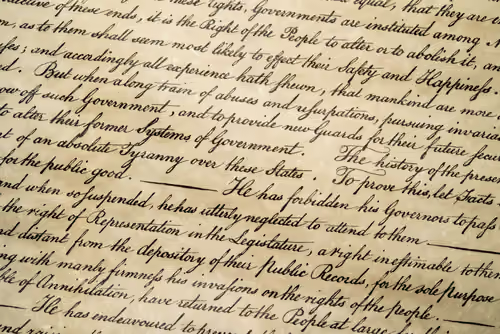
As we approach the Declaration’s 250th anniversary, it’s useful to assess the Declaration’s legal status.


.png)


Get the Civitas Outlook daily digest, plus new research and events.
Get the Civitas Outlook daily digest, plus new research and events.