
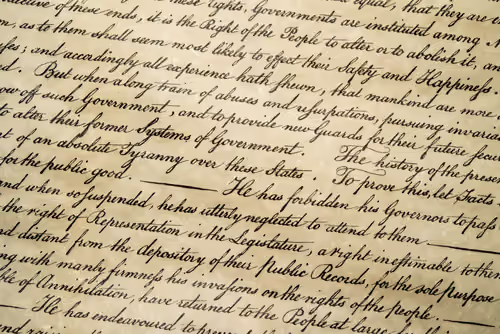
The Declaration as a Constitution

Our Declaration is more of a constitution than a bill of rights. It announced the rights to “Life, Liberty, and the Pursuit of Happiness.” But it did not explain further.
The 250th anniversary of the Declaration of Independence should be celebrated as a testament to natural rights. And rightly so. The Declaration boldly stated three “self-evident” truths: “all Men are created equal”; “they are endowed by their Creator with certain inalienable rights”; and “among these are Life, Liberty, and the Pursuit of Happiness.” No longer subjects of a monarch, Americans became citizens of a republic whose purpose was to protect their rights.
Yet even as the Founding hits the 250th year mark, the Declaration has come under withering fire from all sides. The Left, represented most recently by the New York Times’ 1619 Project, claims the founders did not include minorities and women in their vision of the equality of “all men.” The defenders of slavery made the same claim that the Declaration lied. John Calhoun, the South’s most ardent defender of slavery, declared in 1848 that the idea that all men are created equal “is the most false and dangerous of all political errors.” Chief Justice Roger Taney claimed much the same in Dred Scott v. Sanford, which barred congressional regulation of slavery in the territories. If the authors of the 1619 Project knew more history, they could have counted Calhoun and Taney as inspirations.
Meanwhile, a rising political right blames the Declaration for today’s social ills. These critics believe the Declaration elevates individual autonomy, thereby producing an amoral society that lacks virtue. Liberalism leads to the drug culture, the sexual revolution, transgenderism, and the disappearing family.
It is altogether fitting and proper that we should continue to debate natural rights. But it should not distract our gaze from the Declaration’s primary purpose: founding the nation. The Declaration famously announces natural rights in the second paragraph. It devotes the first paragraph—as well as most of the text—to proclaiming the right of the United States to exist as a free and equal nation.
The Declaration explains our divorce from the British Empire—to show why the time had come “for one People to dissolve the Political Bands which have connected them with another.” It described “a long train of abuses and usurpations” that “evinces a design to reduce [the people] under absolute Despotism.” At that point, “it is their right, it is their duty, to throw off such Government, and to provide new Guards for their future security.” After listing King George III’s litany of abuses, the revolutionaries underscored the nationalism at the heart of the Declaration. The “United Colonies” were now “FREE AND INDEPENDENT STATES”; they were “absolved from all Allegiance to the British Crown”; and “all political Connection between them and the State of Great Britain” was “dissolved.”
Our Declaration is more of a constitution than a bill of rights. It announced the rights to “Life, Liberty, and the Pursuit of Happiness.” But it did not explain further. Americans would have to wait 15 years for a Bill of Rights to protect the rights to free speech, freedom of worship, the right to bear arms, and the like. Instead, the revolutionaries announced their purpose as “laying [the new government’s] foundation on such principles and organizing its powers in such form, as to them shall seem most likely to effect their Safety and Happiness.” The Declaration proclaimed its fundamental purpose in its “throw[ing] off old government” and becoming a new nation among equals.
The revolutionaries established a nation governed not by the divine right of kings, but by the consent of the governed. They could have refused to recognize the rule of other nations that did not similarly govern by consent. Their French counterparts would do just that in 1789, when they sought to overturn the European monarchies. Instead, the Americans claimed independence within a world that they largely accepted. Their understanding of that system paralleled their view of man in the state of nature. In such a state, men—the primary actors in society—are presumed equal; no superior authority can compel them to obey. Likewise, the world is populated by “the powers of the earth”—i.e., nation-states—which hold “separate and equal station” and engage with each other under “the Laws of Nature and of Nature’s God.” The organizing principle of that system is anarchy. The rules that governed international politics derived from the state of nature, too.
Independence created a new actor on the world stage. Because Americans had become a separate “people” from Great Britain, they were entitled to the same “equal station” as any other nation—an equality that authorized the United States to exercise the powers of a sovereign nation. The last paragraph of the Declaration announced that the United States now would “have full power to levy War, conclude Peace, contract Alliances, establish Commerce, and to do all other Acts and Things which INDEPENDENT STATES may of right do.”
Independence re-ordered the New World in a single stroke. The new nation became the first on the American continent not beholden to a European empire. Its emergence would prevent North America, unlike Asia and Africa, from becoming a playground for European rivalries. The United States would oust the Great Powers from most of North America and, under the Monroe Doctrine, block their return. The Declaration marked the birth of a great power in the new world.
The founders also set out an implicit design for the structure of their new nation-state. Most readers of the Declaration of Independence focus on Jefferson’s famous passage on natural rights, quickly pass through the list of grievances against King George III and Parliament, and then perk up again at Revolutionaries’ stirring closing “And for the support of this Declaration, with a firm reliance on the protection of divine Providence, we mutually pledge to each other of our Lives, our Fortunes and our sacred Honor.” The middle, however, contains more than just a bill of particulars; it provides insights into the Revolutionaries’ view of the foundations of the American nation-state.
The revolutionaries began their list of particulars with colonial lawmaking. King George, they observed, had “refused his Assent to Laws, the most wholesome and necessary for the public good”; had “forbidden his Governors to pass Laws of immediate and pressing importance”; and had “refused to pass other Laws for the accommodation of large districts of people” unless they “relinquish[ed] the right of Representation in the Legislature.” The Declaration also registered the revolutionaries’ dissent from imperial policies: Great Britain had imposed taxes and trade regulations on the colonies; it had “enacted a multitude of New Offices, and sent hither swarms of Officers to harass our people, and eat out their substance”; and it had stationed a standing army in the colonies for the first time and quartered soldiers in civilian homes.
These accusations did not rest on individual rights. Trading rights, the size of the army, and the creation of new offices raise questions of government authority and structure, not rights. As the crisis between the colonies and the mother country intensified, Parliament’s inflexible stance prompted the revolutionaries to develop a new theory of empire. They argued that their colonial assemblies were not subordinate to Parliament but instead enjoyed the same relationship to the Crown as did Parliament. Upon independence, the Declaration naturally proclaimed the United States to be a nation that exercised the same sovereign powers as the king-in-Parliament did in Great Britain. It was from these premises that the colonists established principles for domestic government, beginning with the proper working of the three branches.
The Declaration assumed that representation meant the exercise of legislative power with the consent of the people. Though the document did not clearly define the legislative power, it did provide illustrations—for example, through its criticism of the king and Parliament for “imposing Taxes on us without our Consent.” Here, the revolutionaries did not take issue with the power of taxation itself, only with Parliament’s theory of virtual representation that justified colonial taxes. The Declaration similarly complained that the king and Parliament had “cut[]off our Trade with all parts of the world.” Again, the revolutionaries did not question whether a proper legislature could regulate or even prohibit trade; they only objected to their lack of consent.
The Declaration sketched out a vision for two other branches as well. On the executive, the revolutionaries did not equate the office with tyranny; instead, they argued that King George III had abused his position, rendering imperial rule tyrannical. The Declaration’s bill of particulars began: “[The King] has refused his Assent to Laws, the most wholesome and necessary for the public good.” As with the legislative authority, the revolutionaries did not challenge the executive’s power to veto legislation; they merely rejected the way in which the king had used that power. And in criticizing the king for “render[ing] the Military independent of and superior to the Civil power,” and creating a “Standing Armies without the Consent of our legislatures,” they implied that the United States would have civilian control of the military—perhaps the most important yet least-studied aspect of American constitutional law.
The Declaration further implied a check on the powers of government through judicial review. The revolutionaries attacked the king for “refusing his Assent to Laws for establishing Judiciary powers” and for “ma[king] Judges dependent on his Will alone, for the tenure of their offices, and the amount and payment of their salaries.” Here, the revolutionaries made clear that their nation should have an independent judiciary.
Finally, the Declaration addressed a dispute over British imperial governance. For a century, the colonies had benefited from a policy of benign neglect, which allowed elected, popular assemblies to wield significant governing authority. But the Seven Years’ War required Britain to establish a larger military presence in North America. Parliament asked the colonies to contribute to the costs of their protection. The colonists broke from the mother country because they wanted the right to participate in their own governance. London, however, saw no need to grant the colonies actual representation when they already had virtual representation in Parliament. Members were supposed to make decisions with the entire empire’s interests in mind, rather than just those of their constituents. The revolutionary slogan of “No Taxation without Representation” concisely expressed the colonists’ broader complaint against imperial policymaking. The Revolution arose from the Empire’s failures in federalism and the separation of powers.
The Declaration based a future American government on the separation of powers, with a representative legislature, an independent judiciary, and an executive, the latter of which would be devoted to foreign affairs and national security. Civilians would command the military. A balance between a central government and the states would govern domestic issues. The structure would rest on the consent of the governed, not on divine right or on a mixed government divided among the people, an aristocracy, and a monarchy. The United States would have a decentralized government, but one capable of exercising national sovereignty over the continent.
This last achievement alone rivaled the importance of the declaration of natural rights. It established a nation that would soon have the resources, organization, and drive to oust European intrigue and rivalries. The Declaration of Independence would eventually make possible the day, as Winston Churchill memorably hoped in June 1940, when “the New World, with all its power and might, steps forth to the rescue and the liberation of the old.” The Declaration of Independence not only declared American independence from Great Britain; it also founded a nation that, two centuries later, would restore Europe’s independence.
John Yoo is a senior research fellow at the Civitas Institute, and a distinguished visiting professor at the School of Civic Leadership at the University of Texas at Austin.
The Declaration and the American Inheritance
In the spirit of America’s Semiquincentennial, let us temper our zealous tributes to “experiment” and amplify our appeals to “inheritance” when describing the political character of the United States.

The Declaration as Law
As we approach the Declaration’s 250th anniversary, it’s useful to assess the Declaration’s legal status.

.png)


.png)
Get the Civitas Outlook daily digest, plus new research and events.
Get the Civitas Outlook daily digest, plus new research and events.