
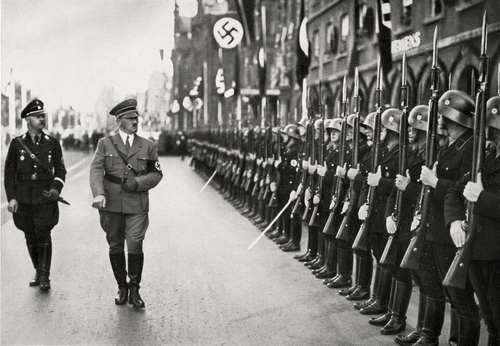
How the Weimar Republic Fell

Fateful Hours: The Collapse of the Weimar Republic is a readable, enriching, and provocative book that highlights the strange curveball the fates threw in the form of Adolf Hitler.
“Even in late January 1933,” Volker Ullrich claims, there were “ways of keeping Hitler from power.” With this pained lamentation, Ullrich encapsulates the argument of his latest foray into the perilous history of Germany, the Third Reich, and the man who would define it: Fateful Hours: The Collapse of the Weimar Republic.
Hitler, in short, never needed to happen. His rise was not the inevitable outcome of an intrinsically flawed Weimar Republic nor the manifestation of regular Germans’ unwillingness to embrace democracy. No, Hitler and the catastrophe he would unleash could almost certainly—and dare one say easily—have been avoided. Politicians lacking prudence, backroom deals, and high political chicanery made Hitler possible. Fateful and fatal decisions by men in power, who should have known better, made Hitler happen.
Indeed, what shines through in Ullrich’s account is the pluck and determination of the Weimar Republic. Those of us who see Weimar in light of its eventual collapse will be struck by how dynamic and resourceful the republican cause and its supporters were. For most of its existence, millions of Germans consistently voted for candidates who championed the constitutional order and the new stage in German history it represented. It took immense pressure from internal and external factors to break the republic’s spine and leave it supine at the feet of Adolf Hitler.
The years from 1919 to 1933 were among the most calamitous and historically decisive in European history, and Volker Ullrich is more than up to the task of navigating its perils and possibilities for modern readers. Throughout its eleven chapters, Ullrich weaves together an engaging narrative of political history that captures the uncertainty of the fourteen years when German politicians and voters decided the fate of a continent.
Ulrich reveals the narrative in full, diving into the social and political upheavals of late 1918 when Germany was gripped by naval mutinies, workers’ strikes, and soldiers refusing their orders. Over a chaotic span of weeks, the Kaiser was forced to abdicate, and Wilhelmine Germany collapsed to shouts for peace, bread, and socialism. Philip Scheidemann, a member of the Social Democratic Party (SPD), declared a republic on November 9, 1918. The possibilities of where the nation might go seemed endless.
The SPD and the first president it would elect, Friedrich Ebert, emerge as the protagonists of the tale, and Ullrich charts the herculean efforts of these republicans to forge a democratic Germany amid diverging social classes and political aspirations. The panoply of German society is represented in full: the curious but often disgruntled bourgeoisie, the aspirational proletariat, the recalcitrant nationalists, and political Catholicism. These are the forces that dominate the history of Weimar from its foundation to its eventual collapse. Throughout the republic’s history, different voices constantly clamored for different revolutions
Leavened throughout are the voices of literary figures, historians, and journalists who lived through the heady moment and its frenetic—and often kinetic—energy, and Ullrich makes skillful use of memoirs, diaries, and newspapers to add a flair of personal immediacy to his account.
One of his major points, captured in the title of chapter 3—“The Enemy is on the Right”—is that the threat to the republic came almost entirely from conservative, nationalist, and reactionary elements in German society. The far-left, the revolutionary Marxists and German Communist Party (KPD), would prove immaterial in the big scheme of things; from initial Spartacist successes and brief municipal revolutions, their primary threat was as propaganda fodder for the far-right and bodies for the bloody street battles and bar fights that peppered life under Weimar. The true danger was the conservative elites, industrial titans, and old landed gentry, who were skeptical of democracy and downplayed the danger posed by the far-right. Ultimately, they opened the door to Hitler.
Indeed, the preponderance of conservative skepticism among elites meant that Weimar governments often had to rely on men who regarded its democratic principles with suspicion at best and hostility at worst. The counter-revolutionary Kapp-Lüttwitz Putsch of 1920 highlighted this, with government officials allowing the insurrectionists to come dangerously close to succeeding and being exceptionally lenient in punishing them. Another leading issue in Ullrich’s account was Article 48 of the constitution, which gave the president emergency powers and a wide latitude in their deployment—something successive governments increasingly relied upon.
In 1925, Friedrich Ebert, the man who pioneered a broad, moderate coalition government and led the republic through seven of its most volatile years, died of septic shock at 52. With his death, the republic lost its best friend and champion. Ebert had been forced to navigate the Treaty of Versailles, the terror of hyper-inflation, socialists who thought he was too moderate, and conservatives who thought he was too radical. In Ullrich’s account, he was a hero who died well before his time, and before Germany could afford to lose him. In a surprise upset, Paul von Hindenburg won the presidency after Ebert and led Germany with an increasingly authoritarian and right-wing government. For Ullrich, the death of Ebert and election of Hindenburg marked a decisive turning point in the fortunes of the republic. Had the left been able to unify—the social democrats and Marxists—and present a united, pro-republic front, Hindenburg might not have happened, and the rise of Hitler averted.
Yet, even with conservatives and skeptics in power, Ullrich is keen to stress that there was hope for the Weimar Republic. While Hindenburg and his allies had authoritarian sympathies, it is unlikely they intended to end the republic. Traditional conservatives never had much respect for Hitler, and it was a series of poor decisions and a gross misunderstanding of the Nazis that led them to try to “tame” Hitler by bringing him into government. However, blunders go both ways, and Hitler made his own mistakes that nearly kept him from power. At what should have been a vital juncture, the Führer overplayed his hand by asking for too much from Hindenburg and was rebuffed, forcing his movement back into the political weeds. Unfortunately, Hindenburg gave him a second chance.
This is one of the book’s pre-eminent features, and Ullrich successfully demonstrates it. At multiple points, Hitler could have been forced from the stage. In fact, the sheer unlikelihood of a Hitler government is repeatedly demonstrated. Were the liberal days of Weimar under the SPD bound to face conservative backlash? That seems likely and is a normal feature of democratic politics. But Hitler? The strange Austrian who cobbled together a band of misfits and tried to capture Bavaria? No one could have expected that. The personal anecdotes Ullrich marshals reveal that liberals, Marxists, and conservatives were all united in the overriding sentiment that of all the possible futures, surely a Hitler future was not among them.
However, while Ullrich presents a consummate political and economic history, his analysis often leaves key factors unexplored, and at times, this prevents the reader from truly grasping the nuances of the events unfolding. Fateful Hours is very much a high political history; it’s dominated by the politicians in charge and the major names in their orbit. But this leaves cultural, social, and religious factors barely discussed. We hear about the Catholic Center Party often, but what were its policies? How did the German churches respond to the Weimar Republic, and how did they enable or frustrate the rise of the Nazis? And what about women? For the first time in German history, women had full suffrage—how did they vote and how did parties appeal to them? And political ideologies? What separated the German People’s Party, the National German People’s Party, and the National Socialist German Workers’ Party? How did the Nazis outmaneuver their right-wing opponents to win the votes of 37.3 percent of Germans in 1933? These questions are important but absent from his account. The Weimar Republic wasn’t brought down by the decisions of the politicians in charge, but also by the social, cultural, and religious values that shaped Germans’ imaginations and informed which decisions they would ultimately make.
Ullrich, of course, knows this, and has opted to present a top-down political history guided by the intricacies, efforts, and anxieties of the men who forged a republic and those who let it slip away. It’s emblematic of the scholarly and stylistic choices that every historian has to make when putting pen to paper. Even if certain nuances are left on the table, Ullrich executes his approach as a master of his craft.
In sum, Volker Ullrich presents a readable, enriching, and provocative book that highlights the strange curveball the fates threw in the form of Adolf Hitler. His narrative is both fast-paced and scholarly, weaving a tale where “what ifs” and folly abound. It has something for academics and casual readers alike. If you want to see just how close Germany—and the world—was to dodging catastrophe, this is the book for you.
Christopher Coome is a John and Daria Barry Postdoctoral Fellow at the Civil Discourse Project at Duke University. His research examines intellectual and religious history with a focus on civil society, the long 19th century, and transformations in Western religiosity.


Isolation Is Not an Option
The lesson the Trump administration ought to have learned by now is that Eastern Europe and the Middle East are two theaters of the same war, not separate conflicts.

A Deadly New York Parable
The public mood in New York City sharply changed when the Mamdani administration took one large and foolish step.
How the Weimar Republic Fell
The years from 1919 to 1933 were among the most calamitous and historically decisive in European history.

.jpg)


Get the Civitas Outlook daily digest, plus new research and events.
Get the Civitas Outlook daily digest, plus new research and events.