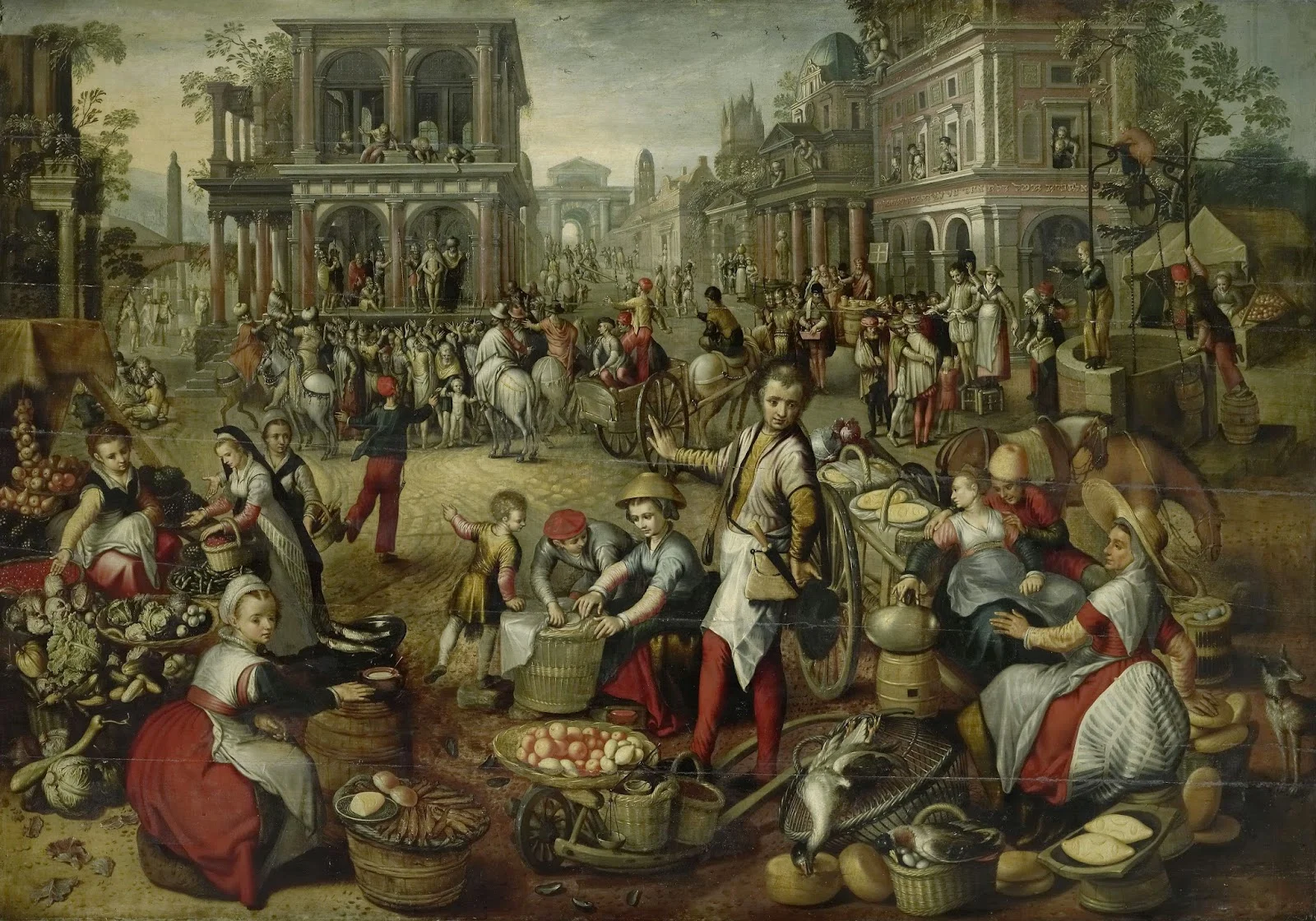
Rediscovering History as the Story of Liberty

The power of renewal, of refoundings, and returns to first principles, is an intrinsic part of history as the story of liberty.
Once upon a time, classical liberalism wasn’t just a theory of political economy; it was a theory of history.
Like its economics counterpart, it owed its origin to the thinkers of the Scottish Enlightenment, like William Robertson, David Hume, and Adam Smith. Classical liberalism’s history was one of inevitable civilizational advance, as economic freedom spawned other forms of freedom — political, intellectual, social, and even religious freedom.
That theory underpinned Adam Smith’s Wealth of Nations and a century of historians and political economists in the English-speaking world. It also inspired the historicist theories of Georg Friedrich Hegel and even Karl Marx. It was an Italian disciple of Hegel, Benedetto Croce, who summed up its vital message in the title of his most influential work: History As the Story of Liberty.
This confident and optimistic view ruled academic historiography until a book appeared in 1931 that cast the entire theory into question.
We’ve been living under the shadow of that overthrow ever since. The consequences have been frightening, and not only for the study of history but for the fate of freedom itself.
In the year of the 250th anniversary of the Scottish Enlightenment’s most celebrated work, and on the eve of the 250th anniversary of America’s founding, is a great time to resurrect that despised and discredited “Whig interpretation of history,” as detractors called it, as a better way to understand not only our past, including the American past, but the future, as well.
Classical Liberal History
Classical liberal history arose from the research of key figures of the Scottish Enlightenment, like Lord Kames, William Robertson, and David Hume into the evolution of European and non-European societies over time.
The conclusion they drew was that as society changes from an ecosystem populated first by hunter-gatherers, then shepherds and herders, followed by farmers and peasants, and then merchants and workers, our sense of ourselves and our relations with others change, as well. The commercial stage of this civilizing process is the crucial stage, they decided: because the freedom to exchange goods and services opens the floodgates to free ourselves from subordination to all forms of authority — economic, political, intellectual and religious — as we become strong enough to live our lives as we, not others, see fit, starting with how we make our living.
This year, Adam Smith’s Wealth of Nations celebrates its 250th anniversary as the founding document in free market political economy. However, its accompanying understanding of human history as the rise of civilization was just as influential, not only in Britain but across Europe. It inspired French thinkers like Alexis de Tocqueville and Francois Guizot; German thinkers like Hegel and Marx (his manner of fulsome praise for Europe’s bourgeoisie for achieving “wonders far surpassing Egyptian pyramids” in The Communist Manifesto reflects that view). It also inspired waves of economic and political reform across the Continent, starting in Britain, all aimed at freeing the individual whom the inevitable march of history had made ready for that freedom.
The one criticism of this classical liberal view of history faced by Marx and other socialists was that this march hadn’t gone far enough, i.e., that there was a final stage beyond capitalism. Hegel saw its inevitable endpoint as the rise of the bureaucratic state; Marx saw it as the rise of the proletariat. But both accepted that history, with its optimistic view of civilization’s progress, was more or less true.
As the nineteenth century progressed, other worries arose. Perhaps that progress was not as universal as the Scots had originally thought, that only certain races, i.e. white Europeans, were able to sustain and benefit from that march, while others worried (as I explained in my book The Idea of Decline in Western History) the West’s success would breed its opposite, i.e., spawn decadent and degenerative trends inside civilization that would halt or even reverse that forward progress.
Still, the classical liberal view became a virtual orthodoxy in the English-speaking world, led by historians like Lord Acton and J.R. Seeley. The figure who came to epitomize its optimism and faith in liberty, however, was Thomas Babington Macaulay. One of the most influential figures in his era’s politics as well as the life of the mind, Macaulay’s History of England (1848-1861) shaped three generations of thought on the relationship between liberty and historical change. Macaulay had no doubts that the latter led directly to the former, and about who was right and who was wrong in that advance.
His rival Thomas Carlyle once complained, “I wish I could be as cocksure about anything as Tom Macaulay is about everything.” The reason Macaulay was so cocksure was that he believed the England of his day—of the Reform Bill and repeal of the Corn Laws—was about as perfect as any country could be. In his mind its history sharply split into heroes, those like the men of Magna Carta and supporters of the Reform Bill of his own day, who advanced liberty; and villains, those like King John and Charles I and the Tories who opposed reform.
In the end, one could argue it embodied a simplistic view of human nature and a barren view of what historical research should be about. Macaulay made an easy target for those who sensed the limitations of both, especially after the traumatic experience of World War I, when the supposedly civilized nations of Europe tore each other apart with a ferocity and barbarism that belied the confidence in civilization and liberty that had prevailed before.
It was in 1931 that a young British historian named Herbert Butterfield published an essay, entitled “The Whig Interpretation of History,” that exposed the fallacies of the entire approach to history of Macaulay and the Victorian age.
Butterfield brilliantly exposed the classical liberal view that had guided Britain’s leading political party, the Whigs, for more than a century, not only to refutation but ridicule. He showed how it relied too heavily on a simple-minded teleology that weighed people and events in the past by a single standard, i.e., whether they had anticipated our modern view of politics and society. It also relied too little on research on what actually happened in an event’s historical context and why, whether it was Magna Carta or the execution of Charles I or even the passage of the First Reform Bill in Macaulay’s time, now a hundred years in the past when Butterfield’s essay was written.
“The study of the past with one eye upon the present is the source of all sins and sophistries in history,” Butterfield wrote.
The Whig view of history also ignored the sometimes terrible price that had to be paid for the advances in liberty and civilization that did come, whether it was the English Civil War or the Industrial Revolution, or in more recent memory, the killing fields of the Somme and Passchendaele.
Butterfield’s timing for undermining the optimism of history as the story of liberty was nearly perfect. A year after his book appeared, Adolf Hitler came to power; five years later, the Spanish Civil War broke out. Europe, like the United States, was already in the grip of economic depression, spawned (it was widely believed) by the stepchild of classical liberalism, i.e., runaway capitalism. The forward march of freedom didn’t look so inevitable after all, as all around the world, dictators and tyrants were seizing power and committing terrible acts of murder as well as aggression.
Then came another world war, with upwards of 75-80 million human beings killed around the planet, and the hideous revelations of the Holocaust as perpetrated by one of the most supposedly civilized nations on earth.
Suddenly, the civilizing process, as the driving force behind history and the story of liberty, lost its analytic power. The historical profession yielded to Butterfield’s original onslaught, supported by various Marxist insurgencies, and in ways that would horrify Butterfield himself. The study of the West instead became an investigation into the West’s hitherto unacknowledged dark side, from religious fanaticism and racism to the nationalism of the masses, as well as the triumph of industrialization, imperialism, and the perversion of science in service to the State or capitalist exploitation.
Reducing all Western history to an extended discourse on race, class, and gender—a disingenuous and malicious discourse at that—was only the next step. If historians and Western intellectuals weren’t ready to endorse Susan Sontag’s claim that Western civilization represented “the cancer of human history,” they weren’t inclined to put up much of a fight, either.
Reviving the History of Liberty
By the 1980’s, the Whig interpretation of history, i.e., history as the story of liberty, was all but dead. It did live on in certain corners of economic history, and in the popular imagination in places like the United States when it came time to celebrate the Fourth of July or reflect on the larger meaning of the American Civil War—although inside the academy, those events had taken on a very different, far more sinister, meaning.
When President Barack Obama launched his notorious “apology tour” and framed American history as a kaleidoscope of mistreatment of indigenous peoples, slavery, bombing Hiroshima, torture at Guantanamo, and insufficient respect for the Muslim world, he was simply bringing into the public square the anti-Whig view of history that had prevailed in the profession for more than two decades.
The irony is that all the revisionist schools of historiography that despised the old Whig approach still saw liberty as history’s ultimate goal, just not according to an American or Western model.
And Butterfield’s other warning, that “The study of the past with one eye upon the present is the source of all sins and sophistries in history,” applied with just as much force, perhaps even more, to all the leftist attempts to bury the old classical liberal paradigm, from feminist scholars like Judith Butler to Project 1619, as it did to Thomas Babington Macaulay.
Butterfield’s other criticism was also well-taken. The older Whig tradition simply didn’t know enough (and were insufficiently curious) about the historical context in which key events in the evolution of liberty from Magna Carta to the American Revolution, or back to the world of fifth-century BCE Athens, as we did by Butterfield’s time, or now one hundred years later.
Given that gain in knowledge of the past, and the insufficiency of the alternative approaches to either guide or inspire an interest in history as a discipline or as a source of civic pride, perhaps it’s time to take a fresh look at the idea of history as the story of liberty, in a contemporary context.
We can begin by admitting that the old Whig tradition, including Macaulay, was more right than wrong. The pursuit of liberty—the seminal idea that individuals deserve to organize their lives as they, not others, see fit—is what separates the West as a civilization from all the others. This has been so since the ancient Greeks and continues to be so today.
At the start of this journey, theories of liberty adhered to the practices of the polis or city-state, whether Greece or Republican Rome. In the Middle Ages, theories of human freedom and liberty sprang up from the aspirations of Christian doctrine, set against a backdrop of constant war, turmoil, and material squalor.
But starting in the eighteenth century, the emphasis on the importance of liberty, which had been the interest of philosophers, thinkers, and activists, began to seep into public opinion, forcing institutions to align themselves with that ideal.
The result was that the past two centuries have witnessed more progress in the growth and expansion of liberty than in any period in history, and the greatest growth in institutions to suppress that liberty, for the same reason.
Seen in this way, the story of liberty does form a cumulative process: arising first in the realm of ideas, then making its way into reality. Instead of an inevitable process, here Macaulay and the Victorians had it wrong; it’s a story full of setbacks and unexpected twists and turns.
Nonetheless, over time, liberty and the pursuit of individual freedom have become intrinsic parts of the fabric of reality in the West, whatever its detractors say, and increasingly so around the world.
As such, we can see those advances coming in four distinct stages, each building on the other.
The Stages of Liberty
The first is political liberty, starting with the ancient Greeks with their idea of the self-governing polis and the Romans with their res publica, the public space where citizens come together to decide their collective fates, and enjoy their individual rights.
That story of liberty is well-known. What’s less well known is that the Middle Ages made an invaluable contribution to this notion of political liberty, by insisting that all forms of political authority, from municipal corporations to monarchies—at one point even the Papacy itself—require the consent of the governed. Although theorists like William of Ockham and Nicholas of Cusa failed to create representative government in the Catholic Church, their ideas did catch on in Europe’s national monarchies, including at a greater distance, the British king’s claim in 1776 to rule his American colonies without their consent.
The second stage is intellectual liberty, which emerged during the Renaissance. Inspired by its rediscovery of antiquity’s ideal of the free individual as the basis of public and civic life, the Renaissance gave posterity the image of the human being free to pursue all forms of creative expression and rational inquiry.
The third stage is closely related to the second, namely religious liberty, which emerged from the Reformation. The viability of that notion would be severely tested by decades of sectarian violence and bloodshed. But out of that century of religious war and persecution would come another principle that is fundamental to the modern West: that religious belief should be a matter of private conscience rather than public obligation, a principle being severely tested in today’s Europe with its Muslim immigrant population.
Finally, by 1750 or so, we come to the fourth stage: the idea of social and economic liberty. It may be the most crucial discovery of the eighteenth century, i.e., that free individuals interacting in free markets in pursuit of their own self-interest was not a social minus, as centuries of theologians and philosophers had insisted, but a major social plus.
It’s the view of liberty enshrined in Adam Smith’s Wealth of Nations. But it also comes at the end of a long and bloody road, establishing liberty first in the political, intellectual, and religious spheres. It serves as the start of an even rockier one, establishing the truth of that notion of liberty against its enemies around the globe. A struggle that is still going on today.
Liberty’s Continuing Story
This is because Smith understood that the realization of social and economic liberty did not represent “the end of history” of the story of liberty, but only the beginning of a new phase in that struggle. Thanks to the division of labor, free markets release a dynamism in society that quickly flows over into other spheres of activity. Once human beings have mastery over the decisions that affect their economic lives, they begin to expect and demand similar independence in other matters, as well.
The sources of resistance to that independence are bound to multiply; the story of liberty gets increasingly messy. The sources of energy unleashed by the division of labor, from steam power and electricity to nuclear power and AI, surge forward at ever-faster speeds. Without an adequate framework for understanding and accounting for what is happening, the result is the kind of cultural confusion that the enemies of freedom can exploit, while the friends of freedom hesitate and worry about what has been unleashed, and where it’s headed.
In that sense, I believe the ongoing debate about artificial intelligence and machine learning reflects that confusion. Likewise the debates over transgenderism; over confronting the threat of Muslim radicalism; over the fate of the planet as an ecosystem; confusions that arise, I am convinced, when we abandon the view that the evolution of the West is a cumulative process centered around expanding the sphere of liberty — and that each stage is fundamental to the next.
As historian A.J.P. Taylor once wrote, “Macaulay made liberty the theme of all his writing and looked forward to a time when everybody would care for it as he and his friends did.”
History as the story of liberty doesn’t solve every cultural conundrum or smooth out all the problems we face in teaching and understanding history. But it can be a way to center ourselves today, and to renew the institutions and beliefs that are central to that history and its legacy. The power of renewal, of refoundings, and returns to first principles, is an intrinsic part of history as the story of liberty. It’s also why the West, and the United States as the guiding force in that pursuit of liberty, will remain a vital force in the world.
Arthur Herman is Senior Research Fellow at the Civitas Institute and the author, among other works, of The Cave and the Light: Plato, Aristotle, and the Struggle for the Soul of Western Civilization. His most recent book, Founder’s Fire: From 1776 to the Age of Trump, will be released on April 21.


Spielberg’s Empty Hope
'Disclosure Day' should have been called 'Hope and Change,' or rather 'Change and Hope.'
.jpeg)
Deliberative Republicanism and the Triumph of the American Founding
Instead of rejecting the moral urgency of the postliberal right and left, it is fitting and proper that we redirect it through the right kind of education—both formal and informal—that can inspire affection for our Constitution.
Can Civic Friendship Save America?
Start with “civic assimilation” on the way to a more peaceful Union.


.avif)


Get the Civitas Outlook daily digest, plus new research and events.
Get the Civitas Outlook daily digest, plus new research and events.