
We Can’t Tax Our Way Out of the Entitlement Hole

Republicans set themselves up for Oren Cass and other new right types to build their preferred case for tax increases.
When it comes to budgeting, Congress has two problems. The first is that they spend more money than they take in and do so with shocking regularity. The second, less obvious but far more harmful, is that most federal spending is considered “mandatory.” This spending generally continues under standing law rather than being considered under annual appropriations. While it can be reformed, doing so requires new legislation and is politically much harder than trimming annual appropriated accounts. This is why the now-common “government shutdowns” produce a good deal of smoke, but very little fire. Airports become more difficult to deal with, and national parks and museums close their doors, but Social Security checks, Medicare, and Medicaid all continue uninterrupted.
Today, with an accumulated federal debt rapidly approaching $40 trillion, annual deficits projected to exceed $2 trillion, and with Congress already spending more money servicing the debt than on defense, the problem seems dire. If we are to right this fiscal ship, there are three options before us: cut spending, increase revenues, or some combination thereof.
Last week, Oren Cass, the Founder and Chief Economist of American Compass, and Grover Norquist, the Founder and President of Americans for Tax Reform, debated this very topic on Conservative Crossroads. Cass argued that conservatives should be willing to raise taxes. Norquist argued that they should not. Listening to the debate highlights two very different theories of how a country climbs out of a fiscal hole.
Norquist took the hard line and did so without apology. A tax increase is a pay cut, and the Republican party ought not be cutting pay for its voters. He went further, saying that if Republicans put increasing revenue through taxation on the table, they will essentially be telling the other side that more spending can be financed. The steelman version of Norquist’s position, therefore, is that Republicans should refuse to raise taxes and refuse to increase spending. Historically, Republicans have kept their word on the first part but have mostly abandoned the second. The failure of the past 40 years or so has mostly been a failure of spending discipline.
Cass tried to stake out a prudential middle. After all, an individual who finds themselves in debt might dig themselves out by cutting spending, working overtime, or perhaps driving for Uber/Lyft on the side. Why shouldn’t the federal government adopt the same approach? If spending cuts could close two-thirds of the gap and new revenue could close the remaining third, neither side would get everything it wants, but the country as a whole would move toward solvency.
The trouble is that Cass’s whole case rests on confusing two things that are not at all the same: tax rates and tax revenues. Congress can set the rates, but it cannot set the revenues. Since 1950, tax rates have varied wildly, with top rates exceeding 90 percent under Eisenhower and falling below 28 percent under Reagan. Other tax rates have similarly varied, though not to the extent of top marginal rates. Given this variation, one would expect that tax revenues as a percentage of GDP would follow. Unfortunately for Cass, it does not. Despite the swings in tax rates, tax revenues as a percent of GDP have held remarkably stable at between 17 and 18 percent.
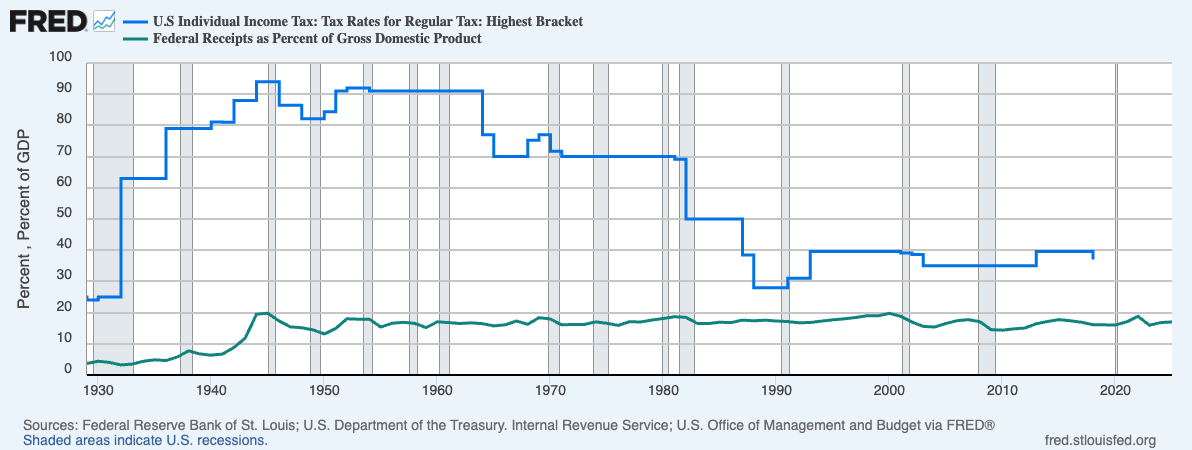
The reason for this is simple. Raising the statutory tax rate gives taxpayers an extra incentive to rearrange how and when they receive their income to minimize their tax burden. Lower the tax rate, and people don’t bother as much.
With this, Cass’s middle ground approach falls apart. Presumably, he does not want higher tax rates in and of themselves, but instead seeks greater tax revenue. Under charitable assumptions, pushing the tax rates as high as Republicans might stomach could generate an extra $500 billion in tax revenue. Now suppose that Cass gets everything he wants and matches this with a $1 trillion decrease in spending, which would already be a 14 percent reduction compared to Washington’s $7 trillion budget. With annual deficits of roughly $2 trillion, Cass’s plan would only accomplish a net savings of $1.5 trillion per year. This still leaves us with a $500 billion deficit that is projected to continue growing. While a big step in the right direction, Cass’s plan would still amount to a growing national debt.
The deeper reason this middle-ground plan is doomed to fail is due to mandatory spending. Budget items such as Social Security, Medicare, Medicaid, and net-interest-on-the-debt (which is also considered mandatory despite being listed separately in the CBO’s figure) for FY2025 totaled $5.2 trillion. Federal revenues, coincidentally, also totaled $5.2 trillion. In other words, every single dollar of federal revenue is already committed to the mandatory spending process and cannot be touched through the regular budget process that should keep federal spending in line with revenues.
This is why the phrase “spending problem, not a revenue problem” is more than a slogan. But here is where Norquist and I disagree. He has been characterized as being one of the chief architects of the “starve the beast” approach to reigning in federal spending. The federal government presumably cannot spend money it does not have and cannot incur debts it knows it cannot repay. If we limit their access to revenues by refusing to raise taxes, then the government will necessarily have to limit itself and live within its means. The trouble is that that hasn’t worked, either, which Cass pointed out. Reagan and George W. Bush both cut taxes and both left office with a larger, more expensive government. The real answer, as Nikolai Wenzel and I have argued, is to starve the beast of responsibility, not resources.
Fortunately, Grover Norquist agrees with this. Time and again, he steered the debate back to federalism, which is another way of saying “starve the beast of responsibility.” Cass dismissed this as the now-tired chant of “waste, fraud, and abuse” and demanded a line-item budget. But this isn’t what Norquist was pointing out. Shifting a program from the federal budget to a state budget does not ipso facto save money. However, by placing spending as close to the recipient as possible, it can be more effective. A caseworker in Grand Rapids, MI understands the wants and needs of the people there better than any bureaucrat in Washington ever will.
This is the point of federalism that Cass never considers. It’s not about how to balance books, but about how much federal government we actually need. Norquist’s point is to ask what Washington should be responsible for, hand the rest back to the states (or eliminate it), and the revenue needed to operate the government will fall. A federal government doing only the things that a federal government ought to do can be funded off of 17 to 18 percent of GDP quite comfortably.
Still, Cass is correct that we owe the next generation a country in better fiscal shape than the one we inherited ourselves. We cannot tax our way there, because tax revenue does not follow tax rates and what we do collect is already committed to mandatory spending programs. The only way out of this mess is through answering the difficult question: what should the federal government actually do? As we’ve seen, a federal government that tries to do too much can only afford to do too little.
This entails a discussion on what type and size of federal entitlement state we want and how we will pay for it. For now, that conversation seems difficult to have. Republicans proclaim that they aren’t touching entitlement spending, and Democrats only want to increase it. However, by refusing to engage this question, Republicans set themselves up for Oren Cass and other new right types to build their preferred case for tax increases to fund transfer payments. Ohio’s Republican senator Bernie Moreno has already sponsored legislation with Elizabeth Warren to lift current income caps on Social Security taxes, raising revenue for what will remain a structurally indebted program. But Moreno’s tax increases, among other kinds, will seem reasonable if we continue on this current course.
David Hebert is a senior research fellow at the American Institute for Economic Research.





Get the Civitas Outlook daily digest, plus new research and events.
Get the Civitas Outlook daily digest, plus new research and events.