
The Backstory of 1776

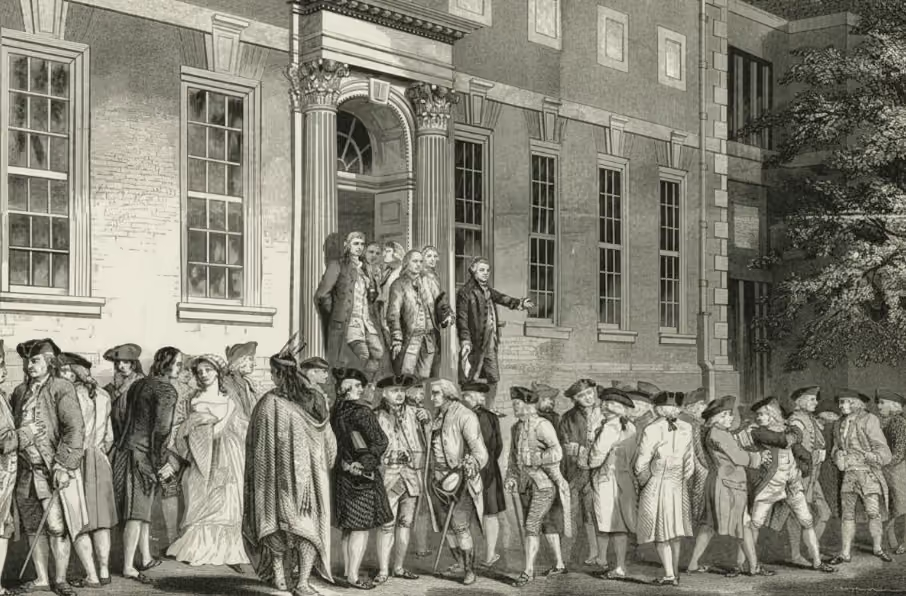
We should begin by exploring what ultimately produced the extraordinary level of liberty that was already enjoyed by American colonists.
The Constitution is one of the most important documents ever written. But a common misconception is that it gave Americans the rights and freedoms we now hold dear. In reality, colonial citizens already enjoyed many of our most cherished rights and freedoms.
So the Declaration of Independence was not written to attain liberty. It was written because the founders concluded that England was eroding the liberty they already had.
A proper treatment of the Constitution should therefore begin before 1788 or even 1776. It should begin by exploring what ultimately produced the extraordinary level of liberty that was already enjoyed by American colonists.
Suppressing opportunism through culture
All social species have to deal with opportunism, the general problem of individuals benefiting themselves at the expense of others or the group as a whole.
The most common way nature solves this problem is by genetically encoding behavior so as to leave no room for opportunism. Social insects are the best example. There’s not much shirking going on in beehives.
This is because bee behavior is rather like the execution of “if-then” statements in a computer program. These “if-then” statements leave no room for opportunism.
But this solution comes at a high cost. When behavior is genetically encoded into what amounts to “if-then” statements, adaptation through independent thinking is impossible.
One reason we humans now dominate the planet is that our extraordinary ability to teach and learn has enabled us to address opportunism differently – by encoding behavior culturally rather than genetically.
How does culture do this?
The cultural transmission of knowledge involves teaching children things so early in their lives that it’s better described as absorption than learning. In early childhood, neural connections can be easily constructed and modified. This is why young children learn so easily.
At the same time, what’s taught is presumed to be true by young children. By the age of 7, however, the brain slowly begins to switch to a more discriminating style of learning.
This opening and closing of the window of highly absorptive learning is the key to how culture works. When the window is open, the adults of the current generation can decide how to shape the neural architecture of the next generation.
When that window starts closing in early adolescence, the constructed neural architecture starts to firm up. New ideas that conflict with ideas learned earlier are treated as likely to be wrong. Changing an individual’s mind gets harder and harder the older they become.
In some cases, this powerfully locks in behavior. The brain connects the “if” to the appropriate “then” response without passing through the part of the brain where rational thinking occurs. This comports well with what Adam Smith described in his masterpiece The Theory of Moral Sentiments. In his account, groups develop behavioral norms through others' approval and disapproval.
So in primitive societies, children quickly learn that when a given circumstance arises, they had better do, or not do, any number of particular things. In this way, behavior becomes automatic. Social behavior takes the form of “If X occurs, then do A.” For example, if someone needs help out of quicksand, then extend your hand.
But increasingly in the West, social behavior became mediated by a different kind of protocol, one that takes the form of “Never do B.” For example, never steal.
This profoundly changed how norms worked. Instead of precisely guiding what people do, norms shifted to guard-railing what they do by telling them what they can’t do.
Think of driving a car. Guiding dictates precisely where a driver goes on the road and which way to turn at intersections. Guard-railing only keeps the driver from driving off the road he is currently on by keeping the car within the guardrails. Until very recently, most of our behavior was precisely guided, so guard-railing was superfluous.
The shift from guiding to guard-railing norms helped make high-trust societies possible. If you are a trustworthy person, it is almost certainly because you possess high guardrails that were ingrained into your subconscious at such an early age that you are now mostly unaware of them.
Think about it. Last week, you had dozens of chances to act opportunistically, often with no chance of being caught, yet you didn’t. Why not?
You didn’t because it never crossed your mind. Long ago, your parents and teachers pushed you to take opportunistic actions outside your guardrails. They also tried to make those guardrails so tall that, as an adult, you can’t see over them, so what lies outside them might as well not exist.
In this way, the actions through which opportunism occurs were redacted from your conscious thinking. And there is, of course, no greater assurance to others that you won’t behave in an untrustworthy way than their knowing that opportunism never crosses your mind.
How suppressing opportunism fosters rationality and individuality
As we came to live in ever larger groups, we produced and consumed an ever-larger array of goods and confronted an ever-growing list of circumstances. Eventually, it became impossible for parents and teachers to provide all the “if-then” statements needed to guide behavior in every circumstance.
So, without consciously deciding to do so, parents and teachers increasingly place greater emphasis on the “never do” protocols and less on telling children and adults precisely what to do through de facto “if-then” statements.
This ultimately led to greater exercise of rational thinking and individuality.
When precise behavioral responses are culturally encoded for every circumstance, considering all other actions is a waste of time. The hunter-gatherer approach to suppressing opportunism, therefore, results in less exercise of rational thinking than is normal for us today.
When nearly all encoding takes the form of guardrails, however, a wide array of possible behavioral responses fall under the individual’s discretion in most circumstances.
This led to a shift in focus from striving to conform by doing what was precisely scripted to striving to do what was in one’s own best interest because conforming only required staying within the guardrails. Now that there are many possible options to consider, it pays to think carefully about which one would be best.
This put rational thinking to work, helping cultivate the rational mind.
At the same time, when socially proper behavior was mostly a matter of obeying “if-then” statements, personal preferences were not very important, but conforming was. But when it became more about staying within the guardrails, personal preferences became increasingly relevant.
This got humans, especially in the West, used to thinking about their own individual preferences. Each person is different, so what’s the best possible decision differs by individual.
Increasingly, an individual’s own preferences determined which choice was made. This contributed to a growing sense of individual identity and, later in America, would lead to a uniquely strong ethic of individualism.
The shift from a preoccupation with conformity to an increasing focus on making good decisions for oneself therefore stoked both rationality and individuality.
From trust to rationality to free-thinking
To see the connection between trust and free thinking, consider these two propositions:
1. The truer it is that thinking is strongly bounded between guardrails that keep a person from considering opportunism, the truer it is that the individual will be trustworthy.
2. The truer it is that thinking is only bounded between guardrails that keep a person from considering opportunism, the truer it is that the individual is free to do anything else.
In other words, guardrails foster a manner of thinking that promotes trustworthiness and, therefore, a rational basis for extending trust. But that’s not all.
When what we think and do is only guard-railed by norms, we are free to choose any action within those guardrails. This rewards the exercise of rationality. Rational thinking and free thinking, therefore, go together. What a beautiful thought.
Here’s an example to drive the point home.
When you were 12, and you asked your mom if you could see a movie at the 10-plex, she likely said something like “OK, but only movie A or B.” Four years later, however, she likely said something like “OK, but not movie D or E.”
In the first case, your decision-making was strongly guided. You were only free to choose between two of ten possibilities. In the second case, your decision-making is more accurately described as guard-railed because you were free to choose between eight of ten possibilities.
So at age 16, you were 4 times freer than at age 12.
But that also means that you had to exercise your rationality more, because it’s harder to pick the single best option out of 8 than the single best option out of 2.
Now here’s one more wonderful thing about guardrails.
The truer it is that the guardrails of civilized behavior are fully internalized in your constructed neural architecture, the more likely you simply do what you want to, because you won’t want to do what you’re not supposed to do.
Here’s what I mean. Stealing is against the law. Does that put a damper on your feeling free? It probably doesn’t, because your parents worked hard to make sure you would never want to do such a thing in the first place. For you, laws against stealing are superfluous.
This is an incredible gift. It means that, for the most part, you simply think about what you want to do. This is a big part of not just being free, but actually feeling free.
The connection between free thinking and rights
After the fall of Rome in the 5th century, the geography of Western Europe led to many small kingdoms with numerous borders. The intense competition for land between these kingdoms made kings worry about internal strife that might invite attack.
Because of this, when the nobles were angry with the king, he would sometimes feel it necessary to placate them. But placating nobles with money or land was a bad idea. It would reward carping a little too directly and take resources away from military defense.
So kings would often go a different route, granting a new specific right to precisely address their grievance, which reduced the king’s power only a tiny bit and his coffers not at all.
After a generation or two, such rights became almost impossible to take back. They began to feel normal, customary, and proper. They were, after all, given by a king whose authority to give them was, in turn, given by God. It is easy to see why, in short order, these rights came to be viewed as “God-given”.
Taking them back suggested that either the king or God was wrong to grant them in the first place. So the ceding of rights was like a ratchet wrench… the king could give more, but he invited disaster if he tried to take even one back.
Over time, more rights were ceded, leading to an ever-lengthening list. Many of these rights pertained to specific freedoms. For example, having the right to choose whom to ask to marry amounts to having the freedom to ask whom to marry.
Then something truly remarkable began to happen.
Those kingdoms whose nobility had the longest list of rights, and were therefore the freest, became more productive because nobles had much greater incentive to be industrious. So a king, by making his kingdom a little freer to keep the peace within so as to avoid invasion from without, unwittingly ended up making his kingdom richer, too. So a new competitive margin emerged between the kingdoms of post-Roman Europe.
Acting out of fear, kings were becoming more powerful as their richer kingdoms could produce far more tax revenue, but this did not stem from superior wisdom; it came from being forced to cede expanding zones of control to nobles.
The most famous example of this was the Magna Carta, which in 1215 shifted control through rights from King John to the so-called “rebel barons.” Although it proved a failure at the time, it set an important precedent and indicated broader trends throughout Europe.
Eventually, members of lower classes also began to press their own lords for more rights, and these lords were no more enthusiastic about ceding them than the king had been generations before.
The free-thinking mind
We can think of specific rights or freedoms as precisely defined zones of control over our actions and the disposition of our property. Our ancestors from several centuries ago had only a few small zones of control within which they were free to do as they pleased. But as more rights were ceded, these zones of control increased in number and expanded in size.
Eventually, a tipping point was reached.
It became easier to keep track of the relatively few things one could not do than to keep track of the things one knew were approved under various circumstances. The focus became on what was forbidden, and the presumption was that all else was permitted by default.
Freedom was therefore no longer a matter of having a very long list of specific freedoms. It became the condition that as long as one obeyed the relatively short list of prohibitions against certain acts – stayed within the guardrails – one was otherwise free to do as one pleased.
So, increasingly, citizens became free, not merely as a political condition, but as a state of mind.
Why did free-thinking emerge so fully in America?
America enjoyed a propitious coincidence of two important things.
First, from the founding of the first permanent settlement at Jamestown in 1607 until the end of the Seven Years’ War in 1763, sheer distance and frequent wars with France left the colonies very lightly governed by the crown. Colonists, therefore, got used to not being told what to do and to speaking their minds with little fear.
Second, before 1776, free people living in America and Western Europe benefited greatly from inheriting a treasure trove of Western culture and institutions. But while European farmers were mostly employees of the landed class, American farmers mostly owned their own farms.
What American farmers did on their own land was of no concern to others, so they got used to acting with a free-thinking mind. It also meant they had to make all of the decisions, so they also got used to deciding for themselves on important matters. This raised the bar for tolerating others making decisions for them, resulting in a strong preference for self-governance.
In America, a few particularly brilliant citizens were strongly influenced by the wisdom of the ancients, English common law, new ideas in political philosophy, and the unprecedented rise of liberty in the American colonies.
This was their frame of mind when they drafted, debated, and approved the Declaration of Independence. It was also their frame of mind when they created the Constitution, a formula for government devised to ensure it did not erode the liberty it was created to protect.
David C. Rose (@DCRose1776) is CEO of The American Civics Academy, Professor Emeritus of Economics at the University of Missouri-St. Louis, author of The Moral Foundation of Economic Behavior and Why Culture Matters Most, both from Oxford University Press.


Does Liberalism Have a Fighting Faith?
Perhaps reflection will enable us to rout the apostates and rekindle the faith.

The Smithsonian’s Revolutionary World View
The organization, sadly, needs to heal itself by starting over, and so too the academic history profession.

Nolan’s Odyssey and the Search for Wisdom
Nolan’s 'Odyssey' will be a tremendous success, but it is also a work of decadence.




.png)
Get the Civitas Outlook daily digest, plus new research and events.
Get the Civitas Outlook daily digest, plus new research and events.