
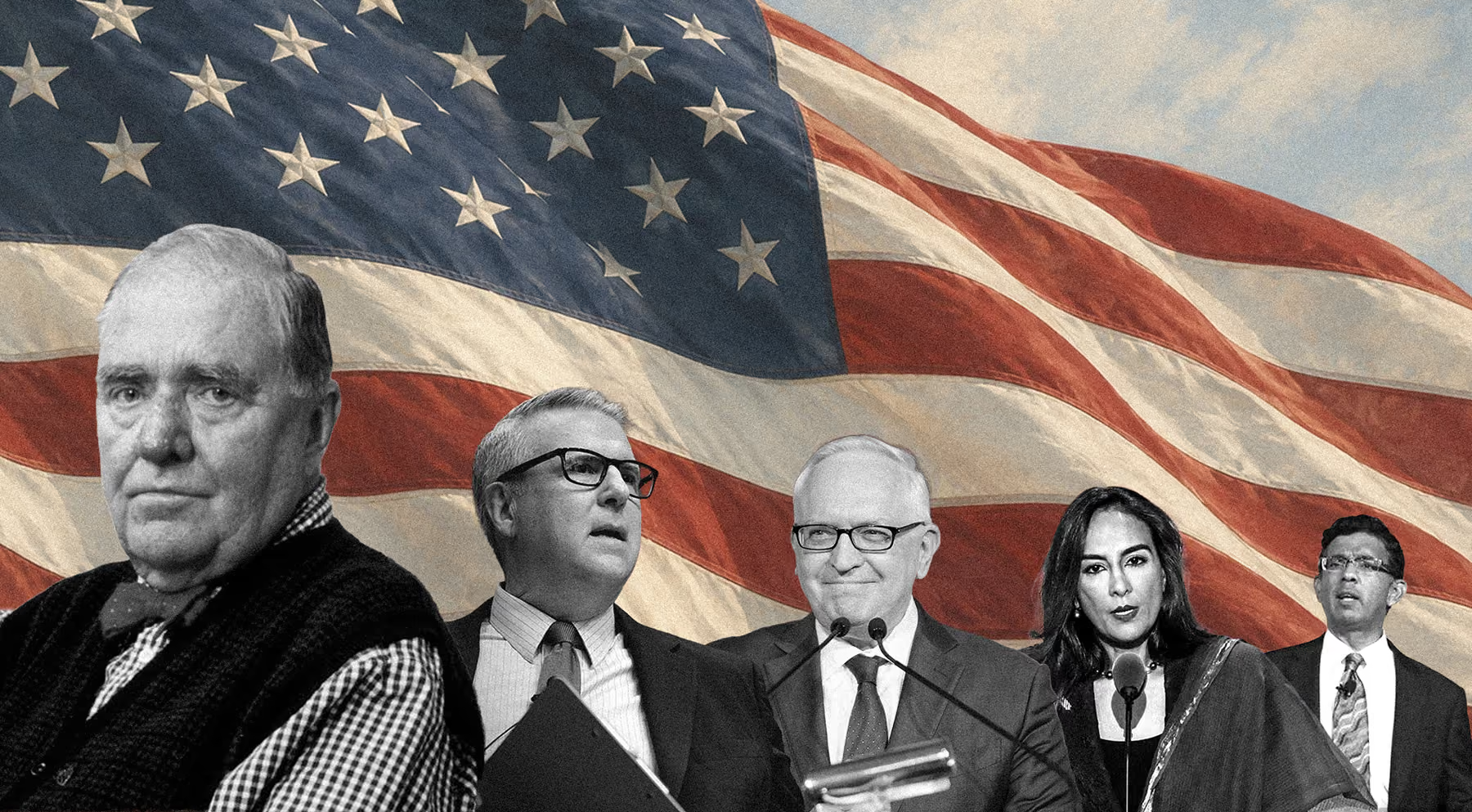
The Hart Conservatives

Jeffrey Hart's influence is inescapable for anyone who watches, reads, or listens to mainstream conservative influencers or follows what's happening in Trump’s Washington.
Jeffrey Hart is perhaps not as much of a household name amongst conservatives (even conservative intellectuals) today as he once was, but he’s arguably one of the movement’s most important figures. His influence is inescapable for anyone who watches, reads, or listens to mainstream conservative influencers or what’s happening in Trump’s Washington.
Born and raised in Brooklyn, New York, Hart earned his undergraduate degree and Ph.D. from Columbia University before permanently moving to Hanover. For thirty years, from 1963 to 1993, he served as a legendary and larger-than-life professor of English literature at Dartmouth College, where he specialized in 18th-century English literature and the political thought of Edmund Burke, and influenced generations of young conservative students.
Hart was also one of Dartmouth’s most memorable classroom performers. In his famous course on Samuel Johnson, he would conclude the semester dressed in Victorian attire, delivering a theatrical celebration of the British Empire. Students were drawn not only to his wit and literary learning but also to his willingness to challenge prevailing campus orthodoxies.
But Hart’s domain extended far beyond the classroom. In 1962, while starting his academic career, he began writing book reviews for National Review and quickly developed a deep, lifelong intellectual partnership with its founder, William F. Buckley Jr. For three decades, Hart served as a senior editor for the magazine, commuting from Hanover to New York City every two weeks for editorial meetings. He became one of the Buckley era’s essential voices, so much so that he was eventually gifted Buckley’s old stretch Cadillac limousine. He notoriously parked it right outside Dartmouth’s Sanborn Library, taking up multiple spaces in a characteristically defiant display against the progressive campus establishment, which decried the excessive use of fossil fuels.
Hart’s inescapable influence is threefold, and one that we should acknowledge. First, he helped pioneer an intellectual shift among conservatives toward a stronger conception of presidential power at a time when many on the right remained skeptical of executive authority in the wake of the New Deal. Second, he mentored a class of Dartmouth students in the 1980s who now are many of the conservative movement’s leading figures, including Fox News host Laura Ingraham; Assistant Attorney General for Civil Rights Harmeet Dhillon; Reagan “Tear Down This Wall” speechwriter, the host of Civitas Institute’s Unbridled and Hoover’s Uncommon Knowledge, host Peter Robinson; Wall Street Journal editorial page editor Paul Gigot; and documentary maker Dinesh D’Souza. Third, he created the nation’s first conservative campus newspaper by launching The Dartmouth Review from his living room in 1980.
The Dartmouth Review, the nation’s first conservative campus newspaper, inspired successors ranging from The Harvard Salient (launched in 1981) to The Stanford Review (launched in 1987), the Princeton Tory (launched in 1984), and the more recently launched Chicago Thinker (launched in 2020). It can’t be overstated how long-lasting Hart’s influence is as a mentor to the students who helped start The Dartmouth Review in the 1980s. Several of the small group of the first writers and editors who met in Hart’s living room to produce the first editions now lead the conservative movement.
To understand the current trajectory of American conservatism, one must look back to that Hanover, New Hampshire, living room. Hart was not merely a teacher of Burke or Hemingway; he was a master strategist of the “counter-establishment.” He understood that for conservatism to survive the hegemony of the progressives, increasingly expanding their reach in the academy, media, and government, the conservative movement needed more than just policy papers—it needed a pugnacious, literary, and deeply unapologetic media vanguard.
Gigot was the oldest of the crew of Jeffrey Hart’s conservative all-stars. Gigot graduated in 1977 (before The Dartmouth Review was founded in 1980) but was the editor-in-chief of The Dartmouth, which would eventually become the campus newspaper of record. Gigot, a government major, took Hart’s celebrated course on Samuel Johnson and remained close to Hart long after graduation. Hart served as an unofficial adviser while Gigot edited The Dartmouth and later helped him secure his first job at National Review as an editorial assistant. Gigot would ultimately carry much of Hart’s intellectual spirit into his stewardship of the Wall Street Journal editorial pages.
Robinson, an English major at Dartmouth who studied directly under Hart, graduated in the spring of 1979 while studying at Oxford for a second bachelor’s in philosophy, politics, and economics, and became an early correspondent and supporter of the Review’s effort. D’Souza and Ingraham were editors-in-chief of the Review as well, graduating in 1983 and 1985, respectively. Ingraham, like Robinson, was an English major in Hart’s department. Dhillon, who majored in classics and was the youngest of the group (graduating in 1989), became a writer and eventually the paper’s editor-in-chief.
Over the decades, the Review has served as a training ground for dozens of journalists, writers, policymakers, lawyers, and public intellectuals who would go on to influence American public life. Like Buckley, Hart used his Catholicism to convince his students of the truths of the Catholic Church. “In the end there’s the Church, and all its critics are footnotes,” as he would famously say. Gigot and D’Souza were already cradle Catholics. Robinson and Ingraham would later convert.
Hart taught Gigot, Robinson, D’Souza, Ingraham, and Dhillon that the primary theater of war was cultural and institutional, but Hart’s influence was not merely political. He taught students to value clear prose, serious literary criticism, and intellectual openness. Although a conservative, Hart admired liberal critics such as Lionel Trilling and encouraged students to engage thoughtfully with ideas across the political spectrum.
Conservatives from Hoover through Eisenhower were often content to fight defensively against the dominant institutions of their age, but Hart trained students to compete for influence within those institutions by using the power of ideas. After graduating from Dartmouth, D’Souza and Robinson joined the Reagan administration in the 1980s and later decamped to conservative think tanks such as AEI and Hoover. They remain highly influential through their respective media projects, including Robinson’s podcasts and D’Souza’s documentaries. Ingraham and Gigot entered the traditional media world of newspapers, radio, and television. Gigot joined and worked his way up Bob Bartley’s Wall Street Journal editorial board. Ingraham went to law school, clerked for Clarence Thomas, and then launched The Laura Ingraham Show in 2001. Her conservative media career culminated in her joining Fox News as a nightly host in 2017.
Hart’s influence on conservative journalism extended well beyond his own students. Years after Gigot became editor of the Journal’s editorial page, Hart recommended a young Review editor named Joe Rago. Gigot hired Rago in 2005, where he quickly became one of the Journal’s most talented editorial writers and won the 2011 Pulitzer Prize for Commentary. Rago died unexpectedly in 2017 at the age of thirty-four, but not before establishing himself as one of the most influential conservative editorial writers of his generation. It was another example of Hart’s remarkable eye for identifying and cultivating intellectual talent.
Among Hart’s lesser-known but increasingly relevant contributions were his arguments for a stronger presidency; these ideas anticipated later conservative defenses of executive authority and aspects of what would become known as the unitary executive theory. These debates are increasingly relevant today as President Trump attempts to transform our understanding of executive power in ways reminiscent of earlier transformative presidencies, including those of Andrew Jackson, Abraham Lincoln, Theodore Roosevelt, Franklin Roosevelt, and others.
In the 1970s, Hart shifted from the traditional conservative opposition to big government that had been standard since the beginning of the progressive era, and argued for a stronger, more powerful presidency as a conservative necessity. He saw a powerful president as crucial to check the growing left-leaning media ("fourth branch") and the vast administrative state, and he advocated for presidential action to tame the bureaucracy. This view laid the groundwork for later conservative theories of executive power, which he detailed in his influential 1974 National Review article, “The Presidency: Shifting Conservative Perspectives?”
Prior to the thinking of Hart and colleagues, post-New Deal conservatives like Barry Goldwater viewed the presidency with deep suspicion. They perceived the office of the President, particularly the growth of the executive-led administrative state under Franklin D. Roosevelt and Lyndon B. Johnson, as a threat to individual liberties, states’ rights, and constitutional limits.
After Hart’s article and decades of being unable to secure a Republican-controlled Congress capable of constraining the rapidly growing administrative state, the idea of using presidential authority to fight bureaucratic expansion from within the executive branch gradually gained influence on the right. Elements of this thinking appeared during the Reagan administration, expanded during the George W. Bush administration’s response to 9/11, and have become central to the constitutional arguments advanced by many conservatives during the Trump era.
Hart himself later strayed from the Republican Party. He criticized the George W. Bush administration from a Burkean perspective and often wrote for outlets such as The American Conservative. He supported John Kerry in 2004 and Barack Obama in 2008. Hart died in 2019 at age 88.
Hart’s seminal thinking peaked in the 1970s and 1980s, but his students and those decades later who edit and read The Dartmouth Review or other conservative newspapers still feel his influence. Whether he would have preferred it at his death or not, much of the media, institutional, and executive-centered conservative movement of today bears his imprint.
Jon Hartley is an economist specializing in finance, labor economics, and macroeconomics.


A Deadly New York Parable
The public mood in New York City sharply changed when the Mamdani administration took one large and foolish step.

Rebuilding Venezuela
The hardest work is only beginning: rebuilding the institutions that will transform a false State into a real one.
The Pope’s AI Politics
Complicating the legal management and ethical control of AI is that it feeds a new, highly attractive mythology.

.jpg)


.png)
Get the Civitas Outlook daily digest, plus new research and events.
Get the Civitas Outlook daily digest, plus new research and events.