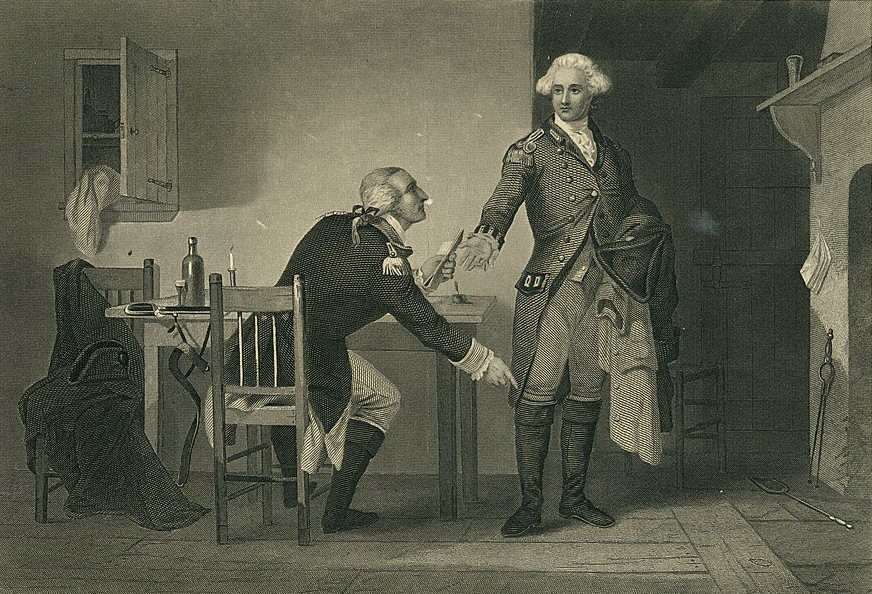
The Root of Benedict Arnold’s Betrayal

After nearly 250 years, Benedict Arnold’s name remains synonymous with treason.
On September 25, 1780, George Washington was traveling through the Hudson Valley with a retinue of troops on his way to West Point, the fortified military post that had been under Benedict Arnold’s command since the summer.
Arnold was headquartered at the home of Col. Beverley Robinson when aides Alexander Hamilton and James McHenry arrived to inform him of Washington’s impending arrival. Arnold welcomed the officers, but shortly afterward, a dispatcher arrived with news that a spy had been seized north of New York City. Suddenly agitated, Arnold rose and departed, leaving a puzzled Hamilton and McHenry behind to await Washington.
When the commander-in-chief arrived, the men ate breakfast. Washington then crossed the Hudson River to inspect West Point, where he found the defenses languishing. There was no sign of Arnold.
Perplexed, Washington returned to the Robinson House, where he was handed a stack of dispatches, including papers taken from the captured spy, “John Anderson.”
Later, Hamilton and the Marquis de Lafayette returned to the Robinson House and, according to historian Ron Chernow, found the normally unflappable Washington “fighting back tears.”
“Arnold has betrayed us,” Washington whispered. “Whom can we trust now?”
‘Treason of the Blackest Dye’
Nearly 250 years after he led the heroic charge that turned the tide at the pivotal Battle of Saratoga, Arnold’s name remains synonymous with treachery.
The documents found in the boot of “John Anderson” — the alias of British Maj. John André proved that Arnold had committed “treason of the blackest dye.” He would later publish a public letter admitting his guilt in a vain attempt to justify his actions.
Arnold’s betrayal has become part of American lore, a story nearly every schoolchild encounters. Yet the reasons for his treason remain a subject of debate.
The most common explanation is that Arnold grew embittered after Congress denied him a promotion despite his battlefield heroism. Although he was promoted to major general in May 1777 following the Battle of Ridgefield — where he led militia against superior British forces — several less-experienced generals had been elevated ahead of him. The decision surprised George Washington and convinced Arnold that political favoritism was shaping promotion decisions.
Additionally, the politically connected Horatio Gates, Arnold’s rival, received a medal for his leadership at Saratoga, though he’d been largely absent from the battlefield. The honor rankled Arnold, who suffered a second serious leg injury during the fighting when a British musket ball struck near his knee. The same gout-ridden leg had previously been wounded at the Battle of Quebec.
Promotions were not Arnold’s only bitter feud with Congress. While he served as military governor of Philadelphia following his injury, Congress accused him of corruption. Though a court-martial acquitted him of all serious charges, Arnold seethed over the accusations.
In his famous “Letter to the Inhabitants of America” (1780), Arnold refers to a group of men whose “Enmity... I prefer to their applause.” He was likely referring to members of the Continental Congress whose accusations and slights had wounded his pride.
‘The Corrupting Biblical Eve’?
All these examples help explain why Arnold, once an ardent patriot, committed treason in the basest of fashions: offering West Point to the British in exchange for a military pension.
But a second theory exists that is more disputed among historians. It involves Arnold’s second wife, Margaret “Peggy” Shippen, whom he married the year before he committed treason. (His first wife had died prematurely in 1775.)
Not yet 20, Shippen was attractive and came from a Loyalist family in Philadelphia — a city the British captured in 1777. During the nine months the city was Crown control, the Shippen home became a magnet for social gatherings among Loyalists and British officers. Some of the parties included a British major — John André, the very spy whom Washington’s forces later captured for conspiring with Arnold. (André was hanged in 1780, a move that caused a rift between George Washington and Alexander Hamilton, who believed André deserved a more gentlemanly death.)
Peggy Shippen’s role in the greatest treason in American history remains debated. The historian James Kirby Martin, author of Benedict Arnold, Revolutionary Hero: An American Warrior Reconsidered, argued that portrayals of Shippen “as the corrupting biblical Eve” who seduced her husband into betraying his country are false.
“What Peggy had were contacts with British officers, including John André, and it’s my opinion that she offered those contacts to Benedict Arnold whose anger led him to begin communications with the British,” wrote Martin.
Others disagree.
W. D. Wetherell, a longtime writer for the New York Times and The Atlantic, summed up Arnold’s betrayal in four words.
“Married the wrong person,” said Wetherell, who also described Arnold as among the hardest of human beings to understand in history.
Privy to the Plot
Historians continue to debate what ultimately drove Benedict Arnold to betray his country. Was it the influence of his young, attractive, Loyalist wife, or did accusations of corruption and repeated promotional slights prove too much for his pride to bear? Or was it some combination?
While there is no single answer, Wetherell’s assertion that Arnold “married the wrong person” rings true in light of the historical record. That record, however, suggests that Peggy Shippen was less corrupting Eve than Lady Macbeth.
In his prize-winning biography of Alexander Hamilton, historian Ron Chernow makes clear that Peggy Shippen had a devious streak and was far from a passive participant in Arnold’s treason.
On the day the plot was exposed, Hamilton found Peggy Arnold shrieking and babbling incoherently in the Robinson House, “in a gauzy morning gown with disheveled hair,” raving that soldiers were going to murder her son. Her hysterical behavior continued into the evening. It was “a command performance,” Chernow writes, an act designed to convince Washington and Hamilton that she was suffering a mental breakdown over her husband’s treason. The ruse worked on both men, who saw Peggy as a victim in her husband’s scheme.
“To their gullible minds, this behavior was proof that she must be a blameless victim of Arnold’s perfidy,” Chernow writes. “In fact, she had been privy to the plot, having acted as conduit for some of her husband’s correspondence with the British, and played her mad scene to perfection.”
The Character Test
Ultimately, the causes of Arnold’s treason do not really matter.
In either case, he betrayed a cause he once cherished, driven by personal ambition and selfish desire. One reason Arnold’s betrayal was so devastating to the cause was that men like Washington and Hamilton regarded him as a genuine patriot. His military record was exemplary, and his courage on the battlefield was nearly unmatched. The idea that such a man could sell out to the British — for a price of £20,000 (half a million dollars in today’s currency) — was almost unthinkable.
Whatever forces shaped Arnold’s decision, his treason ultimately stemmed from the same source: a failure of character.
Few historians today dispute the consensus that Arnold was “shabbily treated” by the Continental Congress. Yet one of the central tests of character is the ability to subordinate personal ambition and wounded pride to a cause greater than oneself.
Such talk may seem quaint today, but individual character is essential to liberty — a truth the Founders knew well.
“Give up money, give up fame, give up science, give up the earth itself and all it contains, rather than do an immoral act,” Thomas Jefferson wrote. “And never suppose, that in any possible situation, or under any circumstances, it is best for you to do a dishonorable thing, however slightly so it may appear to you.”
Arnold failed that test. For that reason, nearly 250 years later, his name remains synonymous with treason.
Jonathan Miltimore is Senior Editor at AIER.


The Root of Benedict Arnold’s Betrayal
“Arnold has betrayed us,” Washington whispered. “Whom can we trust now?”

The Geopolitics of Climate Continues
There is more riding on climate politics at this moment than is frequently acknowledged.

.webp)


Get the Civitas Outlook daily digest, plus new research and events.
Get the Civitas Outlook daily digest, plus new research and events.